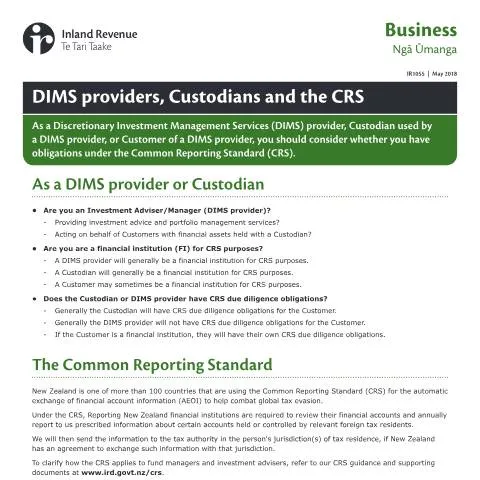
Understanding the IR1055 Document in the Realm of DIMS and CRS
The IR1055 document, which pertains to Discretionary Investment Management Services (DIMS) providers and custodians, plays a crucial role in New Zealand's approach to the Common Reporting Standard (CRS). As a backdrop, the CRS aims to enhance transparency in financial systems across more than 100 nations, including New Zealand. This initiative is designed to combat tax evasion by requiring financial institutions to share information on their clients’ foreign tax residence. Understanding the implications of this document is essential for various stakeholders in the financial sector, including DIMS providers, custodians, and their customers. This article delves into the nuances of the IR1055 form, outlining its significance, who needs to fill it out, and how to navigate this process effectively.Who Needs to Understand the IR1055 Document?
The IR1055 document is primarily aimed at three key groups:- DIMS Providers: These are investment advisers or managers who offer portfolio management services and act on behalf of clients.
- Custodians: These entities hold financial assets on behalf of clients, ensuring that they are managed according to legal and regulatory requirements.
- Customers of DIMS Providers: Individuals or entities engaging with DIMS providers for investment advice and management.
The Profile of a DIMS Provider
DIMS providers typically fall under the definition of financial institutions as per CRS guidelines. To be classified as such, they must provide DIMS and derive a significant portion of their income from these services. Here are the specific criteria that define them:- They offer investment advisory and management services.
- They must generate at least 50% of their income from these services to qualify as a financial institution.
Deciphering the CRS Obligations for DIMS Providers and Custodians
The CRS outlines specific due diligence obligations for custodians and DIMS providers. Here’s a breakdown:Responsibilities of the Custodian
Custodians are required to conduct due diligence on their customers. This entails identifying and verifying the tax residency of clients to ensure accurate reporting. The key points are:- Custodians must maintain a custodial account for each customer.
- They carry out CRS due diligence to ascertain the status of their customers as foreign tax residents.
Responsibilities of the DIMS Provider
Conversely, DIMS providers typically do not have CRS due diligence obligations directly concerning their customers, unless they are classified as financial institutions themselves. Their role is often limited to providing investment advice, as demonstrated with the example of Albert Investments Limited:Albert Investments Limited, functioning as a DIMS provider, engages in investment management for clients but does not perform due diligence on individual customer accounts held with custodians.
The Process: From Submission to Compliance
Navigating the IR1055 process requires an understanding of its operational workflow. Here is a step-by-step guide on how to proceed:Step 1: Assessing the Need for the IR1055
Before submitting the IR1055, stakeholders must assess if they fall within the obligations outlined by the CRS. If a DIMS provider or custodian meets the qualifications for a financial institution, they must familiarize themselves with their responsibilities concerning due diligence and reporting.Step 2: Completing the IR1055 Document
Completing the IR1055 form involves providing detailed information regarding:- The entity’s structure and nature of operations.
- The financial services being provided.
- Income sources to establish qualifications as a financial institution.
Step 3: Submission of the Form
Once completed, the IR1055 should be submitted to the Inland Revenue Department (IRD). It’s advisable to keep a copy for your records. The submission can often be performed online, reflecting New Zealand’s push for digital services.Step 4: Awaiting Confirmation
After submission, stakeholders should await feedback from the IRD. They may require additional information or clarification, particularly if the initial submission raises questions about compliance with CRS obligations.Timing: When to Engage with the IR1055
Understanding the timeline for engagement with the IR1055 is essential for meeting compliance requirements effectively. Here are some critical time frames to consider:- Submission Deadlines: Keep in mind that the fiscal year in New Zealand runs from 1 July to 30 June, which may influence the timing of submissions based on year-end reporting requirements.
- Annual Reporting: Financial institutions must review their accounts annually to ensure all relevant information is reported accurately.
- Response Time: After submitting IR1055, the IRD typically has a defined period for response, which must be monitored diligently.
What If There Are Issues with the IR1055 Submission?
Mistakes or omissions in submitting the IR1055 can lead to significant complications. Here are some scenarios and how to address them:Common Errors
Errors might include:- Inaccurate financial information.
- Failure to properly classify as a financial institution.
- Missing required documentation.
Correcting Mistakes
In the event of an error, stakeholders should immediately contact the IRD to rectify the situation. Prompt communication can help mitigate repercussions.Non-Compliance Consequences
Failure to comply with CRS obligations can result in punitive measures, including fines and reputational damage. It's essential for all parties involved to be proactive in maintaining compliance.Distinguishing the IR1055 from Other Forms
It's vital to differentiate the IR1055 from other forms that may seem similar yet serve distinct purposes. The following table outlines key differences:| Form Code | Purpose | Target Audience |
|---|---|---|
| IR1055 | DIMS Providers, Custodians, and CRS compliance | DIMS providers, custodians, customers |
| IR1049 | General guidelines for CRS due diligence | All financial institutions |
| IR1050 | Assessment of Reporting Financial Institutions | All financial entities |
The Role of RealMe Digital ID in Submitting IR1055
Recent advancements in digital services have transformed how forms like the IR1055 are submitted. The RealMe digital ID system is an important aspect of New Zealand's administrative framework. Here’s how it relates to the IR1055:- Streamlined Authentication: RealMe allows users to authenticate their identity securely, simplifying the submission of forms to the IRD.
- Accessibility: With RealMe, accessing online services becomes more straightforward, encouraging timely submissions and compliance.
Navigating the Future: Staying Informed on CRS Developments
As regulations and reporting standards evolve, staying informed about changes to the CRS procedures is paramount for DIMS providers and custodians alike. This involves:- Regularly reviewing updates from the IRD regarding CRS obligations and guidelines.
- Engaging with professional networks to share insights and best practices.
- Participating in training sessions focused on compliance and regulatory changes.
Conclusion: The IR1055's Importance in Financial Compliance
As New Zealand continues to foster a transparent financial environment, understanding the IR1055 document's implications is vital for DIMS providers, custodians, and their customers. By navigating this form effectively, stakeholders can play a significant role in combating tax evasion while ensuring compliance with international standards. The emphasis on accurate reporting and the responsible handling of financial data paves the way for a more ethical global financial landscape.DIMS Providers in New Zealand: Role and Responsibilities
DIMS, or Discretionary Investment Management Services, are provided by firms that manage investment portfolios on behalf of clients without requiring prior consent for each transaction. In New Zealand, these providers play a crucial role in the financial landscape, especially for investors looking for professional management of their investment assets. The providers must adhere to regulations set forth by the Financial Markets Authority (FMA) and comply with the Financial Advisers Act 2008. This ensures that they operate transparently and are held accountable for their investment decisions.
One key responsibility of DIMS providers is to ensure that they conduct a proper assessment of a client’s financial position and investment objectives. This process, known as a suitability assessment, is mandatory before any investment decisions are made. If a DIMS provider fails to carry out this assessment adequately, they may face penalties and their clients could also be at risk of financial loss due to unsuitable investment choices.
Furthermore, DIMS providers must also provide clients with a Disclosure Statement that outlines their investment philosophy, fees, and any potential conflicts of interest. This document is essential for maintaining transparency in the client-provider relationship. It’s advisable for clients to review this statement carefully to understand the implications of the services being offered.
The Role of Custodians in New Zealand's Financial Ecosystem
Custodians are key players in the investment management industry, primarily responsible for safeguarding a company's or individual's financial assets. In New Zealand, the role of custodians extends beyond just safekeeping; they also facilitate transactions, manage cash flows, and provide account statements to clients. Custodians often work closely with DIMS providers to ensure that all investments are tracked and managed efficiently.
Custodians in New Zealand must adhere to regulations set forth by the FMA, which include maintaining adequate systems and controls to prevent fraud and loss. A custodian's responsibilities include ensuring that investments are properly registered, managing the settlement of trades, and ensuring that all corporate actions (like dividends or voting rights) are executed correctly. In the case of international investments, custodians play a vital role in currency conversion and compliance with foreign regulations.
It's also essential for custodians to have robust cybersecurity measures in place to protect sensitive data. Given the increasing prevalence of cyber threats, custodians in New Zealand are expected to implement best practices in data security, regularly assessing and updating their systems to safeguard against breaches that could compromise client assets.
Understanding the Common Reporting Standard (CRS) in New Zealand
The Common Reporting Standard (CRS) is a global standard for the automatic exchange of financial account information between governments to combat tax evasion. New Zealand has committed to the CRS, placing obligations on financial institutions (including DIMS providers and custodians) to identify and report on accounts held by foreign tax residents. This initiative is particularly crucial in promoting transparency and compliance in the global financial system.
Entities in New Zealand must implement due diligence procedures to determine the tax residency of their clients. This often involves collecting self-certification forms from clients to ascertain their status. Financial institutions must report information such as account balances and interest payments to the Inland Revenue Department (IRD), which subsequently exchanges this data with tax authorities in participating jurisdictions.
Failure to comply with CRS requirements can result in significant penalties for financial institutions. Moreover, non-compliant clients may face additional scrutiny from tax authorities, leading to potential legal repercussions. Therefore, both DIMS providers and custodians must stay informed about CRS regulations and ensure that their compliance processes are robust and regularly updated to align with any changes in legislation.
Additionally, it’s essential for investors to be aware of the CRS requirements, as they can affect their tax obligations and reporting responsibilities. Understanding how CRS impacts financial investments in New Zealand can help investors make informed decisions and avoid potential pitfalls related to tax compliance.