Understanding the Filing Requirements: A Critical Deadline for Tax Returns
In the dynamic landscape of tax compliance in Mauritius, the importance of adhering to deadlines cannot be overstated. The Filing of Returns/Statements and Payments of Tax document, referenced as Communique160623, serves as a crucial element in this process. This official communication from the Mauritius Revenue Authority (MRA) not only outlines the specific deadlines but also delineates the responsibilities of various entities, thereby ensuring compliance with the legal framework established under the PSC Act 1955 and relevant provisions.
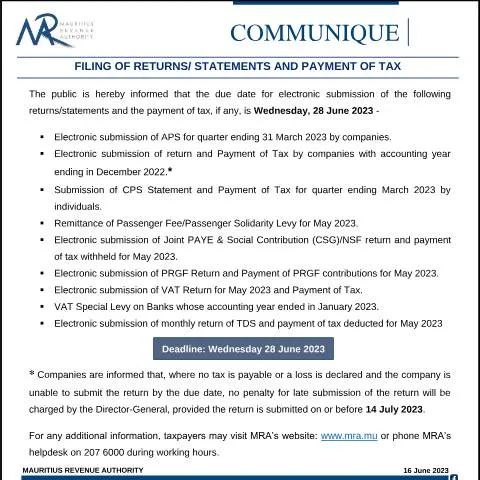
Taxpayers are urged to note that the deadline for the electronic submission of various returns and statements, alongside the payment of applicable taxes, is set for Wednesday, 28 June 2023. This deadline applies to different categories of taxpayers, including companies and individuals, and encompasses a wide range of submissions such as the APS for companies and CPS statements for individuals.
A Deep Dive into Submission Types and Requirements
The Communique160623 elucidates several specific returns and statements that must be submitted electronically. Below is an overview of these submissions, highlighting key details for each category:
| Submission Type | Applicable Entities | Due Dates | Remarks |
|---|---|---|---|
| APS (for quarter ending 31 March 2023) | Companies | 28 June 2023 | Mandatory electronic submission |
| Return and Payment of Tax (for companies with accounting year ending December 2022) | Companies | 28 June 2023 | No penalty for late submission if filed by 14 July 2023 with loss declared |
| CPS Statement and Payment of Tax (for quarter ending March 2023) | Individuals | 28 June 2023 | Electronic submission required |
| Passenger Fee/Passenger Solidarity Levy (for May 2023) | All relevant entities | 28 June 2023 | Includes both filing and payment |
| Joint PAYE & Social Contribution (CSG)/NSF return and payment | Employers | 28 June 2023 | Electronic submission required |
| PRGF Return and Payment of Contributions (for May 2023) | Employers | 28 June 2023 | Must be submitted electronically |
| VAT Return (for May 2023) | All VAT-registered businesses | 28 June 2023 | Include payment of tax |
| VAT Special Levy on Banks (accounting year ended January 2023) | Banks | 28 June 2023 | Electronic submission required |
| Monthly Return of TDS and Payment of Tax (for May 2023) | All relevant entities | 28 June 2023 | Include payment of tax |
The Consequences of Non-Compliance: Rights and Obligations
When navigating the tax landscape, understanding the ramifications of compliance and non-compliance is vital. Failure to meet the deadline for submissions outlined in Communique160623 can lead to several consequences for taxpayers.
- Financial Penalties: Non-compliance may result in financial penalties imposed by the Director-General of the MRA. However, it is important to note that companies declaring no tax or a loss may have the opportunity to avoid penalties if they submit their returns by 14 July 2023.
- Impact on Credit Rating: Companies that fail to adhere to tax obligations risk their credit ratings, which may affect their ability to secure loans or engage in future business ventures.
- Legal Repercussions: Chronic failure to file can result in legal action taken by tax authorities, leading to further complications for the taxpayer.
Document Preparation: Key Considerations for Various Situations
Preparation is key when it comes to filing tax returns. Different taxpayers may face unique circumstances, necessitating tailored approaches to document preparation. Below are some scenarios and considerations to keep in mind:
1. Companies with Declared Losses
For companies reporting losses, swift and accurate submission of tax returns is crucial. While penalties for late submission are waived if filed by the specified date, the documentation should clearly detail the losses incurred to avoid any confusion.
2. Individuals Filing CPS Statements
When submitting CPS statements, individuals should prepare comprehensive records of income and deductions for the quarter ending March 2023. Accurate records not only facilitate the filing process but also help mitigate issues that may arise during audits.
3. New Businesses/Startups
New startups may find themselves in a unique position when it comes to tax obligations. They must ensure compliance from the outset, including registration with the MRA and timely submission of all relevant forms. Consulting with a tax advisor can provide additional clarity.
4. Foreign Entities Operating in Mauritius
Foreign entities must be particularly vigilant regarding compliance. Understanding the local tax obligations and requirements is vital, and they are encouraged to seek professional assistance to navigate the intricacies of the Mauritian tax system.
Distinguishing the Filing of Returns from Other Tax Forms
In the realm of tax compliance, various forms exist, each serving distinct functions. It is essential to differentiate the Filing of Returns/Statements and Payments of Tax document from other commonly confused forms.
- APS vs. VAT Returns: The APS (Advance Payment System) is designed for companies to report their quarterly income and estimated tax obligations, whereas VAT returns focus specifically on value-added taxes collected and owed.
- CPS vs. TDS Statements: CPS statements pertain to individual taxpayers and their contributions to pensions and social security, while TDS (Tax Deducted at Source) statements are usually filed by employers reporting taxes withheld from employee salaries.
- PRGF Returns vs. Other Employment Returns: PRGF (Prison Reform and Good Faith) returns are specific to contributions made by employers to rehabilitation efforts, while standard employment returns cover other payroll-related submissions.
Addressing Issues: What to Do If Problems Arise
Even with the best preparation, issues can occur during the submission process. It is crucial for taxpayers to know how to handle these situations effectively.
Refusals and Errors
If a submission is rejected, clarity on the reasons for refusal must be obtained. Taxpayers should contact the MRA directly via the official helpdesk, ensuring all communications are documented for future reference. Correcting and resubmitting the return promptly can prevent additional penalties.
Missing Documentation
In cases where documentation is incomplete, taxpayers should act quickly to gather the required files. Engaging with a tax professional may expedite this process and ensure that nothing is overlooked.
Contacting the MRA for Assistance
For any concerns regarding the filing process, taxpayers may reach out to the MRA via their helpdesk at +230 207 6000, available during working hours. This resource is invaluable for clarifying complex issues and ensuring compliance.
Submitting the Form: Channels and Procedures
The MRA has embraced digital transformation, facilitating a smoother filing process through online channels. Taxpayers should understand the options available for submitting their returns as outlined in the Filing of Returns/Statements and Payments of Tax document.
Online Submission via Govmu.org
The preferred method for filing is online, utilizing the MauPass single sign-on feature linked to the National ID Card. This method is efficient and ensures prompt processing of submissions.
Paper Submission at MRA Offices
While online submission is encouraged, taxpayers may still submit their documentation in person at designated MRA offices. This method may be necessary for those who encounter technical difficulties or lack access to digital platforms.
Comparing Submission Channels
| Method | Advantages | Disadvantages |
|---|---|---|
| Online Submission | Quick processing, less risk of lost documents, instant confirmation | Requires internet access, may pose issues for those unfamiliar with technology |
| Paper Submission | Accessible to all, no need for technology | Longer processing time, risk of documents getting lost or misplaced |
Navigating the Tax Compliance Landscape: A Broader Perspective
The Filing of Returns/Statements and Payments of Tax is an integral part of a larger framework of tax compliance in Mauritius. Understanding how this document fits into the overall system can empower taxpayers and promote adherence to regulations.
Tax compliance in Mauritius encompasses various forms, submission types, and legal obligations, all designed to foster accountability and transparency in the financial landscape. By familiarizing themselves with the requirements outlined in Communique160623, individuals and businesses alike can mitigate risks associated with non-compliance and maintain a positive relationship with the tax authorities.
Ultimately, adherence to deadlines, thorough preparation, and proactive communication with the MRA can serve to ease the complexities of tax obligations in Mauritius.
Fill in your form directly online
No printing: type your details into the boxes of the official form, tick, then download the PDF ready to send.
- 1Type into the form boxes
- 2Tick in one click
- 3Save and download the PDF
Understanding the Tax Filing Process in Mauritius
The tax filing process in Mauritius is governed by the Mauritius Revenue Authority (MRA), which oversees the submission of various tax returns and the payment of tax dues. Understanding this process is essential for individuals and businesses alike to ensure compliance and avoid penalties. The tax year in Mauritius runs from 1 July to 30 June, with deadlines for filing returns and payments typically falling shortly after the end of the fiscal year.
For individuals, the primary form for annual income tax is the MRA Form IT1, which must be submitted by individuals earning taxable income. The key deadline for filing returns is set for 30 September following the end of the fiscal year. For businesses, the process can be slightly more complex, especially for those registered as corporations. Corporations are required to file their returns using MRA Form C1, and the due date for filing is usually 31 October after the fiscal year.
It is essential to have all relevant documentation prepared well in advance of the deadline. This includes proof of income, deductible expenses, and any other relevant financial information. In the case of e-filing, taxpayers need to create an account on the MRA e-filing portal, which facilitates the submission of returns and allows for easier management of tax affairs.
Penalties and Interest for Late Filing
Failure to file tax returns or make payments on time can lead to significant penalties and interest charges, which are imposed by the MRA. Under the Income Tax Act, taxpayers who submit their returns after the deadline may incur a penalty of up to 5% of the tax payable for each month of delay, with a maximum penalty capped at 20%. Additionally, interest on unpaid tax is charged at a rate of 1% per month from the due date until the tax is paid in full.
For businesses, the penalties can be even more severe, especially for corporate tax returns. If a corporate return is not filed on time, the MRA may initiate additional enforcement actions, including audits and investigations into the company’s financial records. This not only increases the potential financial liabilities but can also damage the company’s reputation.
It is advisable to submit returns as early as possible to avoid these penalties. Furthermore, taxpayers experiencing difficulties in meeting the deadline should communicate with the MRA before the due date. In some instances, extensions may be granted under specific circumstances, although this is not common.
Tax Planning Strategies Before the Filing Deadline
Effective tax planning is crucial for both individuals and businesses to optimize their tax liabilities before the filing deadline. One strategy involves reviewing and taking advantage of all eligible deductions and allowances. For individuals, this may include contributions to approved retirement schemes, medical expenses, and charitable donations. For businesses, expenses related to operational costs, staff training, and other deductible items should be carefully documented.
Moreover, engaging in proactive tax planning can help in making informed decisions about income recognition and expense timing, thus potentially lowering the overall tax burden. For example, a business that anticipates a significant drop in income in the subsequent financial year may consider accelerating certain expenses into the current fiscal year to reduce taxable income.
Furthermore, it is essential for both individuals and businesses to stay informed about any changes in tax legislation that could impact their tax obligations. Regular consultations with a tax advisor or accountant can provide valuable insights and strategies tailored to specific financial situations, ensuring compliance and maximization of benefits before the approaching deadline.