Understanding the Filing of Return and Payment of Income Tax and VAT
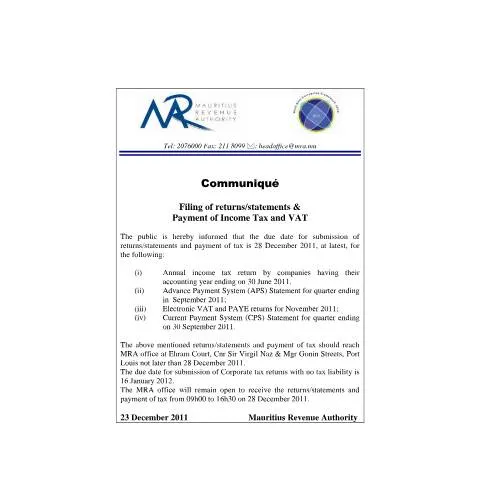
As a business owner or taxpayer in Mauritius, one of the critical responsibilities you must manage is compliance with tax regulations, particularly concerning your annual returns and VAT submissions. The Filing of Return / Statements & Payment of Income Tax and VAT form, referenced under CommuniqueAnnualReturnSubmissionDec2011, is pivotal in ensuring that you meet these obligations efficiently and correctly.
Navigating the Timeline of Submission
The timeline for submitting the required forms and payments is essential to avoid penalties. The Mauritius Revenue Authority (MRA) stipulates specific deadlines for various submissions. For instance, the due date for the annual income tax return, particularly for companies whose accounting years end on 30 June, is set for 28 December 2011. Similarly, different deadlines exist for VAT returns and statements pertaining to the Advance Payment System (APS) and Current Payment System (CPS).
Key Dates to Remember
- Annual Income Tax Return: Due by 28 December 2011
- APS Statement for Quarter Ending September 2011: Due by 28 December 2011
- Electronic VAT Returns for November 2011: Due by 28 December 2011
- CPS Statement for Quarter Ending 30 September 2011: Due by 28 December 2011
- Corporate Tax Returns with No Tax Liability: Due by 16 January 2012
The Process of Completing the Form
Completing the Filing of Return form requires careful consideration and accuracy. The information you provide must reflect your financial activities transparently. Here’s how you can effectively fill out the form:
Collect Necessary Documentation
Before you begin filling out the form, ensure that you have all relevant documents at hand, including:
- Financial statements for the accounting year
- Invoices and receipts relevant to your income and expenses
- Records of previous tax payments
- Details of any advances or VAT collected
Steps to Fill Out the Form
- Start by entering your company’s information: name, registration number, and address.
- Fill in the financial details, including total income, allowable deductions, and taxable income.
- Include information about your VAT obligations, detailing sales and VAT collected.
- Review all entries for accuracy before signing the declaration at the end of the form.
- Ensure that you have attached all supporting documents as required by the MRA.
Submission Procedures
Once your form is completed, the next step involves submission. You can submit your completed form and documents to the MRA office located at Ehram Court, Cnr Sir Virgil Naz & Mgr Gonin Streets, Port Louis. The MRA office has specific hours that you must adhere to, which are from 09h00 to 16h30 on the due date, 28 December 2011.
What Happens After Submission?
Upon successful submission of your return and payment, the MRA will process your documents. Understanding the implications of this processing phase is vital:
Post-Submission Process
- Confirmation of Receipt: You should receive confirmation from the MRA regarding the acceptance of your return.
- Assessment of Tax Liability: The MRA will assess your submission to determine your tax liability or any refund due.
- Potential Follow-Up: Be prepared for any follow-up inquiries from the MRA, especially if discrepancies arise in your submissions.
Consequences of Non-Compliance
Failing to submit your returns or pay your taxes by the due dates can have serious repercussions. Here are some considerations:
Legal and Financial Implications
- Penalties: The MRA imposes penalties for late submissions or payments, which can substantially increase your overall tax bill.
- Interest Charges: Interest may accrue on unpaid taxes, compounding your financial obligations.
- Legal Actions: In severe cases of non-compliance, the MRA may initiate legal proceedings against you or your business.
Preparation for Possible Challenges
In the event that your submission faces issues—such as errors, omissions, or missing documents—it is crucial to know how to respond effectively.
Addressing Common Submission Issues
- Error Corrections: If you discover an error post-submission, you must notify the MRA immediately and provide rectified information.
- Missing Documents: If your submission is incomplete, the MRA will reach out to you. Gather the necessary documents promptly to avoid delays.
- Disputes: Should you disagree with the MRA's assessment following your submission, you have the right to appeal their decision.
Understanding Exceptions and Special Cases
Some taxpayers may find themselves in unique situations that require special consideration during the filing process. This includes:
Cases That May Require Additional Attention
- Foreign Companies: If you are a foreign entity operating in Mauritius, you may have different filing requirements depending on your tax residency status.
- Minors: If a minor is earning income, their guardians must complete and submit the necessary forms on their behalf.
- Complex Financial Scenarios: Entities with complex structures or multiple streams of income may require professional assistance to ensure compliance.
Leveraging Digital Resources for Efficiency
The Mauritian government has implemented a robust digital system that allows for more efficient tax submissions and tracking. Utilizing the e-services offered by the MRA can simplify the process significantly.
Benefits of Using E-Services
- Ease of Access: Submit your returns and payments online at any time, avoiding long queues.
- Immediate Confirmation: Receive instant confirmation of your submission.
- Track Your Submission: Easily track the status of your returns and payments online, ensuring transparency.
In conclusion, navigating the intricacies of the Filing of Return form under the MRA requires diligence and understanding of the processes involved. Staying informed, meeting deadlines, and utilizing available resources will ensure that you fulfill your obligations seamlessly while avoiding potential pitfalls.
Understanding Tax Filing Deadlines and Procedures
In Mauritius, the filing of income tax returns and Value Added Tax (VAT) statements is governed by specific deadlines that are crucial for compliance. For individuals and companies, the fiscal year runs from 1st July to 30th June, and taxpayers must be aware of their obligations within this timeframe to avoid penalties.
The income tax returns for individuals must be submitted to the Mauritius Revenue Authority (MRA) by 15th September following the end of the fiscal year. For corporations, the deadline is 15th October, which allows additional time for the preparation of comprehensive financial statements. It is essential for taxpayers to ensure that their return is not only submitted on time but also is accurate and complete to avoid scrutiny or potential audits.
VAT returns must be filed quarterly, with the deadlines typically set for 15th of the month following the end of the quarter. For instance, for the quarter ending 30th September, the VAT return should be filed by 15th October. Failure to meet these deadlines can result in late fees and interest charges, underlining the importance of maintaining an organized record-keeping system.
Understanding Deductions and Allowances for Income Tax
Taxpayers in Mauritius can benefit from various deductions and allowances when filing their income tax returns. Familiarizing oneself with these can significantly lower taxable income, thereby reducing overall tax liability. There are several categories of deductions that individuals and companies need to consider.
Firstly, taxpayers can claim deductions for certain expenses incurred during the income-generating process. This includes costs related to business operations for self-employed individuals, such as office supplies, utilities, salaries, and other operational expenses. For individuals, items such as medical expenses, educational expenses, and contributions to registered pension schemes are also deductible.
Fill in your form directly online
No printing: type your details into the boxes of the official form, tick, then download the PDF ready to send.
- 1Type into the form boxes
- 2Tick in one click
- 3Save and download the PDF
Furthermore, the Mauritian tax system allows for personal allowances, which are standardized deductions based on an individual's status, such as marital status or dependents. For instance, married couples may access a higher combined allowance, while single parents may claim additional allowances for dependents, which can alleviate some of their tax burdens.
It's important to maintain proper documentation for all claimed deductions, including receipts and invoices, as these documents may be required by the MRA for verification purposes during an audit. Understanding what can be deducted and maintaining meticulous records can lead to significant tax savings.
Implications of Non-Compliance with Tax Obligations
Non-compliance with tax obligations in Mauritius can lead to severe consequences. The Mauritius Revenue Authority (MRA) takes tax evasion and late payment seriously, implementing strict penalties for those who do not adhere to the established guidelines for tax filings.
Late submissions of income tax returns or VAT statements can incur penalties of up to 5% of the outstanding tax amount, in addition to interest which can accumulate over time. Moreover, repeated failures to comply with tax obligations may result in more severe actions, including the possibility of legal proceedings or even prosecution in severe cases of tax evasion.
Taxpayers should also be aware of the risk of being subjected to audits if their returns raise red flags, such as significant discrepancies or unusual patterns compared to previous filings. An audit can be a lengthy and stressful process, requiring individuals and businesses to provide extensive documentation to substantiate their tax positions.
It is advisable for taxpayers to regularly consult with tax advisors or accountants who are well-versed in Mauritian tax law to ensure compliance and to navigate any complexities surrounding tax obligations. This proactive approach can help mitigate risks and facilitate a smoother filing experience.