Understanding the Payment of Taxes Form: A Practical Guide
The Payment of Taxes document, officially coded as PaymentOfTaxes200121, is pivotal in ensuring that taxpayers fulfil their obligations to the Mauritius Revenue Authority (MRA). This formal procedure is not merely a bureaucratic formality; it embodies the legal framework governing tax compliance in Mauritius. Navigating this form necessitates a clear understanding of its nuances, ensuring that each taxpayer can efficiently manage their tax duties.
Navigating the Document Submission Process
When preparing to submit the Payment of Taxes document, taxpayers must adhere to a comprehensive procedure that ensures compliance and accuracy. Here’s a step-by-step overview:
- Gather Required Information: Before filling out the form, collect all necessary financial documents. This includes tax identification numbers, income statements, and previous tax returns.
- Fill Out the Form: The form must be completed accurately, reflecting the current tax year and financial status. Misinterpretations can lead to significant delays.
- Payment Method Selection: Taxpayers must choose from the permitted payment methods, which now primarily focus on electronic transactions.
- Submit the Form: The completed form should be submitted electronically or at the MRA's designated offices. Postal submissions are also accepted but may delay processing.
Handling Rejections and Missing Information
Receiving a rejection or notification of missing information can be disheartening. However, understanding the process allows taxpayers to address these issues promptly. Should the MRA identify discrepancies or incomplete submissions:
- Immediate Communication: Reach out to the MRA Helpdesk at +230 207 6000 for clarification on the specific issues identified.
- Correct the Form: Amend any inaccuracies or provide the missing information. It's crucial to ensure that all details align with official documents.
- Re-Submission: Once corrections are made, the updated form must be submitted again promptly to avoid penalties.
Special Cases: Navigating Unique Taxpayer Situations
Certain taxpayers may find themselves in distinctive circumstances when it comes to filing taxes. The MRA accommodates various situations such as:
- Non-residents: Foreign individuals or entities may have different requirements. They must declare their income sourced within Mauritius.
- Minors: Income earned by minors is taxed differently. Parents or guardians must submit on their behalf.
- Urgent Cases: In instances where tax payments are time-sensitive, taxpayers can request expedited processing through formal communication with the MRA.
Document Workflow: From Initiation to Resolution
The Payment of Taxes document follows a structured workflow, transitioning from the submission phase to resolution:
| Step | Action | Timeframe |
|---|---|---|
| Submission | Complete and submit the Payment of Taxes form | Immediate |
| Processing | MRA reviews the submission | Up to 15 working days |
| Approval/Rejection | Receive notification from MRA | Within 5 working days after processing |
| Payment Confirmation | Confirmation of tax payment | 2 working days |
Decoding the Payment of Taxes Form: Section by Section
Understanding the intricacies of the Payment of Taxes form is essential for accuracy. Each section plays a critical role in ensuring that the taxpayer provides all necessary information:
- Personal Details: This section requires the taxpayer's full name, address, and national ID number. Ensure that these details match official documents to avoid discrepancies.
- Tax Identification: This section demands the tax identification number, which is essential for linking the taxpayer to their tax records.
- Income Declaration: Here, taxpayers must detail their income sources. Accurate reporting is crucial to prevent tax evasion allegations.
- Payment Amount: This segment requires the total tax owed. Taxpayers should refer to previous assessments or use the current year's tax rate for calculations.
Understanding the Payment Options Available
Taxpayers now have a variety of electronic payment methods available to facilitate their tax payments:
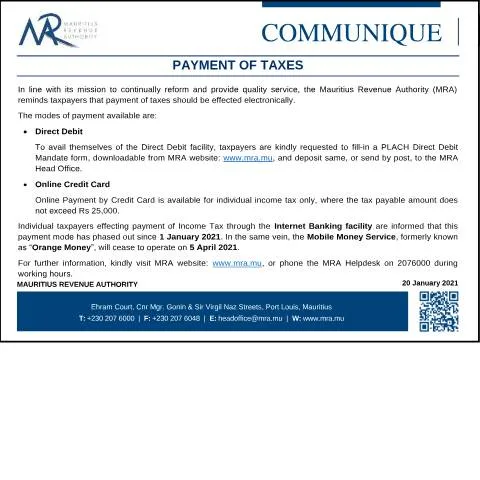
- Direct Debit: This method allows for automatic deductions from a taxpayer's bank account, ensuring timely payments. To initiate, taxpayers need to fill out the PLACH Direct Debit Mandate form, which can be found on the MRA website.
- Online Credit Card Payments: Individual taxpayers can make online payments if their tax amount does not exceed Rs 25,000. This method simplifies the payment process considerably.
Taxpayers should note that the Internet Banking facility has been phased out, and Mobile Money services will be discontinued as of 5 April 2021. Keeping abreast of these changes is vital for compliance.
Following Up on Your Submission
After submitting the Payment of Taxes form, it's essential to monitor the status of your submission. Here’s how to effectively track your application:
- Keep Documentation: Retain copies of all submitted documents for your records. This helps in any future communication with the MRA.
- Contacting MRA: If more than the expected processing time has elapsed without communication, contact the MRA Helpdesk for an update.
- Utilizing Online Resources: Regularly check the MRA website for updates and additional information regarding your submission.
Final Thoughts on Compliance and Financial Responsibility
Engaging with the Payment of Taxes document underscores the importance of financial responsibility as a citizen. Timely and accurate tax payment not only supports national development but also fosters trust between taxpayers and the government. Understanding this form's role within the larger tax framework is critical for all Mauritian citizens.
For further queries or in-depth assistance, taxpayers may contact the Mauritius Revenue Authority directly at their head office or via the provided contact details.
Understanding the Tax Structure in Mauritius
The taxation framework in Mauritius is multifaceted, designed to foster economic growth while ensuring fair redistribution of resources. The primary taxes imposed are income tax, Value Added Tax (VAT), corporate tax, and various other levies. Each of these taxes is governed by specific laws that outline rates, exemptions, and the scope of taxable income.
Income tax in Mauritius is generally assessed on a flat rate basis for individuals, although different rates may apply based on specific income brackets. For the fiscal year, it is important to note that income tax returns must be filed by individuals and companies by the deadline set by the Mauritius Revenue Authority (MRA), which is typically 31 December for individuals and 30 June for companies. The filing process is streamlined through the MRA’s e-filing system, allowing for easier compliance and tracking of submissions.
Value Added Tax (VAT) operates as a consumption tax applied at each stage of production and distribution. The standard VAT rate in Mauritius is 15%, with certain goods and services exempt from VAT or subject to reduced rates. Businesses are required to register for VAT if their annual turnover exceeds the specified threshold, currently set at MUR 2 million. Registration must be done online via the MRA portal, where businesses can also submit their VAT returns periodically.
Tax Compliance and Penalties
Ensuring compliance with tax regulations in Mauritius is crucial for all taxpayers, as failing to meet obligations may result in significant penalties. The MRA has implemented a rigorous enforcement regime to combat tax evasion and ensure that all entities pay their fair share. Compliance includes accurately reporting income, maintaining proper documentation, and timely filing of returns.
It is important to be aware of the consequences of late filing or underreporting income. For instance, the MRA may impose a penalty of up to 10% of the unpaid tax for late payments, with interest accruing on overdue amounts. Additionally, individuals or companies may face further penalties, including legal action or prosecution for severe cases of tax evasion. Therefore, understanding one’s tax obligations and adhering to the filing deadlines is essential to avoid such repercussions.
Taxpayers are encouraged to utilize the MRA’s resources, including instructional materials and helplines, to navigate the complexities of tax compliance. Regular workshops and seminars on tax matters are also conducted by the MRA to educate taxpayers about their rights and responsibilities.
Tax Refunds and Reimbursements
Tax refunds in Mauritius are a fundamental aspect of the tax administration process, ensuring that individuals and companies receive their entitled reimbursements efficiently. The MRA has established a systematic protocol for processing tax refunds, which can arise from overpayments, tax deductions, or adjustments made following the assessment of taxable income.
Taxpayers seeking a refund must submit a formal claim through the MRA’s e-filing platform, providing all necessary documentation to support their request. Essential documents typically include the original tax return, proof of payment, and any relevant correspondence with the MRA. The MRA processes refund claims on a first-come, first-served basis, and while they strive to expedite the process, it is advisable to allow for a timeline of several weeks for processing.
In cases where the refund is not processed within the expected timeframe, taxpayers can inquire about the status of their claim via the MRA’s contact channels. It is also worth noting that the MRA may conduct audits on refund claims, requiring additional documentation or clarification from the taxpayer, which can further extend the processing time.
Furthermore, refunds are typically issued through direct bank transfers to the taxpayer's registered bank account, enhancing the efficiency of the reimbursement process. Taxpayers are encouraged to ensure that their bank details are up-to-date within the MRA's system to avoid delays in receiving funds.