Navigating the Extended Delay for the Individual Income Tax Return: A Practical Guide
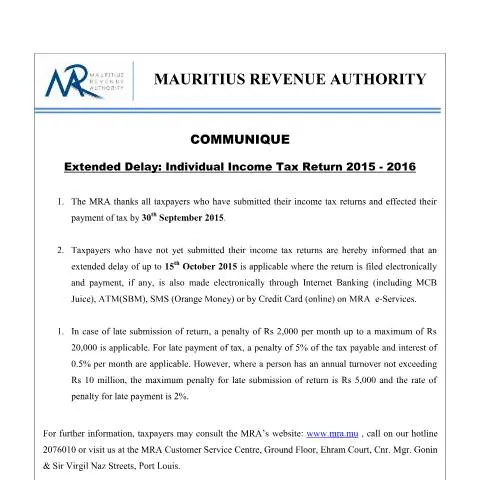
For taxpayers who found themselves facing the deadline for the Individual Income Tax Return in 2015, the Mauritius Revenue Authority (MRA) introduced an important extension: an opportunity to file until October 15, 2015. However, it is essential to understand the implications, the actual process, and the consequences of delays.
Understanding the Essence of the Extended Delay
The Extended Delay, set forth on October 1, 2015, serves as a lifeline for taxpayers who missed the initial cutoff of September 30, 2015. This provision is particularly relevant for those opting to file their tax returns electronically. The initiative is aimed at promoting online engagement, allowing taxpayers to complete necessary obligations seamlessly.
Who Should Take Advantage of This Extension?
- Individuals who have not submitted their income tax returns by the original deadline.
- Taxpayers wishing to avoid penalties associated with late filing and payments.
- Those experiencing difficulties in gathering financial documentation or understanding tax obligations.
Step-by-Step: Completing the Individual Income Tax Return
Filing your Individual Income Tax Return using the Extended Delay is relatively straightforward, yet it requires careful attention to detail. The following sections provide a breakdown of the key components of the form, emphasizing potential pitfalls and essential information needed for completion.
Essential Components of the Tax Return Form
The Individual Income Tax Return (Extended Delay 01.10.15) includes several critical sections that must be filled with precision:
- Personal Information:
This section requires your full name, National ID number, and contact details. Ensure that all information matches your national documents to avoid discrepancies.
- Income Details:
Here, you will report your total income from all sources, including salaries, freelance earnings, and any other taxable income. Double-check your calculations and ensure that you include all relevant earnings to avoid underreporting.
- Deductions:
Claiming deductions can significantly impact your tax liability. Common deductions include contributions to retirement funds and donations to approved charities. Familiarize yourself with eligible deductions to maximize your tax return.
- Tax Calculation:
This part requires you to calculate your total tax liability based on the income reported and the deductions claimed. Review the graduated tax rates applicable for the financial year to ensure accuracy.
- Payment Details:
If tax is owed, you must complete this section outlining your chosen payment method. Remember that the extended delay penalty for electronic filing smooths the way for convenient online payment options.
Electronic Filing: The Preferred Method
The MRA encourages electronic submission of income tax returns. This method is beneficial not just due to the extended delay but also for its efficiency. Filing electronically significantly reduces the chance of human error and enhances processing time.
Advantages of Filing Online
- Speed: Instant submission and acknowledgment receipt.
- Ease of Access: Complete the return from the comfort of your home.
- Payment Convenience: Multiple payment methods accessible, from internet banking to credit card payments.
The Penalties for Late Submission and Payment
Despite the grace period, taxpayers must remain vigilant regarding penalties associated with late submissions and payments. It is crucial to understand these repercussions to avoid unwanted financial burdens.
Understanding the Penalty Structure
| Type of Delay | Penalty Rate | Maximum Limit |
|---|---|---|
| Late Submission | Rs 2,000 per month | Rs 20,000 |
| Late Payment | 5% of tax payable + interest of 0.5% per month | N/A |
| For Turnover ≤ Rs 10 million | Rs 5,000 maximum for late submission; 2% for late payment | Rs 5,000 |
Addressing Errors and Missing Information
Submitting your tax return is not merely a formality; it is a legal obligation that demands accuracy and completeness. Errors or missing information can lead to delays, penalties, or even audits.
What to Do in Case of Errors or Omissions
- Review your submission thoroughly before sending. Utilize checklists to ensure every section is completed.
- If you notice an error after submission, contact the MRA immediately to discuss potential rectifications.
- In case of missing documentation, provide the MRA with a timeline for when you expect to gather the necessary information.
Special Considerations: Taxpayers with Unique Circumstances
Taxation can be particularly complex for certain individuals, such as non-residents, minors, or those with unique financial situations. Understanding the specific obligations for these groups is vital for compliance.
Non-Residents and Their Tax Obligations
For non-residents earning income in Mauritius, tax obligations differ from those of residents. It is crucial to understand how income sourcing and tax treaties may affect your tax return. Non-residents typically face withholding tax rates, which could impact the overall tax return process.
Minors and Tax Filing Requirements
Minors, defined as individuals under 18 years of age, are not exempt from tax liabilities if their income exceeds a specific threshold. Parents or guardians are responsible for filing on their behalf. Ensure that the return reflects all sources of income to avoid penalties.
Consequences of Non-compliance: What Lies Ahead?
Neglecting to file your income tax return can lead to severe financial and legal consequences. Awareness and compliance are essential to safeguard your financial future.
Impacts of Non-Submission
- Financial penalties that accumulate monthly, leading to significant costs.
- Potential legal action for persistent non-compliance, including court proceedings.
- Loss of access to certain governmental services tied to tax compliance.
Final Tips for a Smooth Filing Experience
As the deadline approaches, take proactive steps to ensure a hassle-free filing experience. A little preparation goes a long way.
Prepare Early and Stay Informed
- Gather all required documents well in advance, including payslips, bank statements, and receipts for deductions.
- Familiarize yourself with the tax laws and regulations applicable for the current financial year to ensure compliance.
- Utilize resources available on the MRA website for additional guidance and support.
Utilizing Support Services
Should you find yourself overwhelmed or confused by the process, don’t hesitate to reach out to the MRA Customer Service Centre or consult a tax professional for assistance. Their expertise could save you time and financial resources.
Understanding the Extended Delay for Individual Income Tax Returns
The extended delay for the submission of Individual Income Tax Returns, initiated on October 1, 2015, was a significant development in the Mauritian tax landscape. This extension allows taxpayers more time to file their returns without incurring penalties, thereby addressing various issues that taxpayers may face during the regular filing period. The rationale behind such extensions often stems from the need to accommodate taxpayers who might be experiencing difficulties in gathering the necessary documentation or who are simply unaware of the filing obligations. It’s crucial for taxpayers to stay updated on such changes to avoid any unnecessary complications.
Fill in your form directly online
No printing: type your details into the boxes of the official form, tick, then download the PDF ready to send.
- 1Type into the form boxes
- 2Tick in one click
- 3Save and download the PDF
For individuals, the standard deadline for submitting the Individual Income Tax Return is generally on or before the 30th of September each fiscal year. However, during periods of extended delay, the Mauritius Revenue Authority (MRA) issues specific notices to inform the public about the new deadlines and any related stipulations. It's important to note that while the extension provides additional time for submission, taxpayers are still expected to pay any due taxes by the regular deadline to avoid incurring penalties and interest charges. Since this change was introduced, many taxpayers have benefited from the extra time to ensure their submissions are accurate and comprehensive.
Implications of Late Filing and How to Avoid Penalties
Filing the Individual Income Tax Return beyond the stipulated deadlines can lead to various penalties that may increase the financial burden on taxpayers. According to the MRA guidelines, individuals who fail to submit their tax returns on time may face fines and interest on the unpaid taxes. The penalties may vary based on the duration of the delay and the total tax owed.
In Mauritius, the standard penalty for late submission is generally a monetary fine determined by the MRA. For instance, if an individual fails to file their return within the extended period, they may incur a penalty that could amount to a percentage of the tax due. Therefore, it is critical for taxpayers to not only be aware of the deadlines but also to understand the potential financial implications of late filings.
To avoid these penalties, taxpayers are encouraged to utilize the e-filing system provided by the MRA. The e-filing platform allows individuals to file their returns conveniently and receive immediate confirmations of their submissions. Moreover, taxpayers can benefit from pre-filled forms, which can simplify the process considerably. Keeping track of income sources, expenses, and necessary deductions throughout the year will also contribute to a smoother filing experience.
Accessing Support and Resources for Tax Filing
The MRA provides various resources and support systems to assist taxpayers with the filing of their Individual Income Tax Returns. Engaging with these resources can significantly ease the process, particularly during extended periods of delay. For instance, the MRA's website offers detailed guides, FAQs, and downloadable forms related to tax filing, which can be invaluable to those unfamiliar with the process.
Furthermore, taxpayers can attend instructional workshops or seminars organized by the MRA, which are aimed at educating the public about tax laws, filing procedures, and changes in regulations. These sessions are particularly beneficial for first-time filers or those who may not be confident in their understanding of tax implications.
Additionally, for personalized assistance, taxpayers can contact the MRA’s helpline or visit their local offices, where trained staff can provide guidance on specific queries related to individual tax situations. Utilizing these support services not only helps in avoiding errors during filing but also fosters greater compliance with tax obligations.
In summary, while the extended delay for the Individual Income Tax Return offers taxpayers additional time, it is essential to stay informed about deadlines, potential penalties, and available resources to ensure a smooth filing process.