Official Notice on Income Tax and PAYE for the Year of Assessment 2010 in Mauritius
This official circular, issued on 7 August 2009 by the Mauritius Revenue Authority (MRA), provides essential guidance to all employers regarding the changes in income tax legislation and PAYE (Pay As You Earn) procedures for the upcoming Year of Assessment 2010. The notice aims to inform employers of the legal amendments, transitional measures, and administrative procedures necessary to ensure compliance with the new tax framework following the enactment of the Finance Act 2009.
Context and Scope of the Circular
The circular addresses the significant change introduced by the Finance Act 2009, which shifts the basis of income taxation from a fiscal year running from 1 July to 30 June to a calendar year, from 1 January to 31 December. This legislative reform impacts the calculation of taxable income and the corresponding PAYE deductions for employees. The circular provides detailed instructions to employers on how to adapt their payroll systems and tax deduction practices during this transitional period, specifically for the Year of Assessment 2010, covering income earned from 1 July 2009 to 31 December 2009.
Who Is Concerned?
All employers operating within Mauritius, regardless of the size or sector, are required to comply with the instructions outlined in this notice. This includes employers managing both manual and computerized payroll systems. The circular also emphasizes the importance of accurate employee declarations, especially for new hires or employees experiencing changes in personal circumstances that may affect their applicable Income Exemption Threshold (IET). Employees who are taking up their first employment or changing jobs during this period are particularly impacted, as specific procedures for their PAYE deductions are detailed.
Key Provisions and Administrative Procedures
Transition to the Calendar Year Basis
Following the legislative change, individuals are now liable to income tax on income earned during the calendar year (1 January to 31 December). However, for the Year of Assessment 2010, a transitional measure allows employees to be taxed only on income earned from 1 July to 31 December 2009. Employers should adjust their payroll calculations accordingly, ensuring that PAYE deductions reflect this six-month period.
Income Exemption Thresholds (IET)
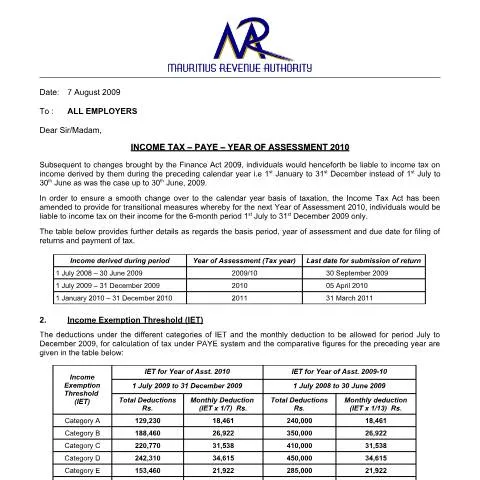
The circular specifies the IETs applicable for the period July to December 2009, which are consistent with those for the previous year. Employers must calculate monthly deductions based on these thresholds, dividing the annual IET by 7 (for the six months plus an additional pay period in December due to year-end bonuses). The detailed table below illustrates the IETs and the corresponding monthly deductions per employee category:
| Category | IET for Year of Assessment 2010 (Rs.) | Monthly Deduction (Rs.) | IET for Year of Assessment 2009-10 (Rs.) | Monthly Deduction (Rs.) |
|---|---|---|---|---|
| Category A | 129,230 | 18,461 | 240,000 | 18,461 |
| Category B | 188,460 | 26,922 | 350,000 | 26,922 |
| Category C | 220,770 | 31,538 | 410,000 | 31,538 |
| Category D | 242,310 | 34,615 | 450,000 | 34,615 |
| Category E | 153,460 | 21,922 | 285,000 | 21,922 |
| Category F | 212,690 | 30,384 | 395,000 | 30,384 |
Employee Declaration Form (EDF) and Deduction Adjustments
Employers are instructed to continue applying the previous year's EDFs for July and August 2009. Due to the limited pay periods remaining in 2009, employees are not required to submit new EDFs for the period from 1 July to 31 December 2009. Employers should, however, treat all employees who submitted EDFs for the previous year as having submitted updated declarations for the current period, allowing deductions based on the same IET categories unless a new EDF is explicitly provided.
In cases where an employee takes up a new job or experiences a change in personal circumstances, a fresh EDF must be submitted to determine the correct IET category. Employers should adjust PAYE deductions accordingly, dividing the applicable IET by the remaining pay periods in the year.
Calculation of PAYE Deductions
The circular emphasizes that the PAYE system remains operational on a cumulative basis, with the key modification being the use of 1/7 of the IET instead of 1/13, reflecting the six-month period. Employers operating automated payroll systems are advised to ensure that deductions do not exceed the specified IETs and to implement the necessary adjustments either through system updates or by applying the proportional deduction based on previous EDFs.
References and Contact Information
This circular is issued by the Mauritius Revenue Authority, located at Ehram Court, Port Louis. For further clarification or assistance regarding PAYE procedures or the application of these guidelines, employers are encouraged to contact the MRA hotline at 207-6010 or 207-6035. Additional resources, including the Employee Declaration Form (EDF), can be downloaded from the official MRA website.
This notice underscores the importance of compliance with the legal amendments and provides comprehensive instructions to facilitate a smooth transition to the new tax year framework. Employers are urged to review the details carefully and implement the necessary administrative adjustments promptly to ensure adherence to Mauritius’s tax legislation for the Year of Assessment 2010.