Understanding the Significance of Form MRACommuniqueFilingofReturns
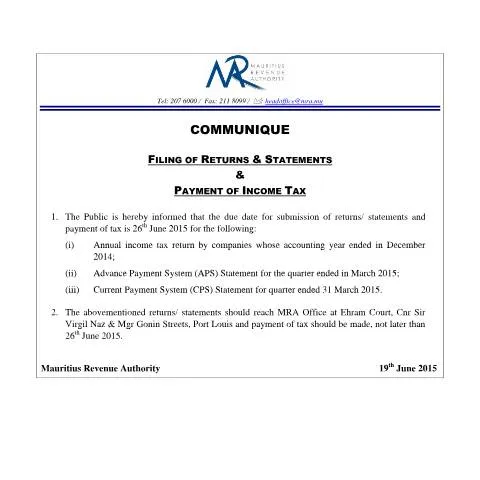
Form MRACommuniqueFilingofReturns plays a critical role in the Mauritian taxation system. It streamlines the process of filing annual income tax returns and various statements crucial for tax compliance. As taxpayers prepare to submit their forms, understanding the context and importance of this document is essential for ensuring a smooth filing process.
The Responsibilities of Taxpayers: Who Must File?
Various entities are obligated to complete and submit this form, based on their financial activities and the specifics of their accounting year. For instance, companies that concluded their accounting year in December 2014 must file their annual income tax return by the stipulated deadline. Moreover, other entities, such as businesses under the Advance Payment System (APS) and Current Payment System (CPS), are required to submit corresponding statements for the quarter ending in March 2015.
- Companies with accounting years ending in December 2014
- Entities under the APS for the quarter ending March 2015
- Entities under the CPS for the quarter ending March 2015
Key Components of the Filing Process: What You Need to Know
Correctly completing Form MRACommuniqueFilingofReturns involves several key components that must be addressed. This section outlines the necessary steps for successful submission:
- Gather Necessary Documentation: Before filling out the form, ensure you have all relevant financial statements, documentation of income, and deductions ready.
- Accurate Completion of the Form: Pay careful attention to each section to include accurate figures and information.
- Review and Verification: Double-check the completed form for any errors or omissions that could delay processing.
- Submission of the Form: Submit your completed form and any required documents to the Mauritius Revenue Authority (MRA) office before the deadline.
- Tax Payment: Ensure that any tax due is paid by the same deadline to avoid penalties or interest charges.
Preparation of Supporting Documents Based on Taxpayer Categories
Different categories of taxpayers will require specific supporting documents to validate their claims and submissions. Here’s a breakdown:
| Taxpayer Category | Required Supporting Documents |
|---|---|
| Companies | Audited Financial Statements, Directors’ Report, Tax Computation |
| Self-employed Individuals | Tax Declaration, Profit and Loss Statements, Receipts |
| Small Businesses | Simple Income Statements, Relevant Invoices and Receipts |
Circumstances Requiring Special Attention: Handling Complex Cases
In certain situations, filing Form MRACommuniqueFilingofReturns may present unique challenges. Understanding how to navigate these complexities is crucial for compliance. Here are some examples of special circumstances:
Filing for Non-residents
Non-residing taxpayers must comply with specific requirements to ensure their filings are accepted. They should consult local tax laws or consider professional assistance to avoid missteps.
Minors and Dependents
When filing on behalf of minors or dependents, special consideration must be given to income limits and applicable deductions. Guardians must provide additional documentation evidencing their relationship and the income sources.
Exploring Submission Channels: Online vs. Paper
The Mauritius Revenue Authority has made significant strides in digitizing tax services, providing taxpayers with multiple channels for submission. Understanding these options can facilitate timely and efficient filings.
- Online Submission: Taxpayers can utilize the MRA e-filing platform, which allows for quicker processing and automated reminders for deadlines.
- Paper Submission: Alternatively, entities may opt to submit their forms in person at the MRA office located at Ehram Court, Port Louis. While this method is straightforward, it may lead to longer processing times.
- Submission at the Counter: For those preferring direct interaction, MRA offices offer assistance at counters for queries and clarifications while submitting the forms.
Assessing the Pros and Cons of Each Method
| Submission Method | Advantages | Disadvantages |
|---|---|---|
| Online Submission | Quick processing, Convenience of time, Real-time tracking | Requires Internet access, Potential technical issues |
| Paper Submission | Direct submission, Personalised assistance | Longer processing times, Risk of lost documents |
In the Event of Filing Issues: What to Do Next
Occasionally, taxpayers may encounter issues such as refusals, errors in submissions, or missing documents. Knowing the steps to rectify such situations can minimize delays.
Addressing Refusals or Errors
In cases where the MRA rejects a submission due to errors, taxpayers are advised to:
- Review the feedback provided by the MRA to identify the specific error or reason for refusal.
- Correct the identified issues and resubmit promptly to meet the deadlines.
- Consider seeking professional advice if the issues persist or are complex.
Handling Missing Documents
If a taxpayer realizes that they have submitted their form without certain required documents, they should:
- Immediately contact the MRA office to inform them of the situation.
- Prepare the missing documents for submission as soon as possible.
- Follow up with the MRA office to ensure that their submission is complete.
The Administrative Processing Timeline and Tracking Your Submission
Once Form MRACommuniqueFilingofReturns is submitted, it undergoes a series of administrative procedures. Taxpayers should be aware of the timeline and how to track their submissions.
Standard Processing Time
The MRA typically processes filings within a standard timeframe. However, during peak periods, such as around tax deadlines, processing may take longer. Understanding these timelines can help taxpayers plan accordingly.
How to Track Your Submission
Taxpayers can track their submission status through several means:
- Using the online portal for real-time updates on their filing status.
- Contacting the MRA office directly via phone for immediate inquiries.
Final Thoughts on the MRACommuniqueFilingofReturns Process
Successfully navigating the filing of returns and statements using Form MRACommuniqueFilingofReturns is essential for compliance with Mauritius tax laws. By understanding the requirements, preparation steps, and submission channels, taxpayers can enhance their filing experience. Ultimately, thorough preparation and timely action are key to avoiding potential pitfalls and ensuring a smooth process.
Understanding the Tax Filing Calendar in Mauritius
The tax filing calendar in Mauritius is crucial for both individuals and businesses to ensure compliance with the Income Tax Act and avoid penalties. The tax year runs from July 1 to June 30, which aligns with the fiscal year. Taxpayers are required to file their income tax returns by September 30 following the end of the tax year. For instance, for the income earned during the tax year 2022-2023 (1 July 2022 to 30 June 2023), the return must be submitted by 30 September 2023.
It is important to note that individuals and companies must also be aware of the quarterly payment deadlines for provisional tax. Provisional tax payments are due on the last day of each quarter: 30 September, 31 December, 31 March, and 30 June. This system aids in spreading the tax burden throughout the fiscal year and helps in the proper budgeting of tax liability.
To file an income tax return, taxpayers should prepare all relevant documentation well in advance, including but not limited to:
- Income statements (payslips, bank statements for interest earned, etc.)
- Investment income details
- Proof of expenses that may be deductible
- Relevant supporting documents for any tax credits or deductions
By adhering to the tax filing calendar and preparing the necessary documents, taxpayers can facilitate a smooth filing process and mitigate the risk of late submission penalties.
Fill in your form directly online
No printing: type your details into the boxes of the official form, tick, then download the PDF ready to send.
- 1Type into the form boxes
- 2Tick in one click
- 3Save and download the PDF
Special Considerations for Self-Employed Individuals
Self-employed individuals in Mauritius face unique challenges and obligations when it comes to filing income tax returns. Unlike salaried employees who typically have taxes deducted at source, self-employed persons must actively manage their tax obligations, including the payment of provisional taxes and filing of returns.
One of the first steps a self-employed individual should take is to register with the Mauritius Revenue Authority (MRA) for a tax identification number (TIN). This is essential as it will be required for all future tax filings and transactions. Once registered, self-employed individuals must maintain accurate and complete records of their income and expenses to substantiate their tax filings.
Self-employed individuals are also eligible to make deductions for legitimate business expenses, such as:
- Business operating costs (rent, utilities, supplies)
- Professional fees (accounting, legal advice)
- Depreciation on capital assets used for business
- Travel and vehicle expenses related to business operations
It is advisable for self-employed individuals to engage with a tax professional or accountant to ensure that they are maximizing their allowable deductions and complying with tax regulations. Furthermore, they should be vigilant about maintaining documentation for all expenses claimed, as these may be required for verification by the MRA.
Self-employed individuals should also be cognizant of the fact that the MRA may conduct audits and reviews of tax returns. Thus, having organized records and clear documentation can help mitigate any disputes that may arise during such audits.
Common Errors in Tax Return Filing and How to Avoid Them
Filing income tax returns can be a complex process, and several common mistakes can lead to delays, penalties, or even legal issues. Understanding these pitfalls can help taxpayers avoid them effectively.
Some of the most frequently encountered errors include:
- Incorrect Personal Information: Taxpayers should ensure that their name, TIN, and contact information are accurate on all forms. Discrepancies can result in processing delays.
- Omitting Income Sources: All sources of income must be declared, including rental income, dividends, and any other earnings. Failure to disclose all income can lead to penalties.
- Miscalculating Deductions: Taxpayers often miscalculate deductible expenses, either by overestimating or failing to claim eligible expenses. Maintaining detailed records can assist in accurate calculations.
- Missing Documentation: Not providing necessary documentation for claims can lead to delays or rejections. Taxpayers should include all relevant supporting documents when filing.
- Failure to Submit on Time: Late submissions can incur penalties, so it is essential to be aware of deadlines and submit returns well in advance.
To avoid these errors, taxpayers are encouraged to double-check their completed forms, keep organized records, and consider electronic filing, which often provides prompts and checks to minimize mistakes. Additionally, consulting with tax professionals can provide further assurance that filings are correct and complete.