Understanding the Filing of Return 2011: A Crucial Step for Tax Compliance
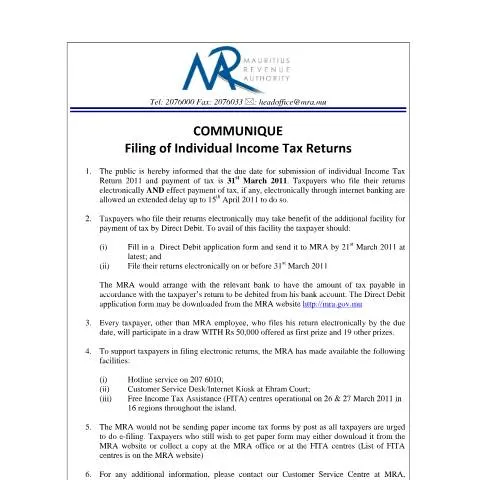
The Filing of Return 2011, officially referenced under communiqueFilingReturn2011, serves as a pivotal document for individuals who are obligated to declare their income for the fiscal year. This form is integral to the taxation framework in Mauritius, and filling it out accurately is essential for compliance with the regulations set forth by the Mauritius Revenue Authority (MRA).
Historical Context and Regulatory Framework Surrounding the Filing of Return 2011
This document falls under the domain of income tax returns, governed by the Income Tax Act as enacted and amended over the years. The regulations mandate that all individuals earning taxable income must declare their earnings by submitting the relevant return. The due date for the Filing of Return 2011 was set on 31st March 2011, with a provision for an extended deadline for electronic filers until 15th April 2011.
The framework illustrates the shift towards digital filing, which has been encouraged by the MRA to streamline the submission process, enhance efficiency, and mitigate administrative burdens on both taxpayers and the authority itself.
Key Features of the Filing of Return 2011: Who It Affects and Essential Conditions
The Filing of Return 2011 applies broadly to any taxpayer, excluding MRA employees. This includes:
- Individuals employed in the public and private sectors
- Self-employed individuals and freelancers
- Individuals with income from investments
An important consideration for taxpayers is understanding the different scenarios under which they might need to file. For instance:
- Standard Filers: Most employees receiving a salary will simply declare their income as reported on their payslips.
- Self-Employed Individuals: Those engaged in business activities must include all income generated, along with relevant deductions.
- Investment Income: Individuals earning dividends or interest must report such earnings.
Steps to Prepare for Submission: Gathering Necessary Documents
Successful completion of the Filing of Return 2011 requires meticulous preparation. Taxpayers should gather the following documentation:
- Income Documents: Payslips, business income statements, or bank statements reflecting interest or dividends.
- Deductions: Proof of any eligible deductions such as medical expenses, retirement contributions, and educational expenses.
- Identification Information: Ensure your National Identity Card and taxpayer identification number (TIN) are readily accessible.
Understanding Taxpayer Obligations and Consequences of Non-Compliance
The timely submission of the Filing of Return 2011 not only fulfills legal obligations but also opens up a pathway to various benefits. Non-compliance could lead to penalties, including fines or even legal action. Taxpayers are also required to settle any dues associated with their declared income. The MRA has established repercussions for failing to meet submission deadlines:
- Late submission penalties: These can accrue quickly, adding financial strain to an already burdensome situation.
- Ineligibility for certain tax benefits: Individuals who fail to file may miss out on potential deductions or tax credits.
- Increased scrutiny: Late or missing returns could trigger audits or inquiries from the MRA.
The E-filing Advantage: How to Navigate Electronic Submission
The MRA strongly promotes electronic filing as a means to simplify the process. Taxpayers opting for online submissions are afforded an extended deadline, making it advantageous for those who may require additional time to prepare their returns. To e-file, follow these steps:
- Access the MRA portal using your MauPass credentials.
- Complete the Filing of Return 2011 form, ensuring all sections are accurately filled.
- Submit the form electronically and ensure payment is made through internet banking if applicable.
- Consider applying for the Direct Debit facility to automate tax payments.
Those utilising e-filing are also given entry into a draw for cash prizes, which serves as an additional incentive to take advantage of this streamlined service.
Exploring Support Mechanisms: MRA Facilities for Taxpayers
The MRA has instituted various support structures to assist taxpayers throughout the return filing process:
- Hotline Services: A dedicated hotline at 207 6010 is available for queries.
- Customer Service Desks: Physical support at the MRA’s headquarters and FITA centres throughout the island, offering personalized assistance.
- Income Tax Assistance (FITA) Centres: Free assistance available for taxpayers in multiple regions, operational on designated dates.
This proactive support from the MRA reflects a commitment to enhancing taxpayer experience and ensuring compliance in a user-friendly manner.
Understanding the Direct Debit Facility: A Convenient Payment Option
Taxpayers may avail themselves of a Direct Debit application for tax payments. This convenient option allows taxes to be automatically debited from the taxpayer’s bank account. Here’s how to initiate this process:
- Complete the Direct Debit application form and submit it to the MRA by 21st March 2011.
- Ensure that the Filing of Return 2011 is submitted electronically by the original deadline of 31st March 2011.
Utilizing Direct Debit not only helps in timely payment of taxes but also mitigates the risk of late fees and penalties associated with manual payments.
Final Considerations: The Importance of Adhering to Deadlines
Meeting the submission deadline is paramount for all taxpayers. The due dates are not merely administrative hurdles but are integral to the functioning of the broader taxation system. Adhering to these dates ensures compliance and contributes to national revenue, which in turn supports public services and infrastructure development.
Taxpayers should mark important dates on their calendars, ensure that all preparations align with the necessary requirements, and proactively reach out to MRA support channels for guidance. This approach not only aligns with civic responsibility but also fosters smoother interactions with tax authorities.
Understanding the Filing Process for Tax Returns in Mauritius
Filing a tax return is a crucial aspect of fiscal responsibility for both individuals and businesses in Mauritius. Understanding the process, especially for the tax year 2011, requires familiarity with the legal frameworks and the necessary documentation involved.
The filing of returns for the year 2011, specifically for individuals and corporations, had to be completed by the stipulated deadlines set forth by the Mauritius Revenue Authority (MRA). Generally, individuals were required to file their returns by the end of August, following the close of the fiscal year on June 30. For companies, this deadline was often aligned with their financial year-end, but it was crucial to adhere to the guidelines provided by the MRA for the 2011 tax calendar.
Fill in your form directly online
No printing: type your details into the boxes of the official form, tick, then download the PDF ready to send.
- 1Type into the form boxes
- 2Tick in one click
- 3Save and download the PDF
In preparation for filing, taxpayers should ensure that they have all relevant documents ready, including their tax identification number (TIN), financial statements (for businesses), and any additional forms such as the PSC Form 7, if applicable. It's essential to gather all supporting documentation, including income statements, receipts, and any relevant deductions you may claim. This thorough preparation will streamline the process and reduce the likelihood of delays or issues during submission.
Tax Compliance and Penalties for Late Filing
In Mauritius, compliance with tax filing is not just a legal obligation; it's a civic duty that fosters national development. The MRA has instituted various measures to ensure compliance with tax laws, including audits and penalties for late filings. For the tax year 2011, penalties were established for individuals and corporations who failed to submit their returns on time.
Individuals who failed to file by the deadline faced a penalty of 5% of the unpaid tax, with additional charges accruing for each month of delay. Corporations were subjected to even stricter penalties, as the MRA aimed to uphold tax integrity. It's crucial for taxpayers to be aware of these penalties as they serve not only as a deterrent but also as a reminder of the importance of timely submissions.
Furthermore, the MRA encourages taxpayers to file electronically, which not only eases the submission process but also comes with reduced chances of errors that may lead to penalties. The MRA's e-filing system is linked to the MauPass single-sign-on, which simplifies the process by allowing individuals to access their accounts using their National ID cards, making tax compliance significantly more accessible.
Document Retention and Record Keeping for Tax Purposes
After the filing of a tax return, it is paramount for taxpayers in Mauritius to maintain accurate records for a period of at least five years. This retention period allows for any audits or inquiries that may arise from the MRA concerning previously submitted returns. For the tax year 2011, keeping well-organized files can facilitate a smoother review process in case of an audit.
Records that should be retained include all forms of income documentation, tax returns filed, receipts for deductible expenses, and any correspondence with the MRA. Maintaining a digital record can be beneficial, as this allows for easy retrieval and reduces the risk of physical document loss. In case of a dispute or a need for clarification regarding a filed return, having comprehensive records ensures that taxpayers can provide necessary evidence of compliance and accuracy.
In addition, understanding the specific documentation required for various declarations can alleviate confusion. For instance, depending on the nature of income, additional forms such as the LGSC Form 7a may be required for local government service tax filings. Taxpayers are encouraged to consult the MRA website or their offices directly for guidance on record-keeping practices to ensure they are fully compliant with taxation requirements.