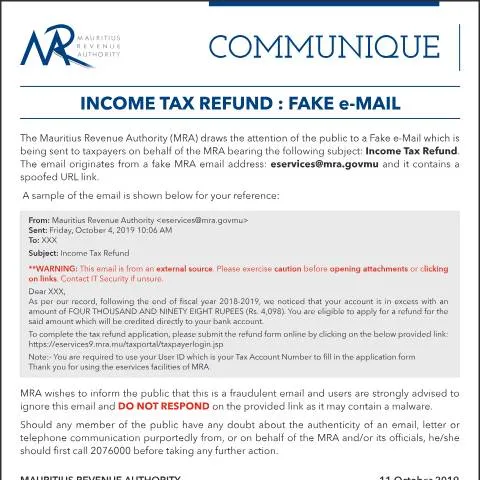
Official Notice: Beware of Fake Email Regarding Income Tax Refunds in Mauritius
The Mauritius Revenue Authority (MRA) has issued an important advisory to the public concerning a recent wave of fraudulent emails impersonating official correspondence from the authority. These emails falsely claim that taxpayers are eligible for income tax refunds and attempt to deceive recipients into revealing personal information or clicking malicious links. This notice aims to inform citizens about the nature of these scams, the methods used by fraudsters, and the precautions to take to protect personal and financial data.
Context and Purpose of the Notice
This official communication serves as a warning to all taxpayers and members of the public about the ongoing scam involving fake emails purportedly sent by the MRA. The fraudulent messages are designed to appear as legitimate notifications regarding income tax refunds following the end of the fiscal year 2018-2019, which concluded on 30 June 2019. The purpose of the notice is to prevent individuals from falling victim to these scams by highlighting the characteristics of the fake emails and providing guidance on how to verify official communications from the MRA.
Characteristics of the Fake Email
The fraudulent email, which is being circulated, has the following notable features:
- Sender Address: The scam email originates from a fake address: [email protected]. This address closely mimics the official MRA email but is not authorized or recognized by the authority.
- Subject Line: The email subject is titled "Income Tax Refund," aiming to attract immediate attention.
- Content and Tone: The message claims that, based on the records, the recipient has an excess tax refund amounting to a specific figure (for example, Rs. 4,098). It then prompts the recipient to click on a provided link to complete an online refund application.
- Link Provided: The email contains a spoofed URL link (e.g., https://eservices9.mra.mu/taxportal/taxpayerlogin.jsp), which is designed to look authentic but is malicious.
- Warning Notices: The email includes disclaimers advising caution, warning that it is from an external source, and instructs recipients not to open attachments or click on links if they have doubts about its authenticity.
Official Guidance from the Mauritius Revenue Authority
The MRA explicitly states that this email is fraudulent and should be ignored. The authority emphasizes that it does not communicate tax refunds via unsolicited emails containing links to external websites. Citizens are advised to exercise vigilance and to verify any suspicious communication before responding or providing personal data.
Recommended Actions for the Public
To safeguard personal information and avoid falling prey to scams, the MRA recommends the following precautions:
- Do not respond: Never click on links or download attachments from unsolicited emails claiming to be from the MRA.
- Verify authenticity: If you receive an email or communication that appears suspicious, contact the MRA directly via official channels, such as the official helpline at 2076000 or through the official website.
- Use official portals: All legitimate tax-related procedures, including refunds, are managed through secure online platforms accessible via the official government websites or authorized e-services portals.
- Be cautious of external sources: Always scrutinize the sender's email address and look for signs of spoofing or irregularities.
Legal and Administrative Context
This advisory aligns with the legal framework governing official communications in Mauritius, which stipulates that the MRA and other government agencies do not send unsolicited emails requesting personal or financial information. Citizens are encouraged to rely on verified official channels for all tax-related matters, including refunds, and to report any suspicious activity to the appropriate authorities.
Conclusion
The Mauritius Revenue Authority remains committed to protecting taxpayers from cyber fraud and scams. This notice underscores the importance of vigilance and the need to distinguish official communications from fraudulent attempts. Citizens are urged to stay informed and to follow recommended security practices to ensure their personal and financial safety in digital interactions with government entities.
For further information or to report suspicious emails, contact the MRA at the official telephone number or visit their official website.