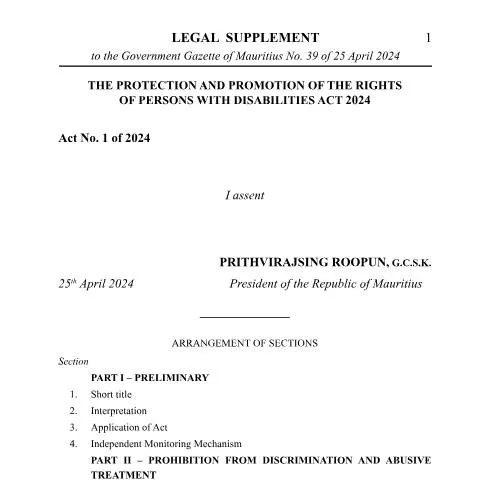
Understanding the Protection and Promotion of the Rights of Persons with Disabilities Act 2024 in Mauritius
The Protection and Promotion of the Rights of Persons with Disabilities Act 2024 is a comprehensive piece of legislation enacted by the Parliament of Mauritius to safeguard the rights and dignity of individuals with disabilities. Signed into law on 25 April 2024 by President Prithvirajsing Roopun, this Act aims to eliminate discrimination, prevent abuse, and promote equal opportunities for persons with disabilities across the country.
Scope and Objectives of the Act
This law establishes a legal framework to protect persons with disabilities from discrimination and abuse while fostering their social integration and empowerment. It aligns with the principles of the United Nations Convention on the Rights of Persons with Disabilities, which Mauritius has ratified, and emphasizes the importance of accessibility, non-discrimination, and equal participation in all facets of society.
Key Provisions and Institutional Framework
Part I: Preliminary and Application
The Act begins with definitions and clarifications, including the meaning of terms such as "disability," "abuse," "discriminate," and "benefit." It applies to all individuals and entities within Mauritius, including the State, local authorities, and private organizations, ensuring a broad scope for protection and enforcement.
Part II: Prohibition of Discrimination and Abuse
One of the core tenets of the Act is the absolute prohibition against discrimination and abusive treatment of persons with disabilities. This covers physical, sexual, psychological, emotional, financial, or moral abuse, as well as derogatory language or gestures that demean individuals. The law explicitly forbids acts that would undermine the dignity or rights of persons with disabilities.
Part III: Rights and Empowerment
This section emphasizes the promotion of rights through measures such as:
- Training and Education: Ensuring accessible learning environments and inclusive curricula.
- Employment: Encouraging equal employment opportunities and protecting workers with disabilities.
- Habilitation and Rehabilitation: Providing services to enhance independence and functional capacity.
- Data Collection: Establishing mechanisms for collecting statistics to inform policy and monitor progress.
- International Cooperation: Engaging with international bodies to align practices and standards.
The Role of the Empowerment Unit and Disability Rights Watch
Part IV: The Empowerment Unit
The Act establishes the Empowerment Unit, tasked with overseeing the implementation of rights-based initiatives, monitoring acts of abuse, and providing support services. It has the authority to investigate reports of abuse, assist victims, and issue protection orders to prevent acts of harm.
Part V: The National Empowerment Authority
The National Empowerment Authority is responsible for formulating policies, coordinating efforts, and ensuring compliance with the Act. It also manages registration of organizations working with persons with disabilities and oversees fiscal incentives for employment and other support measures.
Protection from Discrimination and Abuse
The law provides mechanisms for victims of discrimination or abuse to seek redress. Officers of the Empowerment Unit have powers to enter premises, assist victims, and report acts of abuse to the police. Protection orders can be issued to safeguard individuals, with provisions for appeals and enforcement.
Employment and Incentives for Persons with Disabilities
Employers are mandated to provide suitable employment opportunities for persons with disabilities. Fiscal incentives, such as tax deductions and schemes like the Prime à l’Emploi, are designed to encourage inclusive hiring practices and support organizations that employ persons with disabilities.
Legal and Administrative Safeguards
The Act establishes registers for persons with disabilities and employers, ensuring transparency and accountability. It also includes provisions for annual reporting, confidentiality, and the enforcement of regulations to uphold the rights enshrined in the legislation.
Conclusion
The Protection and Promotion of the Rights of Persons with Disabilities Act 2024 marks a significant step forward in Mauritius’s commitment to an inclusive society. It provides a robust legal framework to combat discrimination, promote empowerment, and ensure that persons with disabilities can participate fully and equally in social, economic, and cultural life.