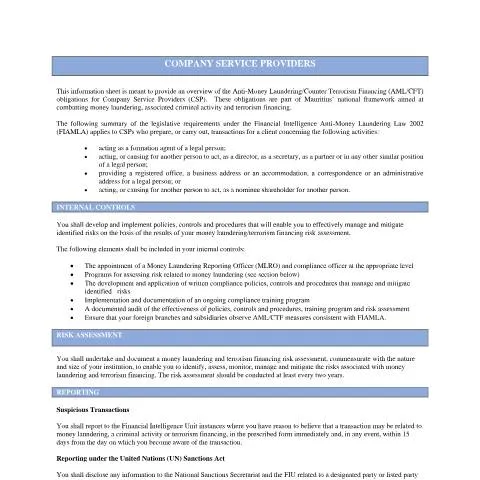
Overview of the Revised Company Service Providers Fact Sheet in Mauritius
The official document titled Company Service Providers Fact Sheet Revised serves as a comprehensive guide for entities operating as Company Service Providers (CSPs) within Mauritius. This notice outlines the legislative framework, compliance obligations, and operational requirements mandated by the Anti-Money Laundering and Counter Terrorism Financing (AML/CFT) laws, specifically under the Financial Intelligence and Anti-Money Laundering Law 2002 (FIAMLA). The primary objective of this guidance is to ensure CSPs adhere to national measures aimed at combating financial crimes, including money laundering and terrorism financing, thereby reinforcing Mauritius’s commitment to maintaining a transparent and secure financial environment.
Scope and Applicability of the AML/CFT Obligations
The revised fact sheet explicitly targets CSPs engaged in activities that involve preparing or executing transactions for clients in specific roles. These activities include:
- Acting as formation agents for legal entities;
- Serving as directors, secretaries, partners, or similar positions within a legal person;
- Providing registered offices, business addresses, or administrative addresses for legal entities;
- Acting or causing others to act as nominee shareholders.
Entities involved in these activities are subject to the obligations outlined in the law, which aim to prevent misuse of corporate structures for illicit purposes. This scope underscores the importance of compliance for CSPs operating within the Mauritian financial and corporate sectors.
Key Compliance Requirements for Company Service Providers
Internal Controls and Risk Management
To effectively mitigate risks associated with money laundering and terrorism financing, CSPs must develop robust internal controls. These include:
- Designating a Money Laundering Reporting Officer (MLRO) and a compliance officer at appropriate levels;
- Implementing risk assessment programs tailored to the size and nature of the CSP’s operations;
- Formulating written policies, controls, and procedures to manage identified risks;
- Establishing ongoing training programs for staff on AML/CFT compliance;
- Conducting regular audits to evaluate the effectiveness of policies and controls;
- Ensuring that foreign branches and subsidiaries observe equivalent AML/CFT measures.
Risk Assessment and Customer Due Diligence
A central element of the legal framework is conducting a comprehensive risk assessment at least every two years. This assessment helps CSPs identify potential vulnerabilities related to money laundering and terrorism financing.
Customer due diligence (CDD) measures are essential when establishing business relationships or executing transactions exceeding a specified threshold. CSPs must:
- Identify and verify clients using reliable, independent documentation;
- Determine the beneficial owner(s) controlling the legal entity;
- Obtain information regarding the purpose and nature of the business relationship;
- Perform ongoing monitoring of the relationship and scrutinize transactions to ensure consistency with the client’s profile.
Enhanced Due Diligence and Third-Party Verification
For higher-risk clients or transactions, CSPs are required to apply enhanced due diligence (EDD). This involves obtaining additional information, verifying documents more rigorously, and securing senior management approval for new relationships or large transactions.
Additionally, CSPs must take reasonable steps to verify whether clients are acting on behalf of third parties. This includes establishing the true identity of third parties involved and understanding their relationship with the client or entity.
Reporting and Registration Obligations
In line with national AML/CFT policies, CSPs must report suspicious transactions to the Financial Intelligence Unit (FIU) within 15 days of becoming aware of such activity. This includes instances where transactions appear to be linked to money laundering, criminal activities, or terrorism financing.
Fill in your form directly online
No printing: type your details into the boxes of the official form, tick, then download the PDF ready to send.
- 1Type into the form boxes
- 2Tick in one click
- 3Save and download the PDF
Furthermore, CSPs are mandated to register with the FIU immediately upon commencing operations or within a timeframe specified by the authority. Registration procedures and support are available through the FIU’s official website, which provides guidance and contact details for assistance, including a dedicated helpdesk.
Ongoing Monitoring and Compliance
To ensure continued adherence to AML/CFT standards, CSPs must establish ongoing monitoring programs. These programs are designed to detect complex, unusual, or suspicious activities, with documented outcomes to support compliance efforts.
In conclusion, the revised Company Service Providers Fact Sheet emphasizes the importance of a structured and proactive approach to AML/CFT compliance. By implementing effective internal controls, conducting diligent customer assessments, and maintaining transparent reporting practices, CSPs can contribute significantly to Mauritius’s efforts in safeguarding its financial system against illicit activities.