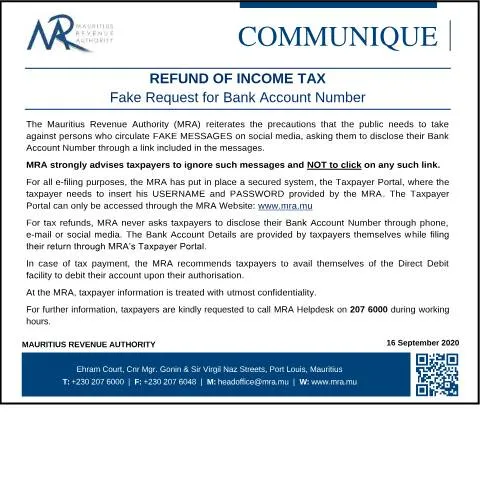
Unveiling the Fraud: Understanding the Refund of Income Tax - Fake Request for Bank Account Number
In an era where digital communication reigns supreme, the unscrupulous spread of misinformation can lead to significant financial repercussions for individuals. The Refund of Income Tax: Fake Request for Bank Account Number document issued by the Mauritius Revenue Authority (MRA) on September 16, 2020, serves as a crucial tool in the government's endeavor to protect taxpayers from scams targeting their personal financial information.
The Essential Role of the Document in Financial Safeguarding
This official document acts as a warning to all taxpayers in Mauritius about the potential risks associated with disclosing sensitive information online. It emphasizes that the MRA will never solicit personal details like bank account numbers through dubious channels such as social media, emails, or phone calls. Instead, all necessary information should be provided directly through the secure Taxpayer Portal on the MRA's official website.
The Secure Taxpayer Portal
Understanding how the Taxpayer Portal functions is paramount for anyone filing for tax refunds. This secure system is designed to ensure that all sensitive data remains confidential and protected from unauthorized access.
- Accessing the Portal: Taxpayers must enter their unique USERNAME and PASSWORD, provided by the MRA, to access their accounts.
- Direct Input: Bank Account Details should be entered directly while filing tax returns on this platform, eliminating any risk of third-party interception.
- Direct Debit Facility: For tax payments, the MRA endorses the Direct Debit option, allowing taxpayers to authorize automatic deductions from their accounts securely.
The Broader Context: Taxpayer Rights and Responsibilities
The MRA's efforts in disseminating this document reflect a broader commitment to taxpayer education and protection. To fully appreciate its significance, one must first understand the legal framework governing tax processes in Mauritius.
Regulatory Framework
The MRA operates within a hybrid legal system combining French civil law and English common law principles. Established under the MRA Act of 2004, the authority is entrusted with various responsibilities, including tax collection and enforcement. The Refund of Income Tax document underscores the importance of taxpayer confidentiality and lays out the contours of taxpayer rights and responsibilities under this framework.
Chronological Context: When to Be Vigilant
Taxpayers should be particularly vigilant during the financial year, which spans from July 1 to June 30. It is in this period that tax returns are usually filed, and thus the likelihood of encountering fraudulent schemes increases.
Key Dates in the Financial Calendar
| Event | Date | Notes |
|---|---|---|
| Start of Financial Year | July 1 | New tax obligations commence |
| Tax Return Submission Deadline | October 15 | Ensure timely filing to avoid penalties |
| Tax Refund Processing | Post October 15 | Refunds typically issued within 30 days after processing |
Examining the Document: Breakdown of Key Sections
This document is not merely a warning; it comprises essential information that taxpayers should thoroughly understand. The sections of the Refund of Income Tax document outline the steps to take and the precautions necessary to safeguard personal information.
Understanding the Content
- Introduction: Highlights the prevalence of fake messages and the importance of vigilance.
- How to Respond: Advises taxpayers to ignore suspicious messages and refrain from clicking on any links.
- Taxpayer Rights: Reiterates that the MRA will never ask for sensitive information via insecure channels.
Special Cases: Navigating Complex Situations
While the general guidelines provided in the Refund of Income Tax document apply broadly, there are certain situations that require additional consideration. Taxpayers in unique circumstances—including non-residents, minors, or those facing urgent financial issues—should be aware of the specific provisions applicable to their situations.
Non-Residents and Minors
Non-residents must follow additional regulations when it comes to tax refunds. They need to provide proof of residency in another jurisdiction and may have different tax obligations. Similarly, minors may require parental consent for any financial actions, including tax filings.
Urgent Situations
In cases where taxpayers experience financial hardship and require immediate access to tax refunds, reaching out directly to the MRA Helpdesk can provide clarity on any expedited processes available.
Preparing Your Documentation: What You Need to Submit
Successful completion of the tax refund process hinges upon the submission of accurate and timely documentation. When filing through the Taxpayer Portal, taxpayers need to ensure they have all relevant documents ready for submission.
Common Required Documents
- Tax Identification Number (TIN): Essential for processing any tax-related request.
- Previous Tax Returns: Copies of past filings may be required for reference.
- Proof of Bank Details: Documentation proving ownership of the submitted bank account may be necessary.
How to Follow Up: A Guide to Tracking Your Application
The journey does not end once the Refund of Income Tax document is submitted. Taxpayers should be proactive in following up on their applications to ensure smooth processing.
Contacting the MRA
The MRA has established a dedicated Helpdesk service that allows taxpayers to inquire about the status of their applications.
- Call the MRA Helpdesk at +230 207 6000 during business hours for assistance.
- Be prepared to provide your TIN and any reference numbers associated with your application.
The Final Word: Staying Informed and Vigilant
As a taxpayer, understanding the nuances of documents like the Refund of Income Tax - Fake Request for Bank Account Number is vital for personal financial security. By remaining informed and vigilant against scams, you can ensure that your tax experience remains safe and beneficial. Always remember: the MRA is committed to protecting your information.
Understanding the Process of Income Tax Refunds in Mauritius
In Mauritius, the refund of income tax may occur when taxpayers have overpaid their taxes during a fiscal year. This process can sometimes lead to confusion, especially in light of fraudulent activities like fake requests for bank account numbers. A taxpayer must understand the steps involved in applying for an income tax refund and the common pitfalls to avoid.
The first step in the refund process is to determine eligibility. Generally, if you have had excess tax deducted from your income or if your tax credits exceed your tax liabilities, you could be entitled to a refund. It's crucial to keep accurate records of your income and tax payments, including payslips and tax returns, as these documents will be necessary for substantiating your claim.
To initiate the refund, taxpayers must complete the required forms and submit them to the Mauritius Revenue Authority (MRA). The primary form used for this purpose is the MRA Form IT 7, which is specifically designed for income tax refund claims. This form must be filled out meticulously, ensuring all necessary information is provided, including your Tax Identification Number (TIN), contact details, and supporting documentation such as proof of income and tax deduction certificates.
Once the form is submitted, the MRA will conduct a review of your claim. This process may take several weeks, and during this period, it is essential to remain vigilant against potential scams. Be wary of unsolicited communication requesting your bank account number, particularly if the request seems out of place or is not directly linked to your tax refund application. The MRA does not contact taxpayers in this manner, thus any such request should be reported immediately.
Safeguarding Against Fraudulent Activities Related to Tax Refunds
Fraudulent activities, such as fake requests for bank account numbers, can pose a significant threat to taxpayers in Mauritius. These scams often take the form of emails, text messages, or phone calls claiming to be from the MRA or other governmental agencies, urging individuals to provide personal or banking information to process their refunds.
To protect yourself, it is imperative to verify the authenticity of any communication you receive. The MRA has established official communication channels, and any correspondence that deviates from these channels should raise suspicion. It is advisable to cross-reference any request with the official MRA website or contact them directly using the contact details provided on their site.
Moreover, taxpayers should ensure their personal data, including bank account details, is kept confidential. Sharing such information with unverified parties can lead to identity theft and financial loss. If you suspect that you have been targeted by a scam, you should document all communications and report them to the MRA and the local authorities, including the Cybercrime Unit, to assist in combating such fraudulent activities.
Additionally, consider enrolling in digital literacy programs that educate citizens on recognizing phishing attempts and safeguarding their personal information. The government, along with various NGOs, frequently organizes workshops aimed at enhancing public awareness regarding cybersecurity, which could be beneficial for taxpayers.
The Role of E-Services in Facilitating Income Tax Refunds
The Mauritian government has increasingly prioritized e-services to streamline administrative processes, including income tax refunds. The introduction of the govmu.org portal has revolutionized the way citizens interact with government services, providing them with a user-friendly platform to submit applications and track their requests.
Through the portal, taxpayers can access a range of services, from filing tax returns to checking the status of their refund applications. The platform requires users to log in using their MauPass single-sign-on credentials, which are tied to their National ID Card and Central Population Database information, enhancing security and ease of access.
When applying for an income tax refund through the e-service portal, ensure that all information entered is accurate to avoid any delays in processing. After submitting your refund application electronically, you will receive a confirmation notification, which can serve as a reference for follow-ups with the MRA.
The digital transformation of tax administration also means that taxpayers can receive updates regarding their refund status via email or through the portal, reducing reliance on traditional mail systems that can be slow and prone to errors. This not only improves the overall taxpayer experience but also enhances the efficiency of the MRA in handling refund requests.
In conclusion, embracing digital services in Mauritius offers a more secure and efficient approach to managing tax obligations, including refunds. As the government continues to expand e-services, taxpayers are encouraged to familiarize themselves with these resources to simplify their interactions with tax authorities.