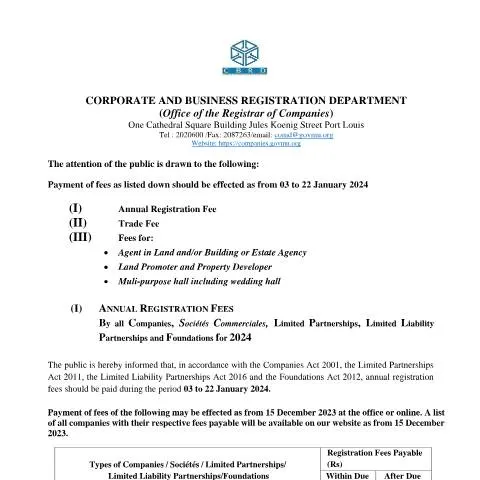
Navigating the Payment of Registration and Trade Fees for 2023-2024
Every business operating in Mauritius must be cognizant of the annual registration and trade fees mandated by the Corporate and Business Registration Department (CBRD) under the Companies Act 2001 and related regulations. The Payment of Registration and Trade Fees for the financial year 2023-2024 is a crucial process for ensuring compliance and maintaining good standing. This article provides a detailed overview of this document's importance, the steps for submission, and guidance on how to effectively navigate the related procedures.
Understanding the Role of the Payment of Registration and Trade Fees Document
The Payment of Registration and Trade Fees document serves as a formal notice for all companies, sociétés commerciales, partnerships, and foundations to fulfill their annual fee obligations. It outlines the specific fees payable during the designated period of January 3 to January 22, 2024. This document is pivotal as it sets the foundation for legal compliance and impacts a company's operational status within Mauritius.
Why Timeliness Matters
Failure to comply with the deadlines can result in late fees or penalties, which may escalate the financial burden on businesses. The fees must be paid within the stipulated timeframe to avoid complications and ensure continued operational capability.
Who Needs to Submit This Document?
The remit of the Payment of Registration and Trade Fees document applies to a diverse range of entities:
- Private companies
- Public companies
- Limited partnerships
- Limited liability partnerships
- Foundations
Each of these entities must pay annual registration fees contingent on their categorization and turnover, making it essential for business leaders to understand where they fit within this framework.
Breaking Down the Fee Structure
The fee structure is categorized primarily based on the turnover of the business. Below, we break down the types of companies and their respective fees:
| Type of Entity | Registration Fees Payable (within due date) | Registration Fees Payable (after due date) |
|---|---|---|
| Small Private Company (Turnover not exceeding Rs 30 Million) | Rs 500 | Rs 750 |
| Small Private Company (Turnover exceeding Rs 30 Million but < Rs 100 Million) | Rs 2,500 | Rs 3,750 |
| Private Company (Turnover exceeding Rs 100 Million) | Rs 9,000 | Rs 13,500 |
| Public Company | Rs 13,500 | Rs 20,250 |
| Foreign Company | Rs 13,500 | Rs 20,250 |
| Authorized Company | US$100 | US$150 |
It's imperative for businesses to ascertain their correct classification based on turnover, as this directly affects their financial obligations.
Gathering the Necessary Documentation
Before initiating the fee payment process, businesses must prepare the relevant documentation. This includes:
- Financial Summary: Companies must submit their financial summary unless previously filed, which verifies turnover for fee calculation.
- Director’s Declaration: Small private companies with a turnover of less than Rs 30 Million must submit a declaration confirming their financial status.
- Previous Registration Documents: Ensure all prior documentation is in order, as discrepancies can delay the approval process.
Companies can download a specimen of the Declaration Form from the official CBRD website or collect it at the office. Proper documentation is vital to streamline the payment process and prevent delays.
Steps for Completing the Payment Process
To effect payment of registration and trade fees, the following steps should be adhered to:
Online Payment Procedure
The CBRD encourages online payment for efficiency. Once registered, follow these steps:
- Log into the CBRD portal and click on 'Pay Yearly Fees.'
- Navigate to 'Dashboard' and select 'Search Pending Fees.'
- Choose 'Yearly Fees' to view pending payments.
- Select the company or companies for which fees are to be paid. These will be added to a cart.
- Choose your payment method from available options: Deposit Account (MUR & USD), Electronic Payment (MUR only), or Credit Card (MUR only).
- Confirm payment and retain any transaction receipts for your records.
In-person payments can also be made at the CBRD office if preferred, although online payment is recommended for ease and efficiency.
Understanding Trade Fee Obligations
Alongside registration fees, businesses are also required to pay trade fees, which follow a different structure. Here are the key considerations:
- Trade fees must be paid in a single instalment by January 22, 2024, or:
- If dues exceed Rs 5,000, businesses may opt for two equal instalments, with the first by January 22, 2024, and the second by June 30, 2024.
Exemptions are also available for certain businesses, including:
- Those whose total trade fees do not exceed Rs 5,000.
- Businesses registered on or after August 5, 2021, which are exempt from trade fees for two financial years.
It is critical to remain informed about these exemptions and ensure compliance to avoid unexpected fees.
After Submission: What to Expect
Once payment of the registration and trade fees is successfully completed, businesses can expect the following:
Fill in your form directly online
No printing: type your details into the boxes of the official form, tick, then download the PDF ready to send.
- 1Type into the form boxes
- 2Tick in one click
- 3Save and download the PDF
- Receipt of payment confirmation via email or through the online portal.
- Updating of company status in the CBRD database, reflecting compliance for the financial year.
- Notification of any discrepancies or issues with submitted documentation, should they arise.
For those who have not received payment confirmation or updates, it is advisable to follow up with CBRD directly at their contact numbers or email provided on the CBRD website.
Monitoring Your Compliance Status
Maintaining an awareness of your compliance status with the CBRD is paramount. Here’s how you can effectively monitor:
- Check Online Status: Regularly log into the CBRD portal to check your company's registration and trade fee status.
- Keep Records: Maintain a file of all communications, receipts, and documentation related to fee payments.
- Engage with CBRD: If discrepancies arise, engage promptly with the CBRD office for clarification and resolution.
Taking a proactive approach to compliance monitoring will help mitigate risks of penalties or operational disruptions.
Final Thoughts on Compliance with Registration and Trade Fees
Successful navigation of the Payment of Registration and Trade Fees for 2023-2024 is essential for businesses to maintain their operational licenses in Mauritius. Understanding the structure, gathering necessary documentation, following payment procedures, and actively monitoring compliance ensures that businesses can focus on growth instead of administrative hurdles.
For additional guidance or inquiries regarding the process, contact the Corporate and Business Registration Department directly at:
Corporate and Business Registration Department Office of the Registrar of Companies One Cathedral Square Building Jules Koenig Street, Port Louis Tel: 2020600 Fax: 2087263 Email: [email protected] Website: https://companies.govmu.org