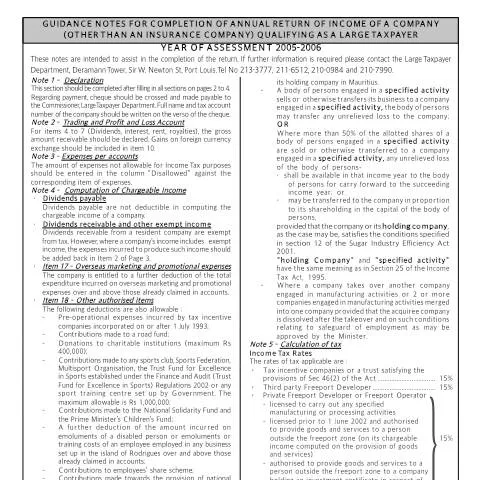
Understanding the Role of the comlt0506n Document in Corporate Compliance
The comlt0506n document, officially known as the "Notes for Completion of Annual Return of Income of a Company (Other Than an Insurance Company) Qualifying as a Large Taxpayer for the Year of Assessment 2005-2006," plays a pivotal role in ensuring corporate compliance with tax regulations in Mauritius. For companies operating within the jurisdiction, submitting this official document is not merely a bureaucratic obligation; it serves as a critical means of reporting financial performance and fulfilling tax responsibilities to the Mauritian authorities.
This document is specifically designed for large taxpayers, which are generally entities that meet certain revenue thresholds, thus requiring them to adhere to more stringent reporting requirements under the Income Tax Act. The completion and timely submission of this form is essential for maintaining good standing with the Mauritius Revenue Authority (MRA) and avoiding potential penalties.
Who is Responsible for Submitting the comlt0506n Document?
The responsibility for submitting the comlt0506n document primarily falls on the companies that qualify as large taxpayers. This includes both local firms and foreign entities operating within Mauritius that fit the specified criteria. The timing and accuracy of such submissions are critical, as the MRA employs these annual returns to assess the tax liabilities of companies effectively.
Identification of Large Taxpayers
- Companies whose annual turnover exceeds Rs 10 million.
- Groups of companies combined revenue that exceeds the threshold.
- Companies operating in specific industries as defined by MRA guidelines.
It is advisable for companies to regularly review their revenue thresholds and consult with financial advisors to determine their tax status and obligations accurately.
Key Elements in Completing the comlt0506n Document
Completing the comlt0506n document requires meticulous attention to detail. Companies must ensure that they provide accurate financial information as failure to do so could lead to audits or penalties. The document typically includes several critical sections, each designed to capture essential aspects of a company’s financial health.
Section Breakdown
1. Declaration
This section must be filled out after all other sections are complete. It includes a declaration that the information provided is correct to the best of the company's knowledge.
2. Trading and Profit and Loss Account
In this section, companies are required to report their trading activities and the respective profit and loss accounts, ensuring that all income streams, including dividends and interest, are declared accurately.
3. Expenses Reporting
Companies must outline their expenses, indicating which are disallowed for tax purposes. This section ensures that only allowable deductions are accounted for in the computation of chargeable income.
4. Computation of Chargeable Income
The computation of chargeable income is a critical part of the document. Companies must calculate their taxable income based on guidelines set out in the Income Tax Act, ensuring that any exempt income is properly treated.
The Process of Submission: From Preparation to Filing
The journey of the comlt0506n document doesn’t end with its completion; the submission process involves several crucial steps that companies must adhere to in order to ensure compliance.
Step-by-Step Submission Process
- Preparation of Financial Statements: Companies must first ensure that their financial statements are prepared in accordance with the relevant accounting standards.
- Completion of the Document: The next step involves accurately filling out the comlt0506n document, referencing the financial statements as needed.
- Review and Verification: It’s advisable for a qualified accountant or tax advisor to review the completed document for accuracy and compliance.
- Filing the Document: The completed form, along with any required supporting documents, must be submitted to the Large Taxpayer Department at the MRA.
- Payment of Taxes: If taxes are owed, payment must be made via a crossed cheque payable to the Commissioner of the Large Taxpayer Department, clearly indicating the company’s name and tax account number on the reverse.
Timelines: Key Dates for the comlt0506n Submission
The timely submission of the comlt0506n document is critical in the corporate calendar. Understanding the timeline is essential for ensuring compliance and avoiding penalties.
Important Dates
| Action | Date |
|---|---|
| Start of Financial Year | 1 July |
| End of Financial Year | 30 June |
| Filing Deadline for Annual Returns | 30 September |
| Tax Payment Deadline | 30 September |
Companies must remain aware of these dates and any potential extensions that may be offered by the MRA. Late submissions can incur fines and interest on outstanding tax payments, exacerbating the overall financial burden on the company.
What to Do in Case of Errors or Missing Documents
Despite the best efforts, companies may occasionally find themselves in situations where errors are discovered after submitting the comlt0506n document or where necessary documents are missing. Understanding the procedure to follow in these instances can mitigate potential issues with the MRA.
Corrective Actions
- Immediate Rectification: If a company realizes that there are errors in the submitted document, it should contact the MRA as soon as possible to discuss corrective measures.
- Submission of Amendments: Companies may need to submit an amended return or additional documentation to clarify discrepancies.
- Documentation Tracking: Keeping thorough records of all submitted documents and communications with the MRA can aid in resolving issues more efficiently.
In some cases, companies may face penalties for late submissions or inaccuracies, so proactive communication with the MRA is essential for minimizing repercussions.
Special Considerations for Unique Situations
Certain circumstances may require additional attention when completing and submitting the comlt0506n document. Companies should be aware of specific requirements that apply to various situations.
Examples of Special Situations
- Start-ups: Companies newly incorporated during the financial year may have specific reporting requirements, including the disclosure of start-up costs.
- Foreign Entities: Foreign companies operating in Mauritius must comply with local tax regulations and may have additional forms to complete.
- Minors: Companies owned by minors must be reported differently, particularly regarding income recognition.
- Urgent Cases: In cases of urgency, companies are advised to directly contact the MRA for expedited processing or guidance on timelines.
Each unique situation may impose different obligations or considerations, underscoring the necessity for companies to maintain open lines of communication with the MRA.
Final Thoughts: Navigating Tax Compliance with Confidence
Completing and submitting the comlt0506n document is an essential aspect of corporate governance in Mauritius. Understanding its nuances, from key elements and timelines to special considerations, empowers companies to navigate the complexities of tax compliance effectively. By prioritizing accuracy and timeliness in their submissions, companies can foster positive relations with the MRA, ultimately ensuring smoother operations and financial stability.
Understanding the National Identity Card and Its Impact on Administrative Processes
The National Identity Card (NIC) is a crucial element in navigating various administrative processes in Mauritius. The NIC serves as an official identification document for Mauritian citizens and is vital for accessing numerous e-services and online applications. When applying for jobs through the Public Service Commission (PSC) or Local Government Service Commission (LGSC), the NIC facilitates a streamlined process via the MauPass single-sign-on system, which links directly to the Central Population Database.
Firstly, obtaining a NIC requires a citizen to provide essential documentation, such as a birth certificate, proof of residence, and in some cases, parental authorization for minors. The application can be submitted online through the relevant government portals or in-person at designated offices. The NIC is not only critical for identification purposes but is also increasingly required for various administrative tasks, including tax filings with the Mauritius Revenue Authority (MRA) and enrolling in government services.
Fill in your form directly online
No printing: type your details into the boxes of the official form, tick, then download the PDF ready to send.
- 1Type into the form boxes
- 2Tick in one click
- 3Save and download the PDF
Moreover, when utilizing the NIC for e-services, it is essential to ensure that your personal details are up-to-date in the Central Population Database. Inaccuracies can lead to complications in accessing services, such as delays in recruitment processes or issues in tax submissions. To update personal information, citizens are required to submit specific forms and supporting documents to the relevant authorities. Thus, keeping your details accurate is paramount for avoiding any administrative hurdles.
Tax Obligations and Filing Procedures for Citizens and Residents
Tax obligations in Mauritius are governed by the Mauritius Revenue Authority (MRA), which oversees the collection of taxes and ensures compliance with fiscal regulations. Both citizens and residents are subject to various tax obligations, including income tax, value-added tax (VAT), and property tax. Understanding these responsibilities is crucial for fulfilling legal requirements and avoiding penalties.
For individuals, income tax is assessed based on cumulative income. The fiscal year runs from July 1 to June 30, and individuals are required to submit their tax returns by the deadlines set out by the MRA. E-filing has become increasingly popular, allowing taxpayers to submit their returns online, which simplifies the process and provides a more efficient way to manage tax liabilities. To file taxes electronically, individuals must register on the MRA's e-filing platform using their NIC details. It’s critical to gather all relevant documents, such as payslips, investment income statements, and any deductible expenses, to ensure accurate reporting.
Corporations operating in Mauritius must also adhere to specific tax regulations. Corporate tax rates and filing procedures are outlined by MRA guidelines, and businesses often need to maintain comprehensive financial records to comply with auditing requirements. Depending on the nature of their operations, companies may also be liable for VAT, which necessitates additional registration. Understanding financial obligations and adhering to the MRA's requirements can significantly impact a business’s operations and financial health.
Exploring the Role of Local Authorities in Service Delivery
Local authorities in Mauritius play a crucial role in the delivery of various services that directly impact daily life. These services include waste management, urban planning, and public health initiatives, all of which are governed by the Local Government Act and overseen by the Local Government Service Commission (LGSC). Understanding how these local bodies operate can significantly enhance how citizens interact with government services and advocate for community needs.
Each local authority, whether a municipal council or a district council, has its structure and responsibilities. For instance, municipal councils are primarily responsible for urban areas, while district councils cater to rural regions. Citizens can engage with their local authorities through public consultations and forums, which offer a platform to voice opinions on community issues. This participatory approach is not only encouraged but mandated in various local governance frameworks, promoting transparency and accountability.
Moreover, local authorities are increasingly adopting digital tools to enhance service delivery. Online platforms allow residents to report issues such as potholes or garbage collection delays, track the status of their complaints, and access information on local services. These innovations aim to improve responsiveness and citizen engagement, fostering a more collaborative relationship between residents and local government.
Understanding the specific functions of local authorities and their impact on community well-being is essential for citizens seeking to navigate administrative processes effectively. By being aware of local governance structures, residents can better advocate for improvements and ensure that their voices are heard in shaping the services they rely on.