The Essential Role of the Number of Companies with Shareholder By Gender Document
Understanding the dynamics of ownership in Mauritius is crucial for policymakers, investors, and researchers alike. The Number of Companies with Shareholder By Gender document serves as a pivotal report that encapsulates the gender-based distribution of company ownership. This report sheds light on the progress and challenges in achieving gender equality within the corporate ecosystem.
Navigating the Submission Process for the Document
Submitting the Number of Companies with Shareholder By Gender document is a straightforward yet critical process. It is typically filed by company directors or designated representatives. The submission must adhere to the guidelines set forth by the Registrar of Companies within the Ministry of Finance. Here’s a step-by-step breakdown of the submission process:
- Gather Required Information: Collect data pertaining to the shareholders' gender representation in your company.
- Complete the Document: Fill in the document accurately, ensuring that all figures reflect the current shareholder demographics.
- Online Submission: Utilize the e-filing portal through govmu.org to submit the completed form.
- Receive Confirmation: After submission, ensure to save the acknowledgment receipt for your records.
Understanding the Data: Insights into Gender Representation
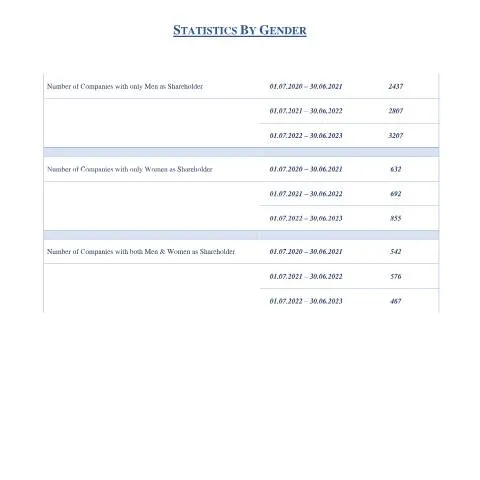
The statistics presented in the document facilitate analysis and discussion on gender representation in corporate shareholding. As outlined below, trends over three fiscal years (from July 1 to June 30) reveal critical insights:
| Gender Representation | FY 2020-2021 | FY 2021-2022 | FY 2022-2023 |
|---|---|---|---|
| Only Men as Shareholder | 2437 | 2807 | 3207 |
| Only Women as Shareholder | 632 | 692 | 855 |
| Both Men & Women as Shareholder | 542 | 576 | 467 |
This data highlights a growing number of companies with women shareholders, indicating a gradual shift towards inclusivity within Mauritius' corporate landscape.
Who Needs to Submit the Document?
The requirements for submitting the Number of Companies with Shareholder By Gender document can vary based on several factors:
Standard Requirements
- Company Directors: All companies must submit the report annually to maintain compliance with local regulations.
- Registered Representatives: In cases where directors are unable to file, authorized representatives may act on their behalf.
Special Considerations
- Foreign Entities: Companies with foreign ownership must also comply with submission requirements, ensuring that local regulations are followed.
- Companies with Minors as Shareholders: Special provisions may apply, particularly around legal representation and guardianship.
The Consequences of Non-Submission
Failing to submit the Number of Companies with Shareholder By Gender document can have significant repercussions:
- Legal Ramifications: Companies may face penalties, including fines or legal action for non-compliance.
- Impact on Funding: Potential investors may be deterred by non-compliance, limiting funding opportunities and affecting business growth.
- Reputation Damage: A lack of transparency in shareholder demographics can lead to public scrutiny, damaging corporate reputation.
Exploring the Implications of Gender Representation
Gender representation among shareholders is more than just a statistic; it reflects broader societal trends and challenges. The evolving landscape of corporate ownership has implications for:
Policy Development
Insights from the document can shape public policies aimed at promoting gender equality in business. As more women engage in corporate ownership, policymakers can design targeted initiatives to support this growth.
Investment Strategies
Investors are increasingly interested in gender diversity as a metric for a company's sustainability and long-term viability. Companies reflecting diverse ownership may attract more investment opportunities.
Real-World Examples of Gender Representation Changes
To further illustrate the impact of the Number of Companies with Shareholder By Gender document, consider the following case studies:
Successful Women-Owned Companies
- Company A: This company transitioned from a male-only shareholder base to include women shareholders, resulting in a 25% increase in revenue.
- Company B: By attracting female shareholders, this company enhanced its brand image and community engagement.
Challenges Faced by Companies with Male Dominance
- Company C: Despite its male-dominated shareholder structure, the company struggled to innovate and attract younger customers, leading to a decline in market share.
Moving Forward: The Future of Gender Representation in Companies
As awareness grows regarding the importance of gender diversity, the submission of the Number of Companies with Shareholder By Gender document will become increasingly vital. Companies are encouraged to not only fulfill their legal obligations but also to embrace the potential benefits that come with diverse ownership.
In conclusion, the document is not merely a statistical report; it is a reflection of Mauritius' commitment to fostering an inclusive and equitable business environment. The data it provides is instrumental for all stakeholders involved in the economic landscape of the nation.
Understanding Gender Distribution in Shareholding in Mauritius
In Mauritius, the gender distribution among shareholders is an important socio-economic indicator that reflects the state's commitment to gender equality and empowerment of women in the business sector. This demographic segmentation reveals the extent to which different genders participate in the ownership of companies, influencing policy making and economic strategies. The analysis of shareholder data highlights trends and potential disparities that exist within the corporate structures of the nation.
The Mauritius Financial Services Commission (FSC) plays a pivotal role in regulating and overseeing the corporate sector, including the registration of companies and the maintenance of shareholder registries. By examining data from various sectors, including finance, manufacturing, and tourism, we can glean insights into the participation of male versus female shareholders.
Recent reports indicate a gradual increase in female representation among shareholders, facilitated by governmental initiatives aimed at fostering entrepreneurship among women. Programs that offer training, mentoring, and financial support are instrumental in helping women secure and manage shares within companies. However, despite these positive trends, challenges remain that hinder equal participation, such as societal norms and access to capital.
Statistics compiled from the Registrar of Companies demonstrate that while the number of female shareholders is on the rise, males still constitute a significant majority in ownership roles. The detailed analysis of these figures provides essential data for policymakers and organizations advocating for gender equality in business.
Fill in your form directly online
No printing: type your details into the boxes of the official form, tick, then download the PDF ready to send.
- 1Type into the form boxes
- 2Tick in one click
- 3Save and download the PDF
Impact of Gender Diversity on Company Performance
The influence of gender diversity in ownership structures extends beyond mere representation; it can significantly affect company performance and decision-making processes. Studies have shown that companies with diverse boards, including a balance of male and female shareholders, tend to perform better financially compared to their less diverse counterparts. This phenomenon can be attributed to a variety of factors, including enhanced creativity, improved problem-solving, and a broader range of perspectives, which lead to more robust business strategies.
In Mauritius, the trend towards gender diversity among shareholders is beginning to gain traction, with more companies recognizing the benefits of inclusive ownership. The introduction of policies that incentivize companies to include women in their shareholder ranks has been beneficial. This includes aligning with the principles of the National Gender Policy, which advocates for equal participation of both genders in economic activities.
Moreover, investor attitudes are shifting, with many stakeholders now prioritizing companies that demonstrate a commitment to gender diversity. This change in perspective is encouraging businesses to adopt more equitable practices, not just in terms of ownership but also in executive management and staff recruitment. As more evidence emerges linking gender diversity to improved company performance, it is likely that more Mauritian companies will strive to create a balanced shareholder environment.
Challenges and Opportunities for Female Shareholders in Mauritius
Despite the growing presence of female shareholders in Mauritius, several challenges continue to inhibit their full participation in the business landscape. One of the primary barriers is the lack of access to finance. Women often face difficulties in securing loans or investments due to entrenched gender biases within financial institutions. This limits their ability to invest in shares or to start their own businesses.
Additionally, societal expectations and cultural norms can discourage women from pursuing ownership opportunities. The responsibilities of managing a household can detract from the time and resources that women are able to devote to business ventures and investments. Consequently, many potential female shareholders may opt for less risky endeavors or may not consider shareholding as a viable option.
However, there are numerous opportunities for women to navigate these challenges. Government initiatives aimed at promoting women's entrepreneurship are on the rise, with specific programs targeting skills development, networking opportunities, and funding access. Non-governmental organizations (NGOs) are also stepping in to provide mentorship and support to female business owners and shareholders.
Furthermore, the digital transition in Mauritius has opened up new avenues for women to engage in shareholding. The rise of online trading platforms and e-commerce provides an accessible entry point for women who may have been previously excluded from traditional investment routes. As awareness of these opportunities increases, it is conceivable that the gender gap in shareholding will continue to narrow.