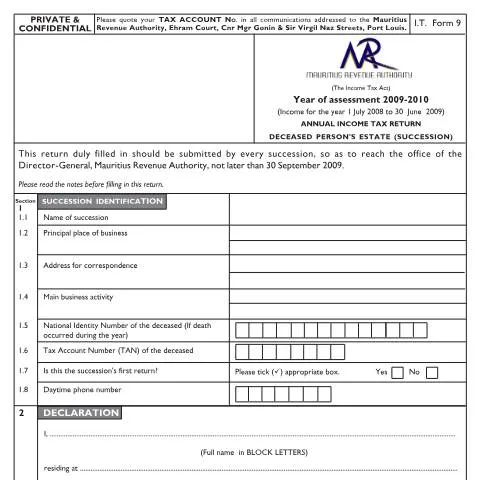
Understanding ITForm920092010: A Comprehensive Insight into the Succession Tax Return
In the delicate intersection of loss and obligation lies the necessity for proper documentation when a loved one passes away. The ITForm920092010, officially recognized as the Annual Income Tax Return for a Deceased Person's Estate, stands as a crucial mechanism for ensuring compliance with Mauritian tax regulations. This document is not merely a bureaucratic requirement; it is a vital part of managing the deceased's financial affairs, particularly when it comes to settling taxes owed and distributing assets among beneficiaries.
Who is Required to File ITForm920092010?
The responsibility to complete and submit this form typically falls upon the executor or administrator of the deceased's estate. Individuals designated as heirs or the surviving spouse may also take on this role, depending on the circumstances surrounding the estate. It is imperative for the responsible party to have a thorough understanding of the deceased's financial situation, as the information provided will directly affect tax liabilities and the inheritance process.
The Role of the Executor
- The executor is usually named in the deceased's will.
- If no will exists, the court may appoint an administrator, often a close relative.
- The executor's primary duty is to settle debts and distribute the remaining assets as per the will or local inheritance laws.
Therefore, before engaging with ITForm920092010, it is crucial for the executor to gather all relevant financial documents, including income statements, property deeds, and other assets, to ensure accurate reporting of income generated by the estate.
Filing Methods: Navigating the Submission Process
Submitting the ITForm920092010 can be approached through multiple channels, each with distinctive procedures and implications. Understanding these methods can significantly simplify the filing process and aid in compliance.
Online Filing via MauPass
The digital filing option through MauPass, associated with the National ID Card, allows for a streamlined submission process. This method is particularly advantageous for those who are comfortable navigating online systems.
- Access the govmu.org portal.
- Log in using your National ID Card credentials.
- Complete the online version of ITForm920092010 and submit it electronically.
The online process helps in receiving immediate acknowledgment of receipt, reducing the chances of lost documents.
Papers Submissions: Traditional Approach
For those preferring a traditional route, the paper submission remains an option. Here’s how to proceed:
- Print the completed ITForm920092010 and any supporting documents.
- Mail it to the Mauritius Revenue Authority (MRA) or deliver it in person to their offices.
- Ensure to keep copies of everything submitted for your records.
It is important to note that postal submissions can lead to delays, and a receipt may not be immediately available unless delivered in person.
The Regulatory Framework: Historical Context of the Form
The genesis of ITForm920092010 is rooted in the broader context of Mauritian tax law, particularly the Income Tax Act, which mandates the filing of tax returns even after an individual's demise. The 2009/2010 designation indicates the specific assessment period for which the return is filed, covering the income earned from 1 July 2008 to 30 June 2009.
Legal Obligations Post-Demotion
Under the regulations set by the Mauritius Revenue Authority, it is legally required for estates to report their income accrued during the assessment year. The law stipulates that:
- Filing must occur by 30 September following the year of assessment.
- Failure to comply may result in penalties or interest on unpaid taxes.
Thus, knowledge of the legal landscape surrounding ITForm920092010 is essential for ensuring proper administration of the estate.
Decoding the Form: Key Sections Explained
The ITForm920092010 consists of various sections, each designed to capture specific aspects of the estate's financial profile. Understanding these sections is crucial for accurate completion, as they directly impact the tax calculations.
Section Breakdown
| Section | Description | Common Pitfalls |
|---|---|---|
| Section 1: Succession Identification | Collects details about the deceased, including full name and National Identity Number. | Ensure all names are filled in BLOCK LETTERS to avoid processing delays. |
| Section 3: Sources of Income | Details various revenue sources such as trade, rental income, and agricultural activities. | Neglecting to report all sources can lead to incorrect tax assessments. |
| Section 5: Distribution to Beneficiaries | Specifies how income or losses will be shared among heirs. | Incomplete beneficiary information may cause issues in tax distribution. |
Each section of ITForm920092010 serves a vital function in reporting the estate's financial situation. Careful and detailed attention to each part can prevent delays and ensure compliance with local tax laws.
The Timeline: From Initiation to Resolution
Filing the ITForm920092010 is just one step in a broader procedure that encompasses various phases.
Chronological Steps in Completing the Form
- Gather all necessary financial documents related to the deceased's estate.
- Consult relevant stakeholders, including other heirs and legal advisors.
- Complete the ITForm920092010, ensuring accuracy and compliance with local requirements.
- Submit the form via the chosen method (online or paper).
- Await acknowledgment from the Mauritius Revenue Authority.
- Monitor the processing of the return and respond to any inquiries from the MRA.
- Distribute the estate's assets according to the filed return and local laws.
Understanding this timeline will help executors manage expectations and ensure that each step is completed promptly.
Comparative Aspects: Differentiating ITForm920092010 from Similar Forms
The ITForm920092010 is frequently misidentified or confused with other tax-related documents. It is essential to distinguish it from similar forms to avoid misfiling.
Key Differences
| Form | Purpose | Filing Deadline |
|---|---|---|
| ITForm920092010 | Annual Income Tax Return for Deceased's Estate | 30 September 2009 |
| ITForm1 | Individual Income Tax Return | 30 June annually |
| VAT Returns | Goods and services tax reporting | Quarterly |
Recognizing these differences is pivotal to ensuring compliance with the appropriate tax obligations and avoiding filing errors.
Tracking the Progress: Administrative Processing and Follow-Up
Once the ITForm920092010 has been submitted, it enters the processing phase managed by the Mauritius Revenue Authority (MRA). Here’s how to effectively monitor and manage your submission.
Steps to Follow-Up
- Maintain a record of all submitted documents, including the date of submission.
- Utilize the contact information provided by the MRA for inquiries regarding the progress of your return.
- Be proactive in responding to any requests for additional information or clarification from the authority.
Effective communication with the MRA is crucial for addressing any issues that may arise during the processing of the return. Keeping detailed records and being responsive can help facilitate a smoother experience.
The Significance of Accurate Reporting: Implications for Heirs
Inaccurate reporting on the ITForm920092010 can have profound implications for the heirs of the deceased. Not only can errors lead to increased tax liabilities or penalties, but they can also complicate the distribution of the estate.
Consequences of Misreporting
- Potential audits by the MRA.
- Legal ramifications for the executor or administrator.
- Delays in the distribution of assets to beneficiaries.
Thus, ensuring precise and complete reporting is not only a legal obligation but also a moral duty to honor the wishes of the deceased and protect the interests of the beneficiaries.
Conclusion: The Integral Role of ITForm920092010 in Succession Management
The ITForm920092010 is not just a bureaucratic hurdle; it is a fundamental part of managing a deceased person's estate in Mauritius. Understanding the nuances of this form, including the submission methods, legal obligations, and consequences of misreporting, is essential for executors and heirs alike. By approaching this task with diligence and clarity, one can navigate the complexities of estate management while honoring the memory of the deceased.
Economic Development and Challenges in 2009-2010
During the period of 2009-2010, Mauritius experienced a complex economic landscape characterized by both growth opportunities and significant challenges. The global financial crisis that commenced in late 2007 had lingering effects, impacting various sectors. Agriculture, tourism, and manufacturing faced headwinds, necessitating strategic responses from the government and local businesses.
The government's intervention through initiatives such as the Economic Recovery Plan aimed to bolster key sectors while promoting diversification. Enhanced support for the tourism sector, which constitutes a pivotal component of the Mauritian economy, included marketing campaigns targeting new markets and improving infrastructure. Recognizing the impact of the crisis, the Ministry of Finance also increased its focus on fiscal measures to stimulate economic activity, such as reductions in tax rates for small enterprises.
In contrast, the agricultural sector struggled due to reduced demand and competition from abroad. The government sought to revitalize this sector through projects aimed at enhancing productivity and sustainability, including the facilitation of value-added products. These initiatives also aligned with global trends toward organic farming and environmentally friendly practices, which received increasing attention during this time.
Another significant challenge was the rising cost of living, exacerbated by inflation rates reaching approximately 4.5% in early 2010. The government implemented social welfare programs to assist vulnerable populations and mitigate the impact of rising prices. Such measures included food assistance schemes and increased support for low-income families, aiding in stabilizing social conditions amidst economic uncertainty.
Fill in your form directly online
No printing: type your details into the boxes of the official form, tick, then download the PDF ready to send.
- 1Type into the form boxes
- 2Tick in one click
- 3Save and download the PDF
Overall, the period was marked by resilience and adaptability, with stakeholders from various sectors collaborating to navigate through the economic difficulties while laying the groundwork for future growth.
Social Developments and Policy Changes
The period of 2009-2010 in Mauritius was also notable for social developments and policy changes that aimed to address pressing societal issues. Education remained a primary focus, with reforms designed to improve access and quality. The Ministry of Education initiated the 'Nine-Year Schooling' policy, ensuring that every child receives education until the age of 16. This policy aimed to reduce dropout rates and enhance literacy skills among the youth, ultimately positioning them for better employment opportunities.
Healthcare continued to be a priority, with the government investing in upgrading facilities and expanding services. The National Health Sector Strategic Plan was launched to address gaps in service delivery, ensuring equitable access to health services for all citizens. This plan emphasized preventive care and public health awareness campaigns to combat diseases prevalent during that period, such as diabetes and hypertension.
Another significant development was the emphasis on gender equality and women’s empowerment. The government, in collaboration with various NGOs, launched programs aimed at increasing women's participation in the workforce and decision-making processes. Legislative measures were introduced to protect women's rights, including laws against domestic violence and harassment, signaling a commitment to fostering a more inclusive society.
Environmental sustainability also gained traction as a public discourse. The 'Mauritius National Adaptation Programme of Action' (NAPA) was under discussion, focusing on responding to climate change and its impacts on vulnerable coastal communities. Awareness campaigns were held to promote sustainable practices among citizens, encouraging conservation efforts that aligned with global sustainability goals.
In summary, the social landscape of Mauritius during 2009-2010 was characterized by significant strides in education, healthcare, gender equality, and environmental sustainability, reflecting a holistic approach to national development.
Digital Transformation and E-Government Initiatives
As Mauritius sought to modernize its economy in 2009-2010, digital transformation became increasingly paramount. The government recognized the potential of technology to enhance service delivery and streamline administrative processes. This led to the establishment of the 'e-Government' initiative, which aimed to create a more paperless and efficient public service environment.
One of the key components of this initiative was the implementation of the MauPass system, which facilitated a single sign-on access for citizens to various governmental services. This not only simplified interactions with government agencies but also ensured secure access through the integration with the National ID Card and Central Population Database. Citizens could now submit applications, renew licenses, and access information online, significantly reducing the time and resources previously spent on in-person visits.
Moreover, the government focused on enhancing transparency and accountability through digital platforms. The creation of online portals enabled citizens to track the progress of their applications and access public records, fostering a culture of openness. The Ministry of Information and Communication Technology played a pivotal role in driving this digital agenda, promoting initiatives to bridge the digital divide and ensure that all segments of the population could benefit from technological advancements.
Investment in IT infrastructure was heightened during this period, with an emphasis on expanding internet connectivity and digital literacy programs. Collaboration with private sector partners facilitated the development of local tech solutions and services tailored to meet the needs of Mauritian citizens, ultimately supporting economic diversification and innovation.
This digital transformation journey ultimately laid the foundation for a more agile government, capable of responding swiftly to the needs of its citizens, and positioned Mauritius as a regional leader in e-Government initiatives.