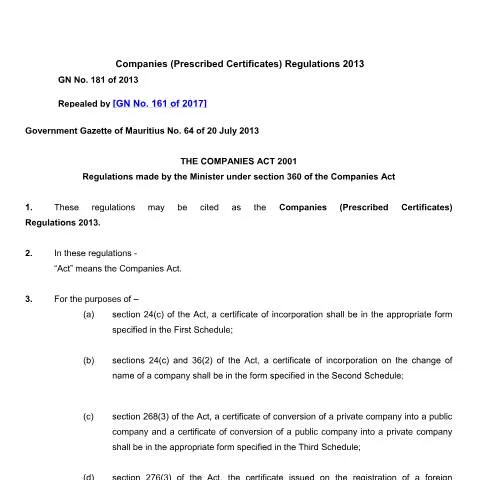
The Significance of GN. 181 of 2013 in Business Operations in Mauritius
When engaging in business activities in Mauritius, the GN. 181 of 2013 document plays a pivotal role in establishing a company's legal standing. This document outlines the regulations prescribed under the Companies Act of 2001, specifically governing the certificates necessary for company incorporation. Understanding the context and implications of this document is crucial for entrepreneurs and business owners in Mauritius.
The Legislative Background
Enacted under the Companies Act of 2001, GN. 181 of 2013 was introduced to streamline the process of company registration and ensure compliance with updated regulatory frameworks. This regulation was officially published in the Government Gazette No. 64 on July 20, 2013, aimed at replacing the previous Companies (Prescribed Forms) Regulations 2001.
The legislation emphasizes the need for formal documentation for various processes, including the incorporation, name changes, and conversions of companies, thus contributing to the enhancement of the business environment in Mauritius.
The Role of GN. 181 of 2013 in Company Registration
GN. 181 of 2013 specifically outlines the prescribed forms that must be used in the company registration process. The various forms can be categorized based on the type of incorporation, including:
- Form 1: Certificate of Incorporation for a Private Company limited by shares.
- Form 2: Certificate for a Public Company limited by shares.
- Form 3: Certificate for an unlimited Private Company.
- Form 4: Certificate for a Private Company limited by guarantee.
- Form 5: Certificate for a Public Company limited by guarantee.
- Form 6: Certificate for a Private Company limited by both shares and guarantee.
- Form 7: Certificate for both types of companies.
This structure ensures that prospective business owners have clear guidelines on the documentation required for their specific business structure, thus minimizing confusion and expediting the registration process.
Completing the Prescribed Forms: A Detailed Approach
Filling out the forms prescribed by GN. 181 of 2013 requires careful attention to detail. Each form has specific fields that must be accurately completed to avoid delays in processing.
Essential Information Required
Each form typically requires the following:
- Company Name: The proposed name of the company must be unique and comply with naming regulations.
- Details of Directors: Information regarding the directors, including their names, addresses, nationalities, and identification numbers.
- Share Capital: The amount of share capital, along with the types of shares that will be issued.
- Registered Address: The physical address where the company will be registered and where official correspondence will be sent.
Completing these fields accurately is fundamental for a smooth registration process, as errors may lead to complications or outright rejection of the application.
The Sequence of Submission
Once the forms are duly filled, they must be submitted to the Registrar of Companies in Mauritius. This submission can be done in person at the Registrar's office or electronically through the MauPass platform. It is vital to ensure all required documentation is attached, as incomplete submissions will result in processing delays.
After submission, applicants receive a confirmation of receipt, which is crucial for tracking the progress of their application.
Potential Challenges: Addressing Refusals or Incomplete Submissions
In some cases, applications may face refusals due to various reasons, including:
- Inaccurate information provided.
- Failure to meet legal naming conventions.
- Inadequate documentation.
Understanding these possibilities prepares applicants to proactively address any issues that may arise. If an application is refused, the Registrar typically provides a detailed explanation, allowing the applicant to rectify the issues before re-submission.
What to Do in Case of Missing Documents
Should any documents be missing from the initial submission, the Registrar will notify the applicant. In such cases, it is essential to respond promptly:
- Gather the required documents as specified in the notification.
- Provide any clarifications or additional information that may have been requested.
- Resubmit the application with the missing documents attached.
Timely action can significantly reduce the risk of further delays and facilitate a smoother registration process.
Timeframes and Next Steps Following Submission
After submitting GN. 181 of 2013 forms, the response time can vary depending on the Registrar's workload and the completeness of the application. Typically, businesses can expect a turnaround period of several weeks.
Key Milestones to Anticipate
| Milestone | Expected Timeframe |
|---|---|
| Initial Submission Acknowledgment | 1-3 days |
| Review of Application | 2-4 weeks |
| Issuance of Certificate of Incorporation | 4-6 weeks (if approved) |
Post submission, applicants may begin preparing for the next stages of business operations, such as opening a bank account and acquiring necessary licenses.
The Broader Context: GN. 181 of 2013 and Business Ecosystem
GN. 181 of 2013 fits into a larger framework of regulations and policies aimed at fostering a vibrant business environment in Mauritius. The emphasis on formal documentation not only ensures compliance but also enhances the credibility of businesses operating within the country.
Moreover, the introduction of digital platforms for submission reflects a significant advancement in public service delivery, aligning with global best practices and encouraging more entrepreneurs to formalize their business activities.
Future Perspectives for Business Owners
As regulatory landscapes evolve, staying informed about changes to forms and regulations like GN. 181 of 2013 is crucial for business owners. Engaging with local business associations or consulting with professionals who specialize in business law can provide valuable insights into navigating these challenges.
Fill in your form directly online
No printing: type your details into the boxes of the official form, tick, then download the PDF ready to send.
- 1Type into the form boxes
- 2Tick in one click
- 3Save and download the PDF
Practical Tips for Successful Registration
To streamline the registration process and ensure compliance with GN. 181 of 2013, consider the following practical tips:
- Conduct Thorough Research: Understand the requirements for your specific business structure before filling out the forms.
- Double-Check All Entries: Verify that all information is accurate and meets legal standards.
- Stay Updated on Regulations: Regularly check for any amendments or updates to the Companies Act and associated regulations.
- Seek Professional Guidance: If in doubt, consult with a legal or business professional to ensure compliance and accuracy.
By adhering to these guidelines, entrepreneurs can effectively navigate the complexities of business registration and focus on establishing a successful enterprise in Mauritius.
Understanding GN. 181 of 2013 Regulations
The GN. 181 of 2013 regulation in Mauritius is a significant legislative framework that governs various administrative processes. It was established to streamline public service recruitment and applications, ensuring transparency and efficiency within the system. At its core, this regulation outlines the specific procedures that candidates must adhere to when applying for public service positions. The regulation is aimed at reinforcing meritocracy in recruitment, a principle that is critical for fostering a competent and trustworthy civil service. Understanding the intricacies of these regulations can provide valuable insights for applicants navigating the public service landscape in Mauritius.
Key Compliance Requirements for Candidates
For candidates intending to apply under GN. 181 of 2013, it is essential to be aware of the critical compliance requirements laid out by the Public Service Commission (PSC). These requirements often include the submission of specific documentation along with the application form (PSC Form 7). Typical documents may include certified copies of educational qualifications, employment records, and national identity cards. It is crucial that all documents are current and reflect the applicant's qualifications accurately. Additionally, candidates must adhere to defined timelines for submission; failure to comply may lead to disqualification. Moreover, candidates need to maintain a high level of integrity throughout the recruitment process, as any discrepancies can lead to severe repercussions, including a ban from future applications.
The Role of E-Services in GN. 181 of 2013
With the implementation of GN. 181 of 2013, there has been a significant push towards e-services, reflecting the government's commitment to modernizing public administration. The use of digital platforms, particularly the services offered through govmu.org, allows candidates to submit applications online, track their application status, and receive notifications regarding their recruitment process. This not only enhances efficiency but also reduces the administrative burden on both applicants and the PSC. The integration of e-services is particularly beneficial for candidates residing in remote areas, as it provides equal access to public service opportunities regardless of geographic location. Furthermore, the e-filing system is linked with the National ID Card, which simplifies the verification process, ensuring that each candidate’s identity and eligibility can be confirmed swiftly and securely.
Impact of GN. 181 of 2013 on Local Government Services
While GN. 181 of 2013 primarily addresses the recruitment process for public service, its implications extend to local government services as well. The Local Government Service Commission (LGSC) has aligned its recruitment strategies with the principles established under this regulation, thereby promoting a cohesive approach to public sector employment across various tiers of governance. This alignment facilitates a unified standard of recruitment, where local authorities are encouraged to adopt similar transparency and merit-based hiring practices. Applicants seeking positions within local government entities, such as municipalities and district councils, should familiarize themselves with both the PSC and LGSC regulations to ensure compliance and enhance their chances of successful employment. The harmonization of these processes also promotes inter-departmental cooperation, which can lead to improved service delivery for citizens.
Common Challenges Faced by Applicants
Despite the structured framework provided by GN. 181 of 2013, applicants often face several challenges throughout the recruitment process. One prevalent issue is the overwhelming complexity of required documentation; many candidates struggle to understand the specific documents needed or how to obtain certified copies of their qualifications. Additionally, applicants may encounter difficulties in adhering to deadlines, particularly if they are simultaneously juggling employment or education commitments. Another common challenge is the perception of bias or favoritism during the recruitment process, which can discourage potential applicants from applying. To mitigate these concerns, it is advisable for candidates to prepare well in advance by familiarizing themselves with the application process, seeking assistance from eligible contacts, and ensuring they have all documentation in order ahead of deadlines.
The Future of Public Service Recruitment in Mauritius
Looking ahead, the landscape of public service recruitment in Mauritius is likely to evolve significantly. As the government continues to embrace digital transformation, more sophisticated e-recruitment systems may be introduced, potentially enhancing user experience and streamlining the hiring process further. Additionally, as Mauritius aims to position itself as a regional hub for excellence in governance, there will likely be a renewed focus on merit-based recruitment practices, aiming to attract top talent to the public sector. Continuous training and development opportunities for public service employees, as mandated by GN. 181 of 2013, will also play a pivotal role in this evolution, ensuring that civil servants are equipped with the necessary skills and competencies to serve the public effectively.