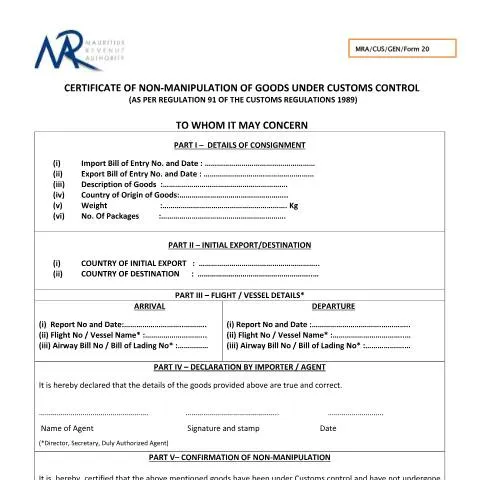
Understanding the Certificate of Non-Manipulation of Goods Under Customs Control
The Certificate of Non-Manipulation of Goods Under Customs Control, referenced as MRACUS-GEN-Form20, plays a crucial role in the realm of international trade and customs operations within Mauritius. Issued by the Customs Department, this certificate affirms that specific goods have remained under customs control and have not been manipulated or processed while in Mauritius. This documentation is not merely procedural but serves as a legal safeguard for both importers and exporters, ensuring compliance with the Customs Regulations of 1989.
The Procedural Journey: How to Obtain Your Certificate
Acquiring this certificate involves a meticulous procedure aimed at verifying the condition and status of goods. Here’s a step-by-step breakdown of the process:
- Preparation of Required Documents: Gather all necessary documentation related to the shipment, including:
- Import and/or export bills of entry
- Details of the goods, including descriptions and quantities
- Shipping documents such as airway bills or bills of lading
- Submission at Customs: Present the collected documents at the Customs Department located at Custom House, Mer Rouge, Port Louis. It's advisable to have all information complete and legible to avoid delays.
- Customs Verification: A customs officer will review the documents to ensure compliance with local regulations. This may involve verifying the details against the customs declaration submitted at the time of import or export.
- Issuance of Certificate: Once verification is complete, the customs officer will issue the Certificate of Non-Manipulation, signing and stamping the document to validate it.
It is wise to allow sufficient time for this process, especially during peak customs activity periods. The entire procedure could take anywhere from several hours to a couple of business days, depending on the volume of requests being processed.
Eligibility Criteria for Obtaining the Certificate
While the certificate can be applied for by various stakeholders in the shipping and logistics sectors, specific conditions must be met:
- Importers and Exporters: Only registered and compliant importers or exporters may apply for this certificate. Compliance includes up-to-date tax obligations and adherence to customs regulations.
- Authorized Agents: Individuals or entities duly authorized to act on behalf of the importer or exporter can also submit an application. They must carry proper authorization documentation.
- Goods Under Customs Control: The goods in question must have been under customs control throughout their time in Mauritius without any alterations, handling, or processing.
The customs authorities may require additional documentation to substantiate claims of non-manipulation based on the nature and history of the goods involved.
Legal Standing: What the Certificate Confirms
This certificate stands as a vital legal document affirming that the goods specified have not undergone any form of manipulation while under customs supervision. It serves several important functions:
- Legal Assurance: The certificate provides a legal assurance to all parties involved that the goods have retained their original condition. This minimizes the risk of disputes arising from the claim of manipulated or altered goods.
- Facilitates Trade: In international trade transactions, having a Certificate of Non-Manipulation can expedite customs clearance processes in both exporting and importing countries.
- Compliance Evidence: It acts as evidence of compliance with Mauritian customs regulations and may be required by authorities in destination countries.
As per Regulation 91 of the Customs Regulations 1989, this certificate is essential for maintaining the integrity of trade and customs operations.
Lost or Damaged Certificate: Steps to Rectify
In the unfortunate event that a Certificate of Non-Manipulation is lost, damaged, or contains errors, it is crucial to act promptly. The following steps guide you through rectifying such situations:
- Report the Loss or Damage: Notify the Customs Department immediately that the certificate has been lost or damaged. This can typically be done through a formal letter or email.
- Provide Documentation: You may be required to provide copies of the original certificate (if available) and any supporting documentation that confirms the issuance of the certificate.
- Request a Reissue: Formally request the reissuance of the certificate by submitting a written application to the Customs Department. Ensure to include all relevant details regarding the goods and original transaction.
- Await Processing: Allow time for the customs officials to process the request for reissuing the certificate. They may contact you for additional information if necessary.
In cases of errors where incorrect information was noted on the original certificate, similar steps can be followed, with specific emphasis on highlighting the corrections needed. Ensure that all communication is clear and documented for reference.
Understanding the Validity Period and Renewal Process
The Certificate of Non-Manipulation does not have an explicit expiry date; however, its practical validity correlates with the associated shipment and customs clearance timelines. Here’s what you need to know about its duration and potential renewal:
- Validity Context: The certificate is typically valid for the duration of the customs clearance process associated with the specified goods. Once the goods have been cleared and delivered, the certificate serves its purpose and is no longer needed.
- Handling Subsequent Shipments: For future shipments requiring similar documentation, a new certificate must be obtained. The customs authority does not provide renewals for certificates once the transaction is complete.
- Retention of Records: It is advisable for both importers and exporters to retain copies of all such certificates for a minimum of five years for auditing and compliance purposes.
Thus, while renewal is not applicable, staying proactive about obtaining fresh certificates for each transaction is essential.
Real-world Applications: Who Requires This Certificate?
The Certificate of Non-Manipulation finds its necessity across various sectors and scenarios, particularly where compliance with customs regulations is paramount. Here are some instances where this certificate might be required:
- International Trade Transactions: Exporters shipping goods to foreign countries often need this certificate to satisfy the import regulations of the destination countries.
- Free Trade Agreements: In cases where Mauritius is involved in free trade agreements, such documentation helps alleviate tariffs and quotas.
- Customs Audits: Businesses undergoing customs audits may be asked to produce the Certificate of Non-Manipulation to demonstrate compliance with customs laws.
- Marine Insurance Claims: In the unfortunate event of damages occurring during transit, this certificate can serve as part of the documentation needed for insurance claims, proving the original condition of the goods.
Organizations and individuals must understand when and where this certificate is applicable, ensuring that all necessary documentation is prepared in advance to avoid delays in their operations.
Final Thoughts: Navigating the Customs Landscape
Obtaining and utilizing the Certificate of Non-Manipulation of Goods Under Customs Control is an essential component of conducting business in Mauritius, particularly for those engaged in international trade. As the landscape of customs regulations continues to evolve, staying informed about the processes and requirements is paramount for compliance and smooth operational execution.
By understanding the nuances of this certificate, stakeholders can better navigate the complexities of customs control, thereby enhancing their ability to operate effectively within both local and international markets.
Contact Information for Further Inquiries
For any additional questions or clarifications regarding the Certificate of Non-Manipulation, individuals and organizations may reach out directly to the Customs Department:
Fill in your form directly online
No printing: type your details into the boxes of the official form, tick, then download the PDF ready to send.
- 1Type into the form boxes
- 2Tick in one click
- 3Save and download the PDF
Customs Department Custom House, Mer Rouge, Port Louis Phone: 2020500 Fax: 2167784 Email: [email protected]
Understanding the Certificate of Non-Manipulation: Purpose and Importance
The Certificate of Non-Manipulation of Goods under Customs Control serves as a crucial document in the realm of international trade and customs regulations in Mauritius. This certificate is primarily needed when goods are imported into the country and are subject to customs control. It ensures that the goods have not been altered, tampered with, or manipulated in any way while under the supervision of customs authorities.
Having this certificate is essential for businesses engaged in the importation of goods, as it provides assurance to both the customs authorities and the buyers that the items are in their original state, thus preserving their integrity and value. For instance, failure to obtain this certificate could lead to significant delays in the release of goods, potential fines, or even seizure of the items, which could have detrimental effects on business operations.
The certificate is particularly relevant for sectors such as pharmaceuticals, electronics, and perishable goods, where the authenticity and condition of the products are paramount. Additionally, it plays a significant role in facilitating smoother customs clearance processes and enhances the credibility of the importing entity. Therefore, understanding its importance is vital for anyone involved in the importation process in Mauritius.
Application Process: Step-by-Step Guide
Applying for a Certificate of Non-Manipulation involves a systematic approach to ensure compliance with the regulations established by the Mauritius Revenue Authority (MRA). Below is a detailed guide on the steps you should follow to successfully obtain this certificate.
- Preparation of Required Documentation: Before initiating the application, gather all necessary documents, including the commercial invoice, bill of lading, and any other relevant shipping documentation. Ensure that these documents are accurate and up-to-date.
- Filling Out the Application Form: Visit the MRA website or relevant authority to obtain the appropriate application form. For Certificate of Non-Manipulation, the application is typically filed using MRA Form C1. Fill it out carefully, ensuring that all details are correctly entered.
- Submission of the Application: Once you have completed the form and compiled the required documents, submit the application through the MRA’s e-filing system. Ensure that you adhere to the submission deadlines to avoid any delays.
- Payment of Fees: Depending on the specifics of the application, you may be required to pay a processing fee. This fee supports the administrative costs of processing your certificate.
- Awaiting Approval: After submission, the MRA will review your application. This may involve inspections or requests for additional information. Be prepared to provide clarification if needed.
- Receiving the Certificate: Upon approval, you will receive the Certificate of Non-Manipulation. Ensure that you keep this certificate safely, as it will be required for customs clearance and any future dealings related to the imported goods.
Common Challenges and Solutions in Obtaining the Certificate
While the process of obtaining a Certificate of Non-Manipulation is generally straightforward, applicants may encounter several challenges. Here, we discuss some common issues and provide practical solutions to streamline the application process.
- Incomplete Documentation: One of the primary reasons for delays in processing applications is the submission of incomplete or inaccurate documentation. To mitigate this risk, create a checklist of all required documents before submission, and cross-verify each document against the MRA's requirements.
- Technical Issues with E-Filing: Given the MRA's push for digital services, applicants may face technical glitches when filing online. Ensure you have reliable internet access and consider filing during off-peak hours. Additionally, keep copies of all documents submitted electronically in case a technical issue necessitates resubmission.
- Inspection Delays: Sometimes, the MRA may require a physical inspection of the goods before issuing the certificate, which can lead to unexpected delays. To avoid this, maintain open communication with customs officials and proactively provide any requested information or access to the goods.
- Misunderstanding of Requirements: Applicants may not fully understand the specific requirements for the Certificate of Non-Manipulation. It is advisable to consult with customs brokers or legal advisors who specialize in trade compliance to clarify any uncertainties before submission.
By being aware of these potential challenges and proactively addressing them, applicants can enhance their likelihood of a smooth and efficient certification experience.