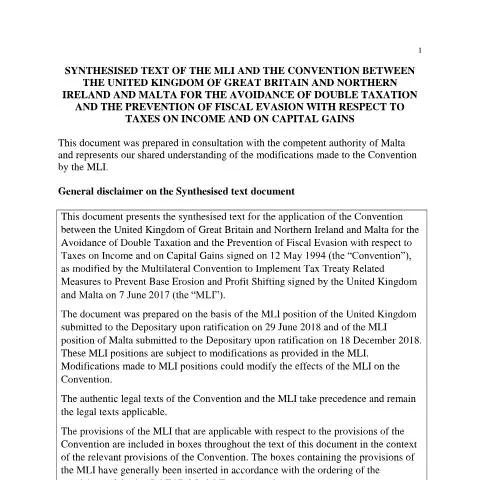
Navigating the Overseas Pensions Double Taxation Agreements Form: Insights and Guidance
In the realm of international taxation, the Overseas Pensions Double Taxation Agreements (DTA) form, specifically the malta---uk-dta-(synthesised-text) document, plays a critical role for individuals holding pensions from the United Kingdom while residing in Malta. Understanding the nuances of this form is vital for ensuring compliance and maximizing tax efficiency. This article delves into the intricacies of this specific form, detailing its requirements, the process of completion and submission, as well as the implications for taxpayers.
Understanding the Framework: The Role of Double Taxation Agreements
The primary purpose of Double Taxation Agreements is to prevent individuals from being taxed twice on the same income. Malta, in its strategic tax policies, has established such agreements with numerous countries, including the UK. This framework is essential for individuals receiving pensions from the UK while living in Malta, as it clarifies their tax obligations. The DTA aims to allocate taxing rights between Malta and the UK, thus providing clarity on the taxation of pensions.
Within the context of the malta---uk-dta-(synthesised-text), pension income may be taxed in either country, depending on the specific provisions outlined in the agreement. Individuals must familiarize themselves with these provisions to effectively manage their tax liabilities.
The Historical Context: Evolution of Malta’s Taxation Agreements
Malta's approach to international taxation has evolved significantly since joining the European Union in 2004. Recognizing the importance of attracting foreign investment and individuals, the Maltese government has progressively entered into various double taxation agreements. The agreement with the UK, in particular, was established to provide assurances to pensioners that their income would not be subject to undue taxation in both jurisdictions.
Historically, the establishment of the DTA has encouraged British retirees to move to Malta, drawn by the island's favorable climate and lifestyle, without the fear of excessive tax burdens. Understanding this historical backdrop provides greater insight into the significance of the malta---uk-dta-(synthesised-text) form.
Who Needs to Complete the Form? A Closer Look at Eligible Taxpayers
The malta---uk-dta-(synthesised-text) form is primarily intended for individuals who receive a pension from the UK and are tax residents in Malta. It caters to various profiles, including:
- Retired individuals receiving state pensions from the UK.
- Those with private pensions from UK-based schemes.
- Individuals who may have previously worked in the UK and are now receiving pensions.
However, it is crucial to note that certain conditions and exceptions apply. For example, if a resident does not meet specific residency requirements or if the pension income falls under different classification based on the DTA provisions, they may not be required to submit this form. It is advisable for potential applicants to consult with a tax professional to ascertain their eligibility and requirements related to pension taxation.
Decoding the Form: Sections and Required Information
The malta---uk-dta-(synthesised-text) is structured into several sections, each requiring precise information. Completing the form accurately is essential to prevent delays and ensure compliance. Let’s break down key sections one by one:
- Personal Information: This section requires the applicant's full name, address in Malta, and details of the UK pension scheme. Ensure that the information matches official records to avoid discrepancies.
- Pension Details: Here, applicants must provide information about the type of pension received, including whether it is a state pension or private. It is important to note that the type of pension can affect tax treatment under the DTA.
- Residency Status: Applicants need to confirm their residency in Malta by providing their Maltese identity card number. This section may require supporting documents to verify residency.
- Declaration of Understanding: A declaration statement where the applicant acknowledges understanding the implications of the DTA, including the potential tax liabilities. It is critical to read this section carefully.
It is advisable to double-check each entry for accuracy and consistency to avoid delays in processing the application.
The Chronological Process: From Submission to Tax Implications
Once the malta---uk-dta-(synthesised-text) form is completed, the submission process commences. Here’s a step-by-step guide through the timeline:
- Preparation: Gather all necessary documents and information before filling out the form. This includes pension statements, proof of residency, and personal identification.
- Completion: Fill in the form with accurate details as per the previous section.
- Submission: The completed form can be submitted online through the Maltese government portal using the e-ID system. Alternatively, it can be mailed to the Corporate Tax Office.
- Processing Time: Following submission, the Corporate Tax Office will review the application. Processing times may vary, so it is wise to allow sufficient time for the authorities to respond.
- Outcome: Upon completion of the review, applicants will receive confirmation of their tax status regarding their pension income, detailing any exemptions or obligations under the DTA.
Being aware of this timeline is crucial for individuals who may have financial planning needs tied to their pension income.
Common Pitfalls: Navigating Potential Challenges
Completing the malta---uk-dta-(synthesised-text) form can be straightforward; however, certain challenges may arise, leading to potential complications if not managed properly:
- Inaccurate Information: Errors in personal or pension details can lead to rejections or delays in processing.
- Missed Deadlines: Submitting the form after the deadline may result in unfavorable tax treatment. It’s essential to stay informed about submission timelines.
- Lack of Supporting Documentation: Failing to provide necessary documents, such as proof of residency, can hinder the application process.
To navigate these challenges, consider consulting with a local tax advisor or expert who understands Maltese regulations and can offer tailored advice based on individual circumstances.
Integrating the Form into Larger Tax Obligations
The malta---uk-dta-(synthesised-text) form is not an isolated document; it is part of a broader spectrum of tax obligations that individuals must manage while living in Malta. Beyond this form, consider the following:
- Income Tax Returns: Residents must file annual income tax returns that reflect their global income, including pension income.
- Other Tax Forms: Depending on one’s financial situation, additional forms may be required for investments or other income sources.
- Compliance with Local Laws: Understanding Malta's tax laws and regulations is essential for maintaining compliance and avoiding penalties.
Recognizing how the malta---uk-dta-(synthesised-text) fits into this broader context is crucial for a comprehensive approach to tax compliance.
Final Thoughts: Importance of Seeking Professional Guidance
Engaging with the malta---uk-dta-(synthesised-text) form and related tax obligations can seem daunting, especially given the complexities of international taxation. Seeking professional guidance is highly recommended for individuals navigating these waters. Tax professionals specializing in cross-border taxation can offer valuable insights, ensuring compliance while optimizing tax liabilities.
Whether you are a retired individual planning your financial future in Malta or navigating the complexities of international pensions, understanding the implications of the DTA and the associated forms is crucial. Armed with the right knowledge and support, taxpayers can effectively manage their obligations and enjoy the benefits that come with their financial arrangements.
Understanding the Double Taxation Agreements (DTAs)
The Double Taxation Agreements (DTAs) play a critical role in preventing individuals and businesses from being taxed twice on the same income in two different jurisdictions. For individuals receiving pensions from overseas, particularly from the United Kingdom, understanding how these agreements function is vital to ensuring compliance and optimizing tax liabilities. The DTA between Malta and the UK facilitates this by delineating which taxes are applicable in which jurisdiction, effectively creating a framework within which pensions can be received without the burden of double taxation.
One of the key elements of the Malta-UK DTA is the concept of 'resident' status, which determines which country has the primary right to tax certain types of income. For example, if a pensioner is considered a resident of Malta under the DTA criteria, they may only be liable for taxation in Malta for their pension income. It is crucial for individuals to establish their residency status through the appropriate filings, which can have implications for their overall tax obligations.
Additionally, the DTA outlines specific exemptions and tax rates that apply to pension income. In many cases, pension income may be taxed at a reduced rate or exempted altogether, depending on the specific provisions of the DTA. Therefore, it is advisable for pensioners to consult with tax professionals who have expertise in cross-border taxation to ensure compliance and to take advantage of any favorable tax treatment available under the DTA.
Navigating Residency and Tax Residency Certificates
To benefit from the DTA provisions, it is essential for pensioners to understand how residency is defined under Maltese tax law. Residency can be determined based on the number of days spent in Malta, as well as the individual's permanent home location and personal ties to the country. Pensioners coming from the UK might find themselves navigating complex residency rules, especially if they maintain ties in the UK while living in Malta.
To formalize their tax residency status, individuals can apply for a Tax Residency Certificate from the Maltese tax authorities. This certificate serves as proof of residency and is often required for tax purposes both in Malta and with foreign tax authorities. Obtaining this certificate involves submitting Form T (Tax Residency Certificate application), where the individual must provide necessary documentation, such as proof of residence and evidence of income. This process is crucial for ensuring that individuals can claim the benefits of the DTA effectively.
It is also important to note that the criteria for maintaining residency status may vary over time, especially in the context of changes in personal circumstances, such as changes in marital status or the acquisition of property. Therefore, periodic reassessment of residency status is recommended for overseas pensioners living in Malta to ensure ongoing compliance and optimal tax treatment.
Implications of Non-Compliance with DTA Provisions
Non-compliance with the terms outlined in the Malta-UK DTA can have significant financial implications for pensioners. If tax authorities in either jurisdiction determine that an individual has not adhered to the residency definitions or has not properly declared their pension income, this could result in penalties, back taxes, and interest charges. Therefore, understanding the nuances of the DTA and adhering to its provisions is paramount for anyone receiving pensions from the UK while residing in Malta.
Pensioners should maintain accurate records of their income and any taxes paid in both jurisdictions. This documentation will be essential if the individual needs to justify their tax position or if there are discrepancies regarding the amount of tax owed. Furthermore, individuals may be subject to tax audits from either the Maltese authorities or HM Revenue and Customs (HMRC) in the UK, making it crucial to stay informed and compliant with regulations in both countries.
It is recommended to seek regular advice from tax consultants who specialize in international tax matters. They can provide guidance on best practices for compliance, potential changes in tax legislation affecting DTAs, and methods to mitigate tax liabilities while remaining compliant with both Maltese and UK tax laws.