Navigating the 2023 Income Tax Update Form: A Practical Guide for Residents
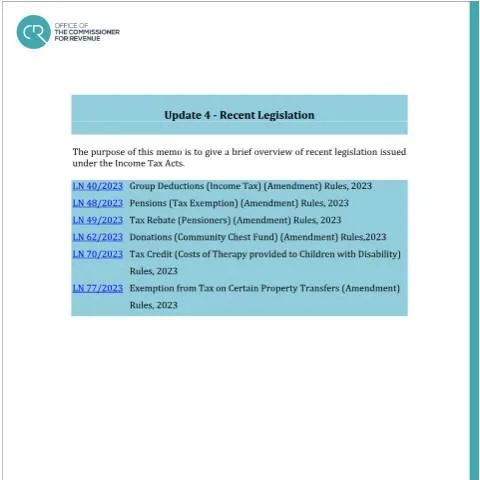
Submitting your income tax can be a daunting task, especially with the annual updates and changes that come into play. The 2023 — update-4---april-2023.pdf form, released by the Income Tax Department, has updates that are critical for residents and business owners alike. Understanding its specific role in your tax obligations and how to navigate it effectively can make a significant difference in your financial planning.
Diving Deep into the Form's Structure
Before you start filling out the form, it's essential to grasp its layout and the specific sections involved. Each part of the form caters to different aspects of your tax liabilities and eligibility. Here’s a breakdown of the essential sections:
Section 1: Personal Information
- Name and Surname: Ensure that these match exactly with your Maltese ID card, as discrepancies can lead to delays.
- ID Number: Enter your 7-digit ID followed by the letter, which is crucial for identification purposes.
Section 2: Income Details
This section is vital for declaring all your income sources. Inputting incorrect figures or omitting sources can lead to serious repercussions.
- Employment Income: Be precise; reference your payslips for accurate amounts.
- Rental Income: If applicable, provide detailed information regarding the properties.
Section 3: Deductions and Allowances
Claiming the correct deductions is fundamental. Familiarize yourself with what qualifies as deductible and ensure you have the necessary documentation for verification.
- Medical Expenses: Keep receipts organized to support your claims.
- Charitable Donations: Specify the organizations, as only registered charities are accepted.
Who is Responsible for Submission?
Understanding who needs to submit the form clarifies potential obligations. The 2023 — update-4---april-2023.pdf is primarily directed at:
- Individuals with taxable income exceeding the stipulated threshold.
- Business owners who need to report their financials.
In some cases, specific entities or individuals might be mandated by law to disclose any significant changes in income, which is vital for compliance.
Channels for Submission: Online vs. Paper vs. In-Person
When it comes to submitting the form, knowing your options is crucial. Here’s a comparative overview of the different channels available:
| Submission Method | Advantages | Disadvantages |
|---|---|---|
| Online | Fast processing, direct confirmation, less paperwork. | Requires e-ID setup, potential tech issues. |
| Paper | Traditional method, suitable for those uncomfortable with tech. | Longer processing times, risk of postal delays. |
| In-Person | Immediate assistance, can clarify doubts on the spot. | Time-consuming, possible queues at service centers. |
A Step-by-Step Journey Through the Submission Process
Once you have filled out the 2023 — update-4---april-2023.pdf, the journey doesn’t end there. Here’s the chronological flow of actions post-submission:
- Review and Finalize: Double-check all entries to ensure accuracy. Mistakes can lead to audits or incorrect tax calculations.
- Submission: Choose your preferred method from the channels discussed.
- Confirmation: If submitted online, expect an immediate confirmation. For paper submissions, keep a copy for your records.
- Assessment: The tax department will process your form, which typically takes a few weeks. You may receive notifications for any additional information required.
- Outcome Notification: Depending on the assessment, you will either receive a tax refund or a notification of the tax owed.
After Submission: What If Things Go Wrong?
Errors can happen, and it's crucial to know the recourse available to you. If your form is rejected or if there are discrepancies, here are steps to take:
- Review the Notification: Understand the reason for rejection—this is often provided in the notification.
- Correction: If you need to amend your submission, do so promptly. Use the correction forms provided by the Income Tax Department.
- Contact Support: Utilize the helpdesk to clarify confusion or seek additional guidance.
In some cases, you may appeal the decision if you believe the rejection was unwarranted, following the procedures outlined by the Income Tax Department.
Key Dates and Deadlines: Planning Ahead
Timeliness is crucial in tax matters. The 2023 — update-4---april-2023.pdf has specific deadlines you must adhere to:
- Submission Start Date: Typically, the submission window opens in early April.
- Submission Deadline: Ensure your form is submitted before the specified closing date, usually by the end of June.
- Assessment Period: Expect notifications regarding your tax status within a few weeks after submission.
Missing these deadlines can lead to penalties and interest on owed taxes, complicating your financial situation further.
Conclusion: Mastering Your Income Tax Obligations
Completing the 2023 — update-4---april-2023.pdf is more than just a bureaucratic task; it's a crucial aspect of your financial responsibility. By understanding the nuances of this form and adhering to the necessary protocols, you can navigate your tax obligations with greater confidence. Remember to stay informed about any changes that may arise and consider consulting a tax professional if your situation is complex. This proactive approach can pave the way for smoother tax seasons in the future.
Understanding Changes to the Citizenship by Investment Programme
As of 2023, significant modifications have been implemented in Malta's Citizenship by Investment Programme, also known as the Individual Investor Programme (IIP). The changes have been tailored to enhance the integrity of the process and ensure that investments are made in a manner that benefits both the economy and society. These revisions include stricter due diligence checks, increased investment requirements, and a more extensive vetting process for applicants.
One of the critical changes is the introduction of a new minimum contribution threshold to the National Development and Social Fund, which aims to bolster social and community projects within Malta. Applicants must now contribute a minimum of €600,000 for the application process and an additional €50,000 for each dependent included in the application. This increase is aimed at ensuring that only serious investors with a genuine commitment to contributing to Maltese society can obtain citizenship.
Moreover, the timeline for processing applications has been extended. Prior to these changes, many applications could be completed within six months; however, with the increased scrutiny, applicants should now anticipate a processing time of up to 12 months. It is crucial for prospective applicants to prepare for this revised timeframe and ensure that all required documentation is in order to avoid unnecessary delays.
Furthermore, the revised programme no longer allows applicants to make a one-time payment to expedite the process. Each application will need to undergo a comprehensive review, including background checks, interviews, and assessments of the applicant's financial status and sources of wealth. To facilitate this, the Maltese government has established a dedicated unit within the Identity Malta Agency to handle these applications more effectively.
Revisions in Taxation Policies for Expatriates
With the changing global economy and Malta's position as a financial hub, the Maltese government has revised several taxation policies that directly affect expatriates living and working in Malta. These changes are designed to enhance transparency, compliance, and alignment with international tax standards.
One major adjustment is the introduction of a new tax residence status for individuals arriving in Malta. Under this new regime, expatriates can apply for a tax residence certificate if they spend more than 183 days in Malta within a calendar year. This certificate is essential as it governs how their global income is taxed. It is critical for expatriates to understand that Malta operates on a territorial basis for taxation, meaning that individuals are only taxed on income generated within the country.
Additionally, the government has implemented a new tax incentive aimed at attracting highly skilled professionals. Under this incentive, qualified expatriates may benefit from a reduced tax rate of 15% on income derived from foreign sources for a limited number of years. This incentive not only improves Malta's attractiveness as a destination for skilled labor but also aims to stimulate sectors such as technology, finance, and digital innovation.
Expatriates should also be aware of the implications of double taxation agreements (DTAs) that Malta has signed with various countries. These agreements are in place to prevent individuals from being taxed on the same income in multiple jurisdictions. It is advisable for expatriates to consult with a local tax expert or legal advisor to navigate these complexities and ensure compliance with both local and international tax regulations.
Digital Transformation of Public Services
In 2023, Malta witnessed a significant push towards the digital transformation of public services, driven by the government's commitment to enhancing efficiency, accessibility, and transparency. This transformation is encapsulated in the e-Government Strategy, which aims to digitize various public services and streamline interactions between citizens and the state.
One of the landmark developments in this digital transition is the introduction of an integrated e-ID system, which allows citizens to access a plethora of governmental services online. From applying for building permits to submitting tax returns, the e-ID serves as a centralized authentication method, ensuring secure and seamless access. Citizens are encouraged to register for an e-ID through the [Identity Malta Agency](https://identitymalta.com), which provides a user-friendly interface for managing personal information and accessing a range of digital services.
Moreover, the government has launched a series of e-forms accessible via the servizz.gov.mt portal. This online platform centralizes the submission of various administrative requests, such as renewing documents, applying for social benefits, and more. By reducing the need for in-person visits to government offices, the initiative has not only improved service delivery but has also minimized waiting times and administrative burdens.
In addition, Malta has committed to enhancing cybersecurity measures to protect sensitive personal data as part of this digital transformation. The implementation of robust cybersecurity frameworks ensures that the migration of public services online does not compromise citizens' privacy and data security. Citizens are advised to remain vigilant about their online presence and familiarize themselves with security best practices when accessing government services.