Understanding the Advance Personal Income Tax (APIT) Statement Submission
Submitting the Advance Personal Income Tax (APIT) Statement through e-Service in Sri Lanka is not merely a formal requirement but an essential process for employers, both corporate and individual, registered under the Pay As You Earn (PAYE) system. This guideline meticulously outlines the steps to undertake this process effectively and efficiently, ensuring compliance with the Inland Revenue Department (IRD) regulations.
The Importance of APIT in Employer-Employee Dynamics
Employers play a pivotal role in the APIT system, acting as intermediaries between employees and the government. By correctly submitting APIT statements, employers ensure that the appropriate taxes are withheld from employee salaries, thus safeguarding both the employer's compliance and the employee's legal obligations. Missteps in this area can lead to severe penalties, interest on unpaid taxes, or even legal repercussions.
Navigating the e-Service Portal: A Stepwise Approach
The journey begins at the IRD’s official website. Accessing the e-Service portal might seem daunting at first, but with a clear understanding of the steps involved, the process becomes manageable.
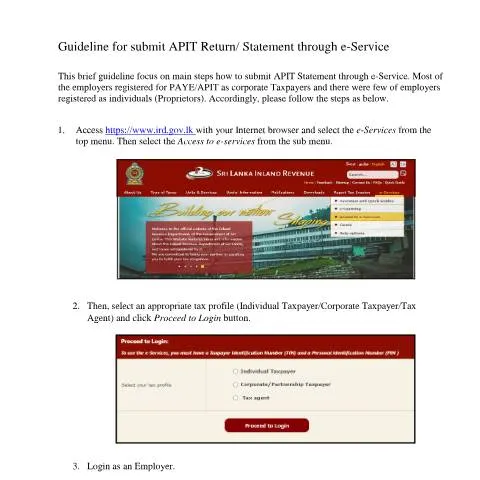
- Accessing the e-Service Portal: Visit https://www.ird.gov.lk using a compatible internet browser. Navigate to the top menu and select e-Services, followed by Access to e-services from the submenu.
- Selecting the Correct Tax Profile: Upon accessing the portal, you must choose the appropriate tax profile: Individual Taxpayer, Corporate Taxpayer, or Tax Agent. Proceed by clicking the Proceed to Login button.
-
Logging In:
- If you are an Individual Taxpayer, input your Tax Identification Number (TIN) and IRD PIN. In case you do not possess a PIN, refer to the guide on obtaining one.
- For Corporate Taxpayers, enter the SSID authorized for APIT alongside the associated IRD PIN. If you lack an authorized SSID, follow the guidelines for creating one.
- For Tax Agents, the requirements are similar to corporate taxpayers, necessitating the SSID and its IRD PIN.
- Accessing the APIT Submission Page: After logging in, the homepage will display comprehensive information. Select the Pay As You Earn (PAYE) / Advance Personal Income Tax (APIT) submenu from the Return / Schedule Management section.
- Selecting Assessment Year: Here, you will choose the year of assessment pertinent to your submission and click the Proceed button.
Detailed Insights into Filling the APIT Statement
Completing the APIT Statement requires attention to detail in both the annual and the monthly summaries. The structure of the submission is vital for accuracy and compliance.
Mandatory Sections: Annual and Monthly Information
The APIT Statement comprises two main parts that must be filled:
- PART I - Annual Information Summary: This section encapsulates the overall income and tax information for the financial year.
- PART II - Monthly Information Summary: This is essential for providing detailed monthly earnings and deductions.
Additionally, it is crucial to update or upload any applicable schedules alongside these parts, which can include:
- Schedule 01: For tax deducted employees under primary and secondary employment.
- Schedule 02: For once-and-for-all payments made to employees.
- Schedule 03: Additional relevant schedules as necessary.
Critical Considerations When Filling Out the APIT Statement
Filling out the APIT Statement is a meticulous task that requires adherence to specific rules to ensure that all information is correctly captured and submitted.
Understanding the Matching Rules
It is imperative to recognize the matching rules that govern how the submitted information across different parts and schedules must correlate. Non-compliance with these rules can lead to discrepancies and potential audits by the IRD. Here’s a breakdown of the key matching rules:
| Part | Matching Requirement |
|---|---|
| PART I with PART II | Ensure that the total annual figures match the monthly declarations. |
| PART I with Schedule 01 | If no employees are reported under Schedule 01, enter zero values in the summary fields. |
| PART I with Schedule 02 | Similar to Schedule 01, submit zero values where applicable. |
Best Practices for Accurate Submission
To minimize the chances of errors during the submission of your APIT Statement, consider implementing the following best practices:
- Verify All Information: Always cross-check employee data, including names, TINs, and associated deductions.
- Utilize Digital Tools: Make use of e-service capabilities for real-time data checks and validations.
- Documentation: Maintain thorough documentation of all submitted schedules and summaries, which can aid in future audits.
- Stay Updated: Regularly review the IRD circulars and announcements to remain informed about any changes in tax regulations or submission processes.
Recognizing the Limitations of the APIT Statement Guide
While this guideline provides a comprehensive overview of the submission process, it is essential to recognize its limitations. The APIT statement submission is subject to ongoing changes, especially concerning tax laws and e-service functionalities. Always consult the relevant sections of the IRD's website or seek professional advice when in doubt.
Further Steps After Submission
After completing your APIT Statement submission, it is prudent to follow these steps:
- Ensure you receive a confirmation of submission from the IRD.
- Review the uploaded documents to confirm that they reflect the correct information.
- Be prepared for follow-up communications from the IRD if they require further clarification or additional information.
Preparing for Potential Challenges
Employers may face various challenges during the submission of the APIT Statement, such as technical issues with the e-Service portal or discrepancies in employee data. It is advisable to:
- Have Backup Plans: If technical difficulties arise, keep a backup of the documents and data to ensure a timely resubmission.
- Seek Guidance: Contact the IRD’s helpline or consult a tax professional for assistance with complex situations.
Final Thoughts on the APIT Statement Submission
Mastering the submission of the Advance Personal Income Tax Statement is an ongoing commitment for employers within Sri Lanka’s tax framework. By adhering to the detailed guidelines provided, you can ensure a smooth submission process that aligns with legal requirements while fostering a transparent relationship with your employees and the government. Continuous learning and adaptation to the evolving tax landscape will empower employers to navigate their APIT responsibilities effectively.
Understanding APIT Statements and Their Importance
In Sri Lanka, the APIT (Annual Personal Income Tax) Statement is a crucial document that serves as a summary of an individual's income, deductions, and the tax calculated for the financial year. This statement is vital for an accurate assessment of tax liabilities and ensures compliance with the Inland Revenue Department’s regulations. Individuals must understand that the APIT Statement is not merely a summarization of financial data but a formal declaration that can significantly affect their fiscal responsibilities.
The purpose of the APIT Statement extends beyond mere compliance; it also facilitates transparency in income reporting, which is essential for national revenue collection. Furthermore, it helps taxpayers avail themselves of potential deductions, thereby optimizing their tax obligations. Understanding the intricacies of what constitutes an APIT Statement—such as allowable deductions, tax credits, and personal exemptions—is crucial for individuals looking to minimize their tax liability legally.
Common Challenges When Submitting APIT Statements
Submitting an APIT Statement through the e-Service platform can present various challenges that individuals must prepare for. One common issue is data accuracy. Errors in recording income or deductions can lead to discrepancies, triggering audits or fines from the Inland Revenue Department. It is imperative that taxpayers double-check their income sources and any claimed deductions to ensure that all data entered into the e-Service platform is correct.
Another prevalent challenge involves navigating the digital platform itself. While the ICTA has made strides in simplifying e-services, some users may find the interface less intuitive than expected. Familiarizing oneself with the e-Service platform through practice or participating in training sessions can alleviate technical difficulties. The Inland Revenue Department periodically releases user guides and tutorials, which can be invaluable resources for those unfamiliar with digital submission protocols.
Additionally, taxpayers often encounter issues related to document uploads. The specifications for file formats and sizes must be adhered to; otherwise, submissions may be rejected. It is advisable to prepare all necessary documentation beforehand and ensure they are in the correct format before initiating the submission process. Users should also remain cognizant of submission deadlines to avoid incurring penalties for late submissions.
Post-Submission: What to Expect and Follow-Up Actions
Once an APIT Statement has been successfully submitted via the e-Service platform, the taxpayer may wonder what the subsequent steps entail. Typically, the Inland Revenue Department will process the submitted statement and review the information provided for accuracy and compliance. This process usually takes up to 14 working days, depending on the volume of submissions being handled at any given time.
Taxpayers can track the status of their APIT Statement through the e-Service platform. It is essential to keep an eye on the submission status, as any requests for additional documentation or clarifications from the Inland Revenue Department will be communicated through this system. Prompt responses to any such requests are vital to avoid delays in processing.
Moreover, once the APIT Statement has been approved, taxpayers will receive a tax assessment notification, detailing their tax liabilities. It is critical to review this assessment closely, as discrepancies may arise from the initial submission. If any adjustments or disputes need to be made, the taxpayer should act swiftly by utilizing the appropriate channels provided by the Inland Revenue Department to rectify these issues.
Furthermore, keeping a record of the submitted APIT Statement and all related correspondence is advisable for future reference, particularly in case of audits or inquiries. This documentation serves as proof of compliance and can be instrumental in addressing any future tax-related queries from the authorities.