Understanding the Context for Change in Taxpayer Registration
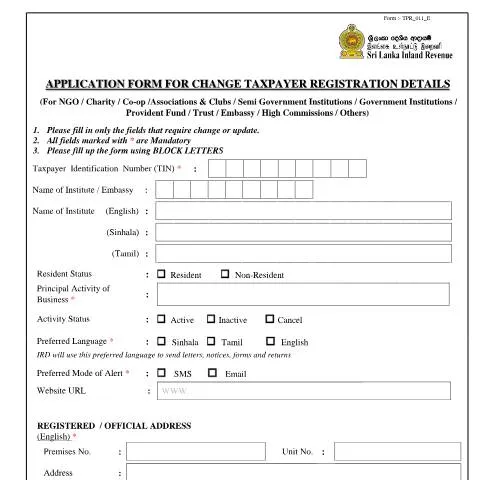
In the dynamic landscape of Sri Lanka's non-governmental and governmental sectors, the need for precise and updated taxpayer registration details is crucial. Organizations ranging from NGOs and charities to semi-government institutions and embassies are pivotal in contributing to both local and national development. Any changes in these entities can significantly impact their operations and compliance with the relevant tax regulations. Understanding the nuances of the Application Form for Change Taxpayer Registration Details (TPR_011) is key for stakeholders involved.
Who Needs to Engage with TPR_011?
The TPR_011 form is specifically designed for a variety of organizations. To facilitate understanding, here is a breakdown of the profiles involved:
- Non-Governmental Organizations (NGOs): These entities must keep their registration details updated to maintain transparency and compliance with laws governing NGOs.
- Charitable Organizations: Similar to NGOs, charities need valid registration details to uphold their operational legitimacy.
- Cooperatives and Associations: These groups benefit from updated information to ensure proper representation and functioning in their respective sectors.
- Semi-Government and Government Institutions: Given their accountability to the public, timely updates in their registration details are mandatory.
- Embassies and High Commissions: For diplomatic missions, accurate registration details are crucial for effective communication and operation in Sri Lanka.
- Provident Funds and Trusts: Financial institutions require updated records to ensure compliance with tax regulations.
- Others: Any other organizations that fall outside these categories but require changes in their taxpayer information can also utilize this form.
The Chronological Process of Submitting TPR_011
To ensure the successful submission of the TPR_011 form, stakeholders should follow a structured process that includes several key steps:
- Identify the Need for Change: Understand what specific details require updating, whether it’s a change in address, bank information, or organizational status.
- Gather Supporting Documents: Certain changes may require documents that support your request, such as proof of address or organizational changes.
- Complete the Form: Fill in the required fields carefully, ensuring that mandatory fields marked with an asterisk (*) are completed in BLOCK LETTERS.
- Review Details: Double-check the information provided to avoid any discrepancies that could lead to delays.
- Submission: Submit the completed form along with any necessary supporting documents to the Help Desk at the nearest Inland Revenue Department (IRD) branch.
- Acknowledge Submission: Keep any receipts or acknowledgments received upon submission for future reference.
Essential Components of the TPR_011 Form
Filling out the TPR_011 form requires attention to detail. Below is a breakdown of the critical components that need to be completed:
| Field | Description | Mandatory? |
|---|---|---|
| Taxpayer Identification Number (TIN) | Your unique identifier for tax purposes | Yes |
| Name of Institute | Official name as registered | Yes |
| Principal Activity of Business | Main activity your organization is engaged in | Yes |
| Preferred Language | Language for correspondence (Sinhala, Tamil, English) | Yes |
| Contact Details | At least one mode of contact is required | Yes |
| Authorization Signature | Certification of truthfulness in the application | Yes |
Preparing the Supporting Documentation
When submitting the TPR_011, certain supporting documents may enhance the credibility of your application. Below is a guideline of what to prepare based on various scenarios:
- Change of Address:
- Utility bill or lease agreement showing the new address
- Change of Organizational Status:
- Official documents from the governing body indicating the status change
- Change of Banking Information:
- Bank statement or letter from the bank confirming the new account details
- Change in Contact Personnel:
- Identification of the new contact person (NIC or passport copy)
Understanding the Implications of Errors or Omissions
Submitting the TPR_011 form with errors or missing documents can lead to complications. When discrepancies arise, the following steps should be taken:
- Immediate Review: Review the submitted details against the original form to identify any mistakes.
- Contact IRD: Reach out to the relevant IRD branch for clarification on how to rectify the issue.
- Prepare Resubmission: If necessary, complete a new TPR_011 form with the correct details and submit it along with any required supporting documents.
- Document Everything: Keep a record of all communications and submissions to provide evidence of compliance.
What to Do in Case of Application Refusal
Encountering refusal to register the updates via the TPR_011 form can be disheartening. However, understanding the steps to take can aid in resolving the situation:
- Request for Clarification: Seek a clear explanation from IRD regarding the reason for refusal.
- Assess Required Actions: Determine what additional documentation or changes are required to meet the necessary criteria.
- Appeal Process: If the refusal appears unjustified, inquire about the process for appealing the decision, including relevant timelines and submission protocols.
Utilizing Digital Platforms for Submission
As part of its commitment to modernize public services, Sri Lanka is promoting the use of digital platforms for administrative tasks. The TPR_011 form may be available electronically through government portals. Engaging with these resources can expedite the process; however, one must ensure that:
- All digital submissions comply with the Electronic Transactions Act, which legitimizes electronic forms.
- Proper documentation is uploaded as required, ensuring all details are visible and accurately represented.
- Confirmation of submission is received digitally for future reference.
Final Thoughts on Compliance and Importance of Accurate Registration
Accurate taxpayer registration is not merely a bureaucratic requirement but a foundational aspect of operational integrity for NGOs, charities, and other institutions in Sri Lanka. The effective use of the TPR_011 form, compliance with submission regulations, and timely updates foster transparency and accountability, ultimately enhancing the organization's credibility. As such, understanding and diligently following the process outlined can lead to more successful operations and compliance with Sri Lankan law.
Understanding the Importance of Accurate Taxpayer Registration
In Sri Lanka, accurate taxpayer registration is not merely a bureaucratic requirement; it is foundational to the smooth operation of both governmental and non-governmental organizations. Ensuring that details are kept up to date prevents legal complications and fosters transparency in financial dealings. For NGOs, charities, cooperatives, associations, clubs, semi-government institutions, and government institutions alike, accurate registration is vital in maintaining eligibility for grants, funding, and tax exemptions. Additionally, the precise recording of information aids in compliance with the Inland Revenue Department (IRD) regulations, thus avoiding potential penalties.
When organizations initiate their process of changing taxpayer registration details, they must be cognizant of the specific requirements that each category entails. For instance, NGOs may be required to provide additional documentation to highlight their charitable activities, while government institutions might need to align their changes with directives from their respective ministries. Hence, understanding the nuances of each entity type is crucial for ensuring that all changes are processed without delay.
Steps to Submit Your Application Form for Change of Taxpayer Registration
Submitting the Application Form for Change of Taxpayer Registration requires attention to detail and a thorough understanding of the associated processes. Here is a step-by-step guide that outlines the necessary actions one must take:
- Gather Necessary Documentation: Before initiating the application, ensure you have all requisite documents ready. This could include a copy of the National Identity Card (NIC) of the authorized signatory, a recent bank statement, and any prior registration documents relevant to the organization.
- Complete the Application Form: Access the Application Form available on the forms.gov.lk platform. Ensure all sections are filled out accurately. Pay particular attention to the 'Reason for Change' section, as insufficient clarity may lead to delays in processing.
- Submit the Application: The completed application form can be submitted either online via the relevant government portal or physically at the nearest Inland Revenue Department office. If submitting online, ensure you have a digital signature in accordance with the Information and Communication Technology Agency (ICTA) protocols.
- Follow Up: After submission, it is prudent to follow up with the IRD to confirm receipt of the application and to inquire about the estimated timeline for processing. Keeping a record of your submission reference number can be beneficial for tracking.
Each of these steps plays a critical role in ensuring that the taxpayer registration details are changed without complications, preserving the integrity and operational capacity of the organization involved.
Common Challenges and Solutions in Changing Taxpayer Registration Details
Organizations may encounter several challenges when attempting to change their taxpayer registration details. Understanding these potential obstacles can help in proactively addressing them. Below are some common challenges and practical solutions:
1. Insufficient Documentation
One of the most prevalent issues is the lack of the necessary documentation during submission. Organizations sometimes overlook specific requirements, leading to delays or rejection.
Solution: A comprehensive checklist should be prepared prior to the application. This checklist should detail every document required based on the type of organization, including proof of address, incorporation documents, and tax identification numbers.
2. Misunderstanding of the Reasons for Change
Another challenge arises from the lack of clarity regarding the 'Reason for Change' section of the application form. Organizations may fail to provide a robust justification for the alterations they are requesting, which can impede the approval process.
Solution: It is advisable to clearly articulate the reasons behind the proposed changes. Detailed explanations can expedite the review process, especially for NGOs that need to outline how their activities have evolved.
3. Delays in Processing Times
Organizations often experience frustration when processing times exceed expectations. This can be especially detrimental for NGOs that rely on timely updates for grants and funding.
Solution: Establishing a relationship with local IRD representatives can provide insights into processing timelines and potential backlogs. Consistent follow-up inquiries post-submission can also facilitate expedited processing.
By anticipating these challenges and preparing accordingly, organizations can significantly improve their chances of a seamless transition in their taxpayer registration details.