Skip to content
Government & admin

Comprehensive Guide to EPF Re-Registration in Sri Lanka

Official documentGovernment & admin
PreviewDocument preview: Comprehensive Guide to EPF Re-Registration in Sri Lanka — Government & admin
Official document

What would you like to do?

Complete the fields, sign, then download.

Unlocking the EPF Re-Registration Process: A Comprehensive Guide

In the dynamic landscape of Sri Lanka's employment sector, the Employees' Provident Fund (EPF) serves as a cornerstone for financial security among employees. The re-registration of EPF members is a pivotal step towards enhancing service efficiency and accuracy. Understanding the intricacies of this process is essential for both employers and employees alike.

Understanding the EPF Re-Registration: Key Objectives

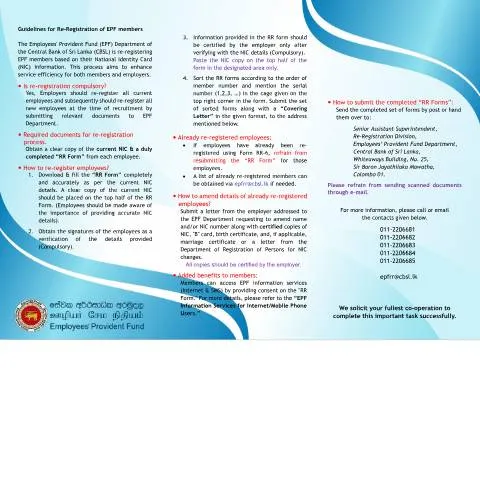
The primary aim of the EPF re-registration is to ensure that all member data is aligned with the National Identity Card (NIC) information of employees. This initiative, led by the Employees' Provident Fund Department of the Central Bank of Sri Lanka (CBSL), is designed to streamline service delivery and improve operational efficiency. Employers should be aware that the re-registration is a mandatory process.

Why is Re-Registration Compulsory?

  • Ensures the accuracy of employee records.
  • Facilitates access to EPF services for members.
  • Enhances compliance with national regulations.

Practical Implications for Employers

Employers are tasked with the responsibility of re-registering all current employees and ensuring that new hires are also registered at the point of recruitment. It is imperative to comply with this requirement to avoid potential legal and operational complications.

The re-registration process may seem daunting at first glance; however, breaking it down into manageable steps can alleviate apprehensions. Here’s how to effectively navigate the re-registration of EPF members:

Step 1: Document Collection

Employers must obtain a clear copy of the current NIC and the duly completed "RR Form" from each employee. This step is crucial as the accuracy of these documents directly impacts the success of the re-registration.

Step 2: Completing the RR Form

  1. Download the "RR Form" from the official platform.
  2. Fill in the form with accurate and current NIC details.
  3. Place a copy of the NIC on the designated area of the RR Form.

Step 3: Verification and Certification

It is mandatory for employers to verify the details provided against the NIC. The employer's certification on the RR form serves as an official endorsement of the accuracy of the submitted information.

Recognizing the Benefits and Limitations of the Guideline

While the re-registration process opens doors to enhanced services, it is vital to recognize its limitations. Understanding what this guideline covers can prevent misinterpretations and ensure compliance:

What the Guideline Covers

  • The re-registration requirements for current and new employees.
  • The process for amending details of already re-registered employees.
  • Access to EPF information services through Internet and SMS, contingent upon member consent.

Limitations to Note

This guideline does not encompass the procedures for registering employees who have never been registered before, nor does it provide details on handling disputes related to EPF contributions. Instead, it focuses specifically on the re-registration of existing members.

Key Personnel and Situations Where Re-Registration is Indispensable

Understanding the target audience for the EPF re-registration process is crucial. The primary stakeholders include:

Employers

Employers play a critical role in ensuring that their employees' data is current and correctly documented. They are responsible for guiding new employees through the registration process and maintaining compliance with EPF regulations.

Existing Employees

Current employees must be informed about the re-registration and its significance. Their cooperation in providing accurate NIC details and signing the RR Form is essential for a smooth process.

Avoiding Common Misinterpretations: Clarifying Key Concepts

Misinterpretation of guidelines can lead to compliance issues. Here are some key concepts that must be understood:

NIC Details

The NIC serves as the primary identification document for Sri Lankan citizens. Accurate NIC details should be provided to avoid discrepancies in the EPF records.

Certification Process

Employers must ensure that the information on the RR Form is verified against the NIC before providing certification. This step is non-negotiable and aims to uphold the integrity of the EPF system.

The Importance of a Covering Letter

A well-structured covering letter accompanies the submission of the completed RR Forms. Employers should adhere to the prescribed format to ensure that all necessary information is included. Here’s an outline of key elements to include:

Contents of the Covering Letter

  • Date of submission.
  • Employer’s name and contact information.
  • Purpose of the submission.
  • List of enclosed documents, including the sorted RR Forms.

Submitting the Completed RR Forms: Ensuring Compliance

Once the forms are completed, employers must submit them to the designated authority. It is crucial to adhere to the submission guidelines to avoid delays:

Submission Methods

  • By post to the Senior Assistant Superintendent, Re-Registration Division, Employees’ Provident Fund Department, Central Bank of Sri Lanka, Whiteaways Building, No. 25, Sir Baron Jayathilaka Mawatha, Colombo 01.
  • Hand delivery is also an option, which may expedite processing.

Important Reminder

Employers should refrain from sending scanned documents via email, as only hard copies of the submissions are accepted. Failing to follow this guideline could result in the rejection of the documentation.

Amending Details of Already Re-Registered Employees: A Focused Approach

In cases where changes need to be made to the details of already re-registered employees, a specific procedure must be followed:

Necessary Steps for Amendment

  • Prepare a letter addressed to the EPF Department outlining the request for amendment.
  • Include certified copies of supporting documents, such as NIC, "B" card, birth certificate, marriage certificate (if applicable), or a letter from the Department of Registration of Persons for changes in NIC.
  • Ensure that all documents are certified by the employer to maintain compliance.

Accessing Additional Information Services: Enhancing Member Interaction

The re-registration process also provides members with the opportunity to access EPF information services, leveraging both Internet and SMS technologies. Consent is required for this service:

Member Consent

  • Members must give their explicit consent on the RR Form to access these digital services.
  • For detailed instructions on utilizing EPF information services, refer to the “EPF Information Services for Internet/Mobile Phone Users.”

Contact Information for Further Assistance

For any inquiries or further clarification regarding the EPF re-registration process, the following contact numbers can be utilized:

Contact Numbers
011-2206681
011-2206682
011-2206683
011-2206684
011-2206685

Additionally, inquiries can be directed via email to [email protected]. It is highly recommended that employers make full use of these resources to ensure successful completion of the re-registration task.

Encouragement for Active Participation

The re-registration process is not merely a bureaucratic formality; it represents an essential component of the overall employee welfare strategy in Sri Lanka. Employers' active participation and diligence in completing this important task will contribute significantly to the enhancement of the EPF system, ultimately benefiting both employees and the broader economic framework.

Understanding the National Identity Card (NIC) and Its Role in Administrative Processes

The National Identity Card (NIC) is a critical document in Sri Lanka, serving as the primary identification for citizens. Issued by the Department for Registration of Persons, the NIC is essential for accessing various government services and completing administrative processes. It is important to understand its significance, especially when navigating through the bureaucratic landscape of Sri Lanka. The NIC contains vital information, including the holder's full name, date of birth, and a unique identification number that is crucial for verifying one's identity in official dealings. For instance, when applying for government forms through ICTA, the NIC number acts as a reference point for both the applicant and the authorities involved. This is particularly significant in cases of online applications, as many services require the NIC number for authentication purposes. Moreover, the NIC is not just a tool for identification; it also facilitates participation in civic duties such as voting and accessing public healthcare services. Citizens must present their NIC when registering to vote or when receiving medical treatment in state hospitals. Therefore, ensuring that your NIC is up to date is vital for seamless interaction with various government agencies. For expatriates or dual citizens, it’s essential to note that having a NIC does not guarantee access to all services. Certain applications, such as those concerning land ownership or business registration, may require additional documentation. This highlights the importance of verifying specific requirements based on individual circumstances. Furthermore, the NIC undergoes periodic updates to incorporate new security features and align with international standards. It is advisable for citizens to stay informed about these changes, as they can affect the acceptance of the NIC in different administrative contexts. Keeping the NIC current not only facilitates smoother transactions but also ensures compliance with any legal changes impacting identification protocols. The Information and Communication Technology Agency (ICTA) plays a pivotal role in driving the digital transformation of government services in Sri Lanka. Established as part of the government’s initiative to enhance public service delivery, the ICTA has developed an array of online platforms that streamline administrative processes. One of the most significant contributions of ICTA is the provision of e-services, which allows citizens to access various government forms and services online. Through the portal forms.gov.lk, users can find a comprehensive list of services that can be availed digitally, reducing the need for physical visits to government offices. This digital approach is particularly beneficial in urban areas where congestion and long queues are common. The transition to digital services also aims to enhance transparency and efficiency in the public sector. By using ICTA's online platforms, citizens can track the status of their applications, reducing uncertainty and improving overall satisfaction with government services. For example, when submitting an Application Form for a birth certificate or a passport, applicants can receive real-time updates on their application status via SMS or email notifications. However, it’s crucial for users to understand the prerequisites for accessing these digital services. A valid NIC is often required for registration on these platforms, and users must also familiarize themselves with the user interface to navigate the services effectively. Additionally, while many forms are available online, some applications may still require a physical submission of documents, especially in cases involving legal or sensitive information. Therefore, it is essential to read through the specific requirements listed for each service carefully. As the digital landscape in Sri Lanka evolves, ICTA continues to explore innovative solutions to improve user experience. Initiatives such as mobile applications and user-friendly interfaces are under development, aiming to make government services more accessible to the general public. Staying updated with these developments is beneficial for citizens, as it opens opportunities for easier engagement with government processes.

The Impact of Electronic Transactions Act on Administrative Procedures

The Electronic Transactions Act (ETA) was enacted in Sri Lanka to provide a legal framework for the use of electronic communications and electronic records in government and commercial transactions. This legislation marks a significant milestone in the digital transformation of public services, allowing for greater efficiency and accessibility in administrative procedures. Under the ETA, electronic signatures are legally recognized, which facilitates the acceptance of digital documents in various administrative processes. This is particularly relevant when submitting government forms online, as citizens can now authenticate their applications electronically, reducing the need for physical signatures and in-person submissions. The implications of the ETA are far-reaching, as it not only simplifies the process of completing applications but also enhances the security of transactions. By ensuring that electronic records are legally valid, the Act instills confidence in users engaging with digital platforms. Consequently, this has led to increased adoption of online services, as citizens feel assured that their transactions are protected under the law. Moreover, the ETA encourages the development of secure online payment systems, enabling citizens to settle fees associated with government services electronically. This advancement further streamlines administrative processes, allowing users to complete their transactions swiftly and efficiently. For example, applicants for construction permits can now pay necessary fees online without the need to visit financial institutions, thus saving time and reducing unnecessary delays. However, it is essential for users to be aware of their rights and obligations under the ETA. While it promotes electronic transactions, users must ensure that they engage with official government portals to avoid potential scams or fraudulent activities. The government regularly publishes advisories on best practices for online transactions, which citizens should adhere to for their protection. The continuous evolution of the ETA will likely lead to further enhancements in the digital landscape of Sri Lanka. It is advisable for citizens to stay informed about updates to the legislation, as changes may affect how various administrative procedures are conducted in the future. Understanding the implications of the Electronic Transactions Act will empower citizens to utilize digital services to their fullest potential.

Frequently asked questions

What is the EPF re-registration process?

The EPF re-registration process involves updating and verifying member data to ensure accuracy.

Why is EPF re-registration important for employers?

It enhances service efficiency and ensures compliance with national regulations.

How can employers facilitate the re-registration?

Employers can facilitate re-registration by collecting accurate data from employees and submitting it to the EPF.

What are the consequences of not re-registering?

Failure to re-register can lead to discrepancies in member records and potential penalties.

Similar documents