Navigating the Administrative Review Process
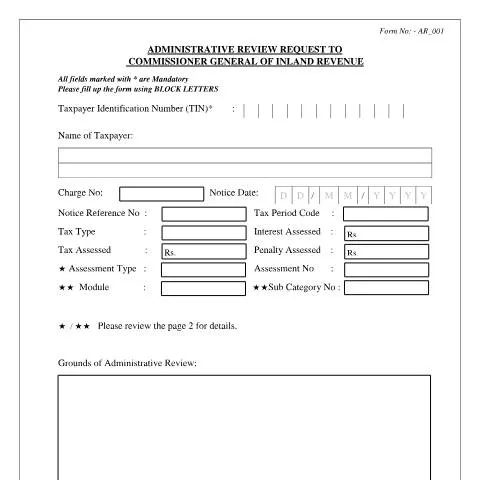
In the complex landscape of Sri Lanka's tax administration, understanding the procedures and mechanisms for contesting tax assessments is crucial for taxpayers. The Application Form for Administrative Review Request to the Commissioner General of Inland Revenue, referenced as AR_001, serves as a pivotal tool for those seeking to challenge decisions made by the Inland Revenue Department (IRD). This document is essential for taxpayers who believe that an assessment, including tax liabilities, penalties, or interest, has been incorrectly applied.
Triggers for Filing an Administrative Review
Administrative reviews are often initiated following the receipt of various types of tax assessments. These assessments can range from default assessments to amended assessments. Each type of assessment has its unique implications and reasons for review:
- Default Assessment: Issued when a taxpayer fails to submit their return by the deadline.
- Advance Assessment: Provided when the IRD wishes to determine a taxpayer's liability before the official return is filed.
- Additional Assessment: Issued if the IRD discovers new information that warrants a review of previous assessments.
- Amended Assessment: A revision of an earlier assessment due to corrections or new disclosures.
Recognizing the assessment type and its implications is critical. Upon receiving a notice, taxpayers have a specific period, typically 30 days, to file an administrative review application. This timeframe can vary based on the assessment type, so it's essential to check the notice's date and the specific instructions provided therein.
Preparing the Application: A Comprehensive Approach
Filling out the AR_001 form requires meticulous attention to detail. The form is designed with several mandatory fields that must be completed accurately:
- Taxpayer Identification Number (TIN): This unique identifier must be filled in as it is crucial for the IRD to trace the taxpayer's records.
- Name of Taxpayer: The full legal name as per the National Identity Card (NIC) or other identification documents.
- Charge No and Notice Date: These details help the IRD locate the assessment in question.
- Tax Period Code: Specifies the period for which the assessment was issued.
- Details of the Assessment: This includes all amounts related to tax, penalties, and interest.
- Grounds for Review: Clearly articulating the reasons for the review is essential. This section should be supported by evidence and documentation.
It is important to note that if the application is submitted by an authorized representative, their details must also be provided, including their designation and identification number.
Documents to Support Your Application
Alongside the AR_001 form, applicants are required to submit supporting documents. The nature of these documents may vary based on the specific grounds for the review. Typical documents include:
| Document Type | Description | Purpose |
|---|---|---|
| Tax Returns | Copies of relevant submitted returns | To substantiate the claims made in the review |
| Payment Receipts | Receipts of any taxes paid | To prove compliance and payment history |
| Correspondence | Any letters or emails related to the assessment | To provide context and evidence of communications with the IRD |
| Additional Evidence | Any other relevant documents supporting the case | To enhance the credibility of the review request |
The inclusion of comprehensive, well-organized documents alongside the application is essential for a successful review process. Failure to provide necessary documentation may lead to delays or rejection of the request.
Submitting Your Application to the Appropriate Authority
Once the AR_001 form and supporting documents are completed, the next step involves submission to the nearest Inland Revenue Department (IRD) branch. It is important for taxpayers to ensure that they submit the application within the stipulated time frame. Here’s how to effectively navigate this submission process:
- Locate the Nearest IRD Branch: Utilizing the official IRD website or contacting their office can help identify the closest branch.
- Ensure Completeness: Double-check that all fields are filled out and all documents are attached before submission.
- Obtain a Receipt: When submitting the application, request an acknowledgment receipt from the IRD. This serves as proof of submission and may be required for follow-up.
The IRD typically acknowledges receipt of the application within a few days. Applicants should retain the acknowledgment for their records as it may be required for any future follow-up or inquiries regarding the status of the review.
Timeline and What to Expect After Submission
Following the submission of the application, the timeline for an administrative review can vary significantly. Generally, the IRD aims to complete reviews within a three-month period, but this can extend depending on the complexity of the case and the volume of applications they are processing at the time.
After the review is completed, the applicant will receive a formal communication detailing the IRD's findings. There are several potential outcomes:
- Agreement with Taxpayer: If the IRD finds merit in the claims, the assessment may be adjusted, and any overpayments refunded.
- No Change to Assessment: In this case, the original assessment stands, and the taxpayer will be notified accordingly.
- Further Action Required: Sometimes, the review may lead to additional inquiries or requests for more documentation.
In instances where taxpayers disagree with the outcome, they may explore further appeals through the appropriate channels, including the Tax Appeals Commission, based on the guidelines laid out in the tax administration laws.
Unique Considerations for Special Circumstances
Certain taxpayers may find themselves in unique situations requiring tailored approaches to the administrative review process. These considerations can include:
- Foreign Taxpayers: Non-residents may face different requirements and should seek guidance on how specific provisions in the tax law apply to them.
- Minors: Applications submitted on behalf of minors will require additional documentation verifying the guardian's legal authority to act on their behalf.
- Complex Cases: Situations involving multiple assessments or various tax types may necessitate a detailed strategy and possibly the assistance of a tax professional.
- Urgency Cases: In situations where immediate financial implications are evident, such as impending legal action, applicants may need to communicate the urgency to the IRD during the submission process.
Understanding the Legal Framework Behind the Process
The administrative review process is governed by principles set forth in Sri Lanka’s tax laws, primarily influenced by English common law principles as articulated in the Interpretation Ordinance. The Electronic Transaction Act enables effective digital submissions, promoting efficiency within tax administration.
Moreover, the legal basis for taxpayers' rights to contest assessments is supported by various sector-specific enactments. It is advisable for applicants to familiarize themselves with these regulations, as they provide context for their rights and the expectations set by the IRD. Understanding this framework empowers taxpayers to engage more effectively with the administrative review process.
Diving Deeper into the Application Form: Sections Explained
Examining the AR_001 form closely reveals essential details pertinent to the administrative review application:
- Section on Taxpayer Identification: This section may seem straightforward, but accuracy is vital. Ensure that the TIN corresponds with what the IRD has on record to prevent delays.
- Grounds for Review: This is arguably the most critical part of the application. Providing a clear, concise rationale supported by evidence can significantly impact the outcome.
- Authorization Section: If an authorized person submits the form, their identification must be precise. This includes checking that the signature matches documents on file.
Each of these sections plays a significant role in ensuring that the application is processed smoothly. Being vigilant about the information entered can prevent setbacks and streamline the review process.
In summary, engaging with the administrative review process through the AR_001 form requires diligence, thorough preparation, and a clear understanding of the relevant legal frameworks. By following these guidelines and being aware of the specific requirements, taxpayers can effectively navigate their administrative review requests with the IRD.
Understanding the Administrative Review Process
The Administrative Review process in Sri Lanka is designed to ensure that taxpayers have a venue for addressing grievances related to decisions made by the Commissioner General of Inland Revenue (CGIR). This mechanism is vital in promoting transparency and accountability within the tax administration framework.
To initiate an Administrative Review, the applicant must complete the designated Application Form for Administrative Review Request, which can typically be obtained from the official website of the Department of Inland Revenue (DIR). It is crucial to understand that the administrative review is not an appeal; rather, it is a reconsideration of the decision based on the presented facts and supporting evidence.
When preparing an Application Form, applicants should include specific details regarding the original decision they wish to contest, the grounds for their request, and any relevant documentation that supports their case. The form should be submitted to the Revenue Division of the DIR, where officials will assess the validity of the claims made.
It is important to note that the effectiveness of the Administrative Review process can depend on the thoroughness of the application. Incomplete or poorly documented requests may lead to delays or a rejection. Thus, applicants are encouraged to seek clarity on the required documentation and to ensure their submissions are comprehensive and well-organized.
Common Grounds for Administrative Review Requests
Applicants submitting an Administrative Review Request to the CGIR should have a clear understanding of the common grounds that justify such a request. The most prevalent grounds for seeking an administrative review include:
- Incorrect Assessment: If the taxpayer believes that the assessment of their tax liability was incorrect due to errors in calculation, misinterpretation of tax legislation, or other discrepancies, they may request a review.
- Failure to Recognize Deductions or Exemptions: Taxpayers often encounter situations where legitimate deductions or exemptions are overlooked during the assessment process. In such cases, a review may lead to rectification of the assessment.
- Change in Circumstances: Should there be a significant change in the taxpayer's financial situation, such as the loss of employment or unexpected medical expenses, this could warrant a review of previous tax liabilities.
- Procedural Irregularities: If there were procedural failures in the way the original decision was reached—such as lack of proper notification or insufficient time to respond—this could form valid grounds for a review.
Understanding these grounds can aid taxpayers in constructing a solid case for their Administrative Review Requests, enhancing the likelihood of a favorable outcome. Furthermore, providing comprehensive evidence that supports their claims will assist the review officials in their deliberations.
Timelines and Expectations for the Review Process
The timeline for processing an Administrative Review Request can vary based on several factors, including the complexity of the case and the volume of requests received by the DIR. Generally, once the Application Form is submitted, an acknowledgment of receipt will be issued, confirming that the review process is underway.
Taxpayers can expect a response within a specified timeframe, which is usually communicated in the acknowledgment. It is essential for applicants to note that delays may occur, particularly during peak tax seasons or if additional information is required to finalize the review.
In terms of expectations during the review, applicants should prepare for a thorough examination of their case. Review officials may reach out for additional evidence or clarification on certain points raised in the initial application. Therefore, maintaining open lines of communication and being responsive to inquiries is crucial to expedite the review process.
Ultimately, the outcome of an Administrative Review Request will be communicated formally, outlining the findings and any adjustments to the initial decision. Should the applicant disagree with the outcome, they retain the right to appeal this decision through the proper channels, which may include lodging a formal appeal with the Tax Appeals Commission.