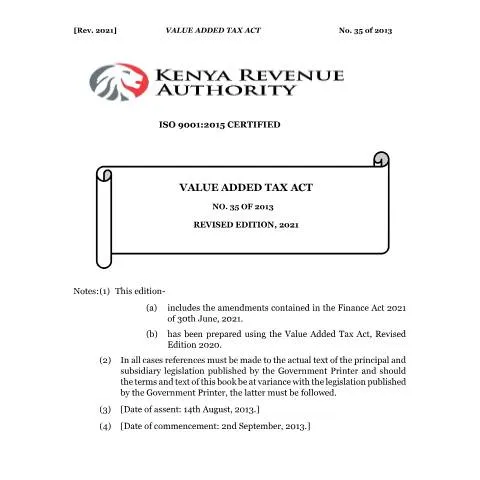
Understanding the Value Added Tax Act, 2013 (Revised 2021 Edition) in Kenya
The Value Added Tax (VAT) Act, 2013, as revised in 2021, is a comprehensive legal framework governing the imposition, administration, and enforcement of VAT in Kenya. This legislation is crucial for businesses, government authorities, and taxpayers to understand their rights and obligations related to VAT, which is a key component of Kenya’s fiscal policy and revenue collection system.
Object and Scope of the VAT Act, 2013
The primary objective of the VAT Act is to regulate the application of value-added tax on goods and services supplied within Kenya, as well as on imports. It aims to create a transparent, fair, and efficient taxation environment that supports economic growth while ensuring the government’s revenue needs are met effectively. The Act covers all persons and entities engaged in taxable activities, including manufacturers, importers, distributors, and service providers, unless specifically exempted under the law.
Legal Basis and Amendments
The Act was assented to on August 14, 2013, and commenced operations on September 2, 2013. Since its enactment, the law has undergone several amendments to adapt to economic changes and policy priorities, notably through the Finance Act, 2021. These amendments include adjustments to the VAT rate, exemptions, zero-rated supplies, and administrative procedures, reflecting the government’s commitment to maintaining a modern and responsive tax system.
Key Provisions and Administrative Framework
Charge to VAT and Rate Adjustments
The Act stipulates that VAT is levied on the supply of goods and services, with the standard rate set by the Cabinet Secretary responsible for finance. The law also provides for zero-rated supplies and exempt goods and services, which are detailed in the first and second schedules of the Act. These provisions aim to reduce the tax burden on essential goods and promote economic activities in targeted sectors.
Place and Time of Supply
Determining the place of supply is fundamental for VAT compliance. The law specifies different rules for goods and services, including imported goods and services, to establish where and when VAT is payable. For example, imported goods are subject to VAT at customs control points, while the time of supply for goods and services is generally aligned with the date of invoice or payment, ensuring clarity for taxpayers and authorities alike.
Taxable Value and Input Tax Deduction
The taxable value of supplies is determined based on the consideration received or receivable, including additional costs such as freight or insurance. The Act also provides mechanisms for businesses to deduct input tax paid on purchases, which is credited against output tax due, thereby avoiding tax cascading and promoting fair taxation.
Registration, Filing, and Compliance
All persons engaged in taxable activities exceeding the prescribed threshold are required to register for VAT with the Kenya Revenue Authority (KRA). Registration involves obtaining a VAT certificate, which must be displayed at the place of business. Registered taxpayers are obligated to submit periodic VAT returns, maintain accurate records, and issue tax invoices in accordance with the law.
Enforcement, Penalties, and Dispute Resolution
The Act grants KRA enforcement powers to ensure compliance, including audits, assessments, and penalties for non-compliance or evasion. Penalties may include fines, interest on overdue amounts, and potential criminal sanctions. The law also provides procedures for taxpayers to object to assessments and seek rulings from the Commissioner, fostering transparency and fairness in tax administration.
Implications for Kenyan Taxpayers and Business Operations
Understanding the provisions of the VAT Act, 2013, as revised in 2021, is essential for businesses to ensure compliance, optimize tax liabilities, and avoid penalties. It influences pricing strategies, supply chain management, and record-keeping practices. Moreover, the law’s provisions on zero-rated and exempt supplies support sectors vital to Kenya’s economy, such as agriculture, healthcare, and education.
In summary, the VAT Act, 2013, as amended, provides a detailed legal framework that balances revenue collection with taxpayer rights. It underscores the importance of compliance, transparency, and administrative efficiency in Kenya’s taxation system, serving as a critical reference for all stakeholders involved in VAT-related activities.