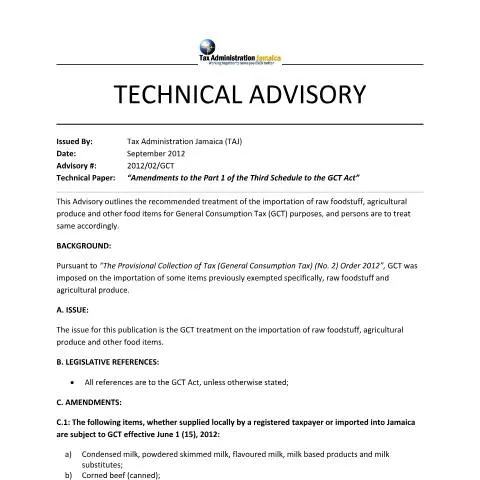
Understanding the Amendments to Part 1 of the Third Schedule to the GCT Act in Jamaica
The Jamaican government, through the Tax Administration Jamaica (TAJ), issued a technical advisory in September 2012 regarding recent amendments to the General Consumption Tax (GCT) legislation, specifically to Part 1 of the Third Schedule of the GCT Act. These changes significantly impact the importation and supply of certain food items, clarifying the application of GCT on raw foodstuffs, agricultural produce, and other food products for general consumption.
Scope and Purpose of the Amendments
The primary objective of these amendments is to specify which imported and locally supplied food items are now subject to GCT, and under what conditions. This ensures that businesses and individuals involved in importing or selling these goods are aware of their tax obligations, aligning with Jamaica’s broader efforts to modernize tax compliance and broaden the GCT base.
The amendments came into effect on June 1, 2012, following the issuance of the Provisional Collection of Tax (General Consumption Tax) (No. 2) Order 2012. They address the classification of food items, differentiating between those that are taxed upon importation and those that are only taxed when supplied locally by registered taxpayers.
Key Changes in Tax Treatment of Food Items
Items Subject to GCT on Importation and Supply
Effective June 1, 2012, certain food products, whether imported or supplied locally by registered taxpayers, became liable to GCT at the standard rate. These include:
- Condensed milk, powdered skimmed milk, flavoured milk, milk-based products, and milk substitutes
- Canned corned beef
- Pickled mackerel, herring, shad, and dried salted fish
- Buns and biscuits (excluding crackers)
- Eggs (excluding fertile chicken eggs intended for hatching)
- Patties and rolled oats
- Olive oil and cooking oil sprays
- Poultry (excluding chicken)
- Syrup
Items Subject to GCT Only on Importation
Some raw foodstuffs are taxed only when imported, provided they meet specific criteria, such as minimal processing. These include:
- Fresh fruits and vegetables, excluding imported apples, pears, quinces, apricots, cherries, peaches, nectarines, plums, berries, grapes, and kiwis
- Ground provisions (e.g., yams, sweet potatoes)
- Legumes, onions, and garlic
- Meat (excluding poultry)
- Fish, crustaceans, and molluscs
Importantly, these items must be unprocessed or minimally processed, such as freezing, chilling, salting, packaging, slicing, or natural drying. Juicing of fruits, however, remains outside this scope.
Special Rules for Eggs and Certain Meat Products
Eggs are generally subject to GCT whether imported or supplied locally, except for fertile eggs intended for hatching, which are exempt. Additionally, certain meat products like corned pork, salted beef, and dried salted fish are liable to GCT upon import and when supplied by registered taxpayers.
Implications for Taxpayers and Importers
Payment of GCT at Importation
Items listed under the above categories are subject to an advance GCT of 5% when imported by a registered taxpayer for use in their taxable activities. This advance payment ensures that the tax is collected upfront, facilitating compliance and revenue collection.
GCT Uplift and Commercial Quantities
When imported by a taxpayer for non-taxable use or by any other person, and where the Customs Commissioner considers the quantities to be commercial, an uplifted GCT may be applied. The uplift is calculated based on the retail market value, potentially increasing the taxable amount.
Input Tax Credits for Registered Taxpayers
Taxpayers registered for GCT are entitled to claim input tax credits for the GCT paid on imported goods, provided these are used for making taxable supplies. However, no credit is available if the imported items are intended for sale or use in non-taxable activities.
Special Provisions for Goods from CARICOM Countries
Goods imported from CARICOM member states that are produced within the region are exempt from GCT, encouraging intra-regional trade and cooperation. This exemption applies to the raw food items listed under the amendments, provided they meet the criteria specified in the legislation.
Conclusion
The amendments to Part 1 of the Third Schedule to the GCT Act clarify the tax obligations related to food imports and supplies. They aim to streamline tax collection, prevent tax evasion, and promote fair competition among local and imported food products. Businesses involved in importing or selling these items should review these provisions carefully to ensure compliance and optimize their tax planning strategies.