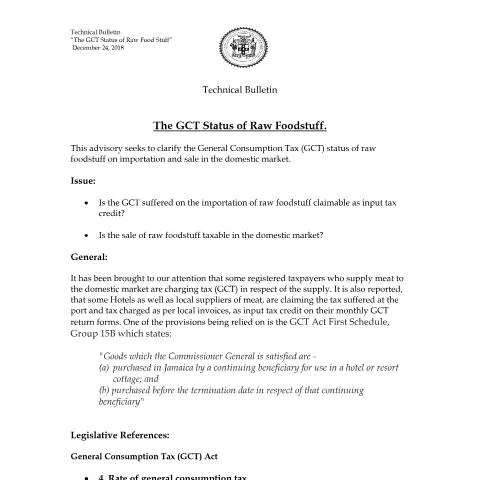
Understanding the 2018 Technical Bulletin on the Tax Treatment of Raw Food Stuff in Jamaica
The Jamaican Tax Administration Jamaica (TAJ) released a comprehensive Technical Bulletin on December 24, 2018, titled "The GCT Status of Raw Food Stuff." This official publication aims to clarify the application of the General Consumption Tax (GCT) on raw food products, particularly concerning their importation and domestic sale. It is crucial for registered taxpayers, importers, and businesses involved in food supply to understand these provisions for compliance and optimal tax management.
Objectives of the Bulletin
The primary purpose of this bulletin is to elucidate the GCT obligations associated with raw foodstuff, addressing key questions such as:
- Is the GCT paid during the importation of raw foodstuff recoverable as an input tax credit?
- Are the sales of raw foodstuff in the Jamaican domestic market subject to GCT?
This clarification helps align business practices with the legal framework established under the GCT Act, ensuring proper tax treatment and avoiding penalties for non-compliance.
Scope and Key Definitions
The bulletin specifies which raw food products are affected by the GCT provisions, referencing the First Schedule of the GCT Act and related regulations. Notably, it distinguishes between taxable and zero-rated supplies based on the nature of the product and its use.
Items Exempt from GCT
Under Part 1 of the Third Schedule of the GCT Act, certain raw foodstuff are classified as exempt from GCT when supplied locally or imported for local use, including:
- Fresh fruit and vegetables, excluding imported apples, pears, cherries, peaches, berries, grapes, and kiwis
- Ground provisions such as yams, cassava, and sweet potatoes
- Legumes, onions, garlic, meat, chicken, fish, crustaceans, molluscs, and corn (with specific processing conditions)
These exemptions are designed to promote local agriculture and consumer access to essential food items without additional tax burdens.
Zero-Rated Supplies for Hotels and Resorts
For entities such as hotels and resort cottages, the GCT Act provides a special provision under Group 15B of Part II of the First Schedule. Goods purchased in Jamaica for use in hotels or resort cottages by continuing beneficiaries are considered zero-rated, provided they meet specific conditions, including the purchase date and the nature of the beneficiary.
Importation and Input Tax Credits
A key point clarified in the bulletin relates to the importation of raw foodstuff. According to GCT Regulations 14.14, registered taxpayers importing specified raw food products are not entitled to claim input tax credits on such imports. This means that businesses cannot offset the GCT paid at the port against their GCT liabilities on sales, affecting cash flow and tax planning strategies.
Implications for Business and Compliance
Businesses involved in the importation or sale of raw foodstuff should carefully review their operations in light of this bulletin. It emphasizes the importance of correctly classifying food products, understanding exemption and zero-rating provisions, and accurately reporting GCT on returns.
Record Keeping and Documentation
Proper documentation is vital for substantiating claims related to GCT treatment. This includes:
- Invoices clearly indicating whether the raw foodstuff is exempt or zero-rated
- Proof of importation and payment of GCT at customs
- Records of purchases made for use in hotels or resort cottages, if applicable
Further Assistance and Contact Points
For detailed guidance or specific inquiries regarding the application of GCT to raw foodstuff, taxpayers are encouraged to contact the Tax Administration Jamaica directly. The TAJ provides support through its Customer Service Department and online resources available via the government portal.
In conclusion, the 2018 Technical Bulletin offers essential clarity on the tax treatment of raw foodstuff, ensuring that businesses remain compliant while optimizing their tax positions. Staying informed of such official updates is vital for effective tax management in Jamaica’s dynamic fiscal environment.