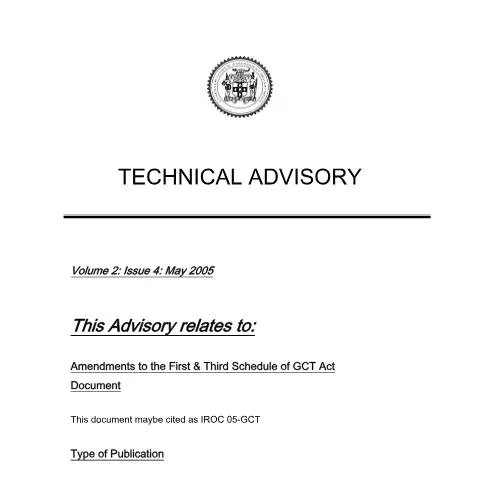
Understanding the Official Document on the Taxability of Goods in Jamaica
The official technical advisory issued by the Jamaica International Revenue Service (IROC) in May 2005 provides crucial guidance on recent amendments to the General Consumption Tax (GCT) Act concerning the tax treatment of specific goods. This document is essential for taxpayers, tax consultants, and business operators involved in the supply of goods that have transitioned from zero-rated to exempt status. It offers a comprehensive overview of legislative changes, procedural steps for deregistration, and implications for assets and input tax claims.
Scope and Purpose of the Advisory
This advisory addresses amendments to the First and Third Schedule of the GCT Act, particularly focusing on the change in tax status for certain goods as of May 1, 2005. Previously, these goods were zero-rated, meaning they attracted a 0% tax rate, but following legislative amendments, they are now classified as exempt from GCT. This change impacts registered taxpayers involved exclusively or partially in the supply of these goods, affecting their registration status, input tax recovery, and asset management.
Key Legal References and Amendments
The advisory references specific sections of the GCT Act, including:
- Section 23: Taxation of assets upon deregistration
- Section 32: Notification requirements for deregistration
- Section 33: Final return filing obligations
- Section 25 & 29: List of exempt goods and exemption from registration
The amendments primarily modify the classification of certain goods listed in the schedules, shifting their tax status from zero-rated to exempt, which has significant implications for taxpayers’ compliance obligations and tax recovery strategies.
Implications for Taxpayers and Registration Status
Taxpayers Supplying Only Exempt Goods
Taxpayers whose entire supply consists of goods listed as exempt from GCT must notify the Commissioner of their change in status. These taxpayers will be deregistered, as they are no longer engaged in a taxable activity. They must submit a formal application for deregistration, file a final return including tax on goods held at deregistration, and surrender their Certificate of Registration. Failure to return the certificate incurs a penalty of $5,000.
Taxpayers Engaged in Mixed Activities
Businesses involved in both taxable and exempt supplies are considered engaged in a mixed activity. If their annual turnover exceeds $1 million, they must remain registered. These taxpayers face input tax implications, especially concerning the claiming of credits for goods used in both taxable and exempt supplies. They are required to adopt a fair and reasonable method to apportion residual input tax, ensuring compliance with the rules on partial exemption.
Procedures for Deregistration and Asset Management
Steps for Deregistration
- Submission of an application by the taxpayer under section 32 of the GCT Act.
- The Commissioner may notify the taxpayer of pending deregistration, allowing objections.
- Notification of whether a final audit will be conducted.
- If no audit is scheduled immediately, the taxpayer must retain records for a specified period.
- Filing of a final return, including tax on inventory at deregistration.
- Submission of the Certificate of Registration prior to deregistration.
Handling of Assets and Input Tax
Assets used in taxable activities before deregistration, including inventory, are subject to GCT at the applicable rate. Upon deregistration, these assets are deemed to be supplied, and tax must be accounted for accordingly. Taxpayers must report and settle any tax due on these assets within the prescribed timeframe.
Points of Attention and Practical Advice
- Taxpayers should promptly notify the Commissioner upon ceasing to supply exempt goods to avoid penalties and ensure proper deregistration.
- Accurate record-keeping is essential, especially for assets and inventory at the time of deregistration.
- For mixed activity businesses, adopting an appropriate apportionment method for input tax claims is critical to maximize allowable credits and maintain compliance.
- Understanding the distinction between zero-rated and exempt supplies is vital for proper tax planning and reporting.
Conclusion
This official advisory clarifies the legislative changes affecting the taxability of certain goods in Jamaica and provides a structured approach for taxpayers to manage their registration status, asset obligations, and input tax claims. Compliance with these guidelines ensures smooth transition and adherence to the revised GCT regulations, minimizing penalties and optimizing tax recovery opportunities.