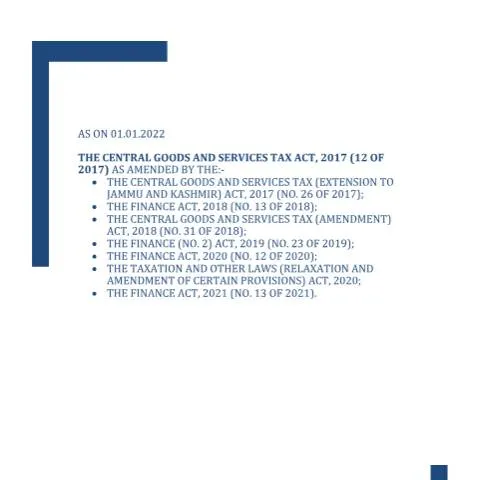
Understanding the Amendments to the Central Goods and Services Tax Act, 2017 as of January 1, 2022
The Central Goods and Services Tax (CGST) Act, 2017, is the primary legislation governing the levy and collection of goods and services tax (GST) across India. As of January 1, 2022, the Act has undergone several amendments to streamline tax administration, expand its scope, and incorporate changes introduced through subsequent finance acts and legislative measures. This guide provides a comprehensive overview of these amendments, their significance, and the legal context for businesses and taxpayers operating under Indian GST law.
Scope and Legal Framework
The CGST Act, 2017, was enacted to establish a uniform indirect tax regime for intra-State supplies of goods and services. It forms part of the broader framework under the GST law, which aims to unify various indirect taxes into a single tax system, thereby simplifying compliance and improving tax collection efficiency. The amendments incorporated up to January 1, 2022, reflect ongoing efforts by the Indian government to refine the law, address implementation challenges, and align with economic policies.
Key Amendments and Their Impact
Legislative Amendments and Finance Acts
- The Finance Act, 2018 (No. 13 of 2018): Introduced provisions related to anti-evasion measures, penalties, and procedural clarifications to strengthen tax compliance.
- The Central Goods and Services Tax (Amendment) Act, 2018 (No. 31 of 2018): Made specific adjustments to definitions, registration procedures, and input tax credit rules.
- The Finance (No. 2) Act, 2019 (No. 23 of 2019): Brought changes to the valuation rules and introduced provisions for the composition scheme.
- The Finance Act, 2020 (No. 12 of 2020): Addressed issues related to refunds, compliance, and digital invoicing.
- The Taxation and Other Laws (Relaxation and Amendment) Act, 2020: Provided temporary relaxations during the COVID-19 pandemic, including extension of deadlines and procedural relaxations.
- The Finance Act, 2021 (No. 13 of 2021): Further refined provisions related to e-invoicing, credit transfer, and compliance mechanisms.
Legal Disclaimer and Reference
It is important to note that the version of the CGST Act, 2017, as amended up to January 1, 2022, is prepared for convenience and reference purposes only. The official legal provisions are those published in the Gazette of India. Any discrepancies or errors in this document should be brought to the attention of the authorities via the designated communication channels.
Significance of the Amendments
The amendments aim to enhance the robustness of the GST regime by:
- Strengthening compliance: Through clearer definitions, streamlined procedures, and digital initiatives.
- Reducing tax evasion: By introducing measures such as e-invoicing and real-time data sharing.
- Facilitating ease of doing business: Via simplified registration, refund processes, and dispute resolution mechanisms.
- Addressing pandemic-related challenges: By providing temporary relaxations and extensions to taxpayers.
Relevant Authorities and Resources
The amendments and ongoing updates to the CGST Act are overseen by the Central Board of Indirect Taxes and Customs (CBIC). For detailed legal texts, notifications, and procedural guidance, taxpayers and practitioners are advised to consult the official publications issued by the CBIC and the Government of India.
Conclusion
The January 1, 2022, amendments to the CGST Act, 2017, reflect India’s commitment to refining its GST framework to ensure better compliance, transparency, and economic integration. Stakeholders are encouraged to stay informed about legislative updates and interpretive guidance issued by the relevant authorities to ensure adherence to the law and optimize their tax planning strategies.