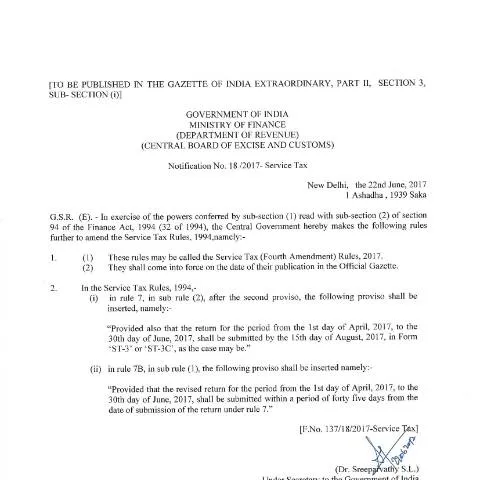
Navigating the Complexities of Notification No. 18/2017-ST
The landscape of Goods and Services Tax (GST) in India has transformed the way businesses operate, ushering in a new regime of compliance and regulation. At the heart of this transition lies Notification No. 18/2017-ST, a pivotal document crucial for businesses seeking to understand their service tax liabilities under the GST framework. This article delves deep into the nuances of this notification, its implications for businesses, and the proper procedures for completion and submission.
Understanding the Timeline: Key Dates and What They Mean
Notification No. 18/2017-ST was issued to clarify the applicability of service tax under the transitional provisions of GST. Understanding the timeline is paramount for businesses to ensure compliance.
Key Dates to Note
- Effective Date: The notification became effective on July 1, 2017, marking the beginning of the GST regime.
- Last Date for Compliance: The transitional provisions allow for certain services to be taxed under service tax until a specified date; hence, businesses must keep track of these dates as stipulated in the notification.
- Review Period: It is advisable to review tax liabilities periodically, as regulatory updates can affect compliance needs.
Positioning of the Notification Within the Broader GST Framework
This notification is not an isolated document but part of a comprehensive regulatory framework. Its role is critical in establishing how existing service tax obligations transition into the GST regime.
Linkage with Other Provisions
Understanding where Notification No. 18/2017-ST fits in the overall GST architecture is essential. Specifically, it ties closely with:
- The Central Goods and Services Tax Act, which lays the foundation for GST.
- Related notifications issued by the CBEC (Central Board of Excise and Customs) that provide further clarity on service tax rules.
- The provisions for input tax credit, which allow businesses to offset the GST paid on purchases against the GST collected on sales.
In essence, this notification sets the stage for a seamless transition for businesses adapting to GST.
Deciphering the Form: A Step-by-Step Breakdown
The notification introduces various compliance requirements, often necessitating the completion of specific forms. Understanding each component of these forms is critical for accurate filing.
Essential Components of the Form
| Section | Description | Common Pitfalls |
|---|---|---|
| Tax Payer Details | Enter the details of the taxpayer, including name and GSTIN. | Incorrect GSTIN or spelling errors can lead to rejections. |
| Service Description | Provide a detailed description of the services rendered. | Vague descriptions can cause compliance issues. |
| Tax Liability | Calculate the applicable service tax based on specified rates. | Miscalculations can lead to penalties. |
| Declaration | Sign and declare that details provided are accurate. | Failure to sign can render the form invalid. |
Submitting the Notification: Channels and Procedures
Once the form is duly filled out, the next step involves its submission. Here, you must consider the various channels available for this process.
Options for Submission
- Online Submission: Through the GST portal, which is often recommended due to faster processing times.
- Physical Submission: Some businesses may still prefer submitting documents in person at designated offices. This option, although less popular, may provide immediate confirmations.
- Email Submission: In certain cases, the option to submit via email may be available, particularly for supplementary documentation.
It’s crucial to verify the specific requirements and procedures for your state or Union Territory, as these can vary significantly.
Follow-Up Actions: What Happens After Submission?
Upon submitting Notification No. 18/2017-ST, businesses enter a phase of anticipation as they await feedback from tax authorities.
Post-Submission Steps
- Verification: The authorities will review your submission for completeness and accuracy. Be prepared for possible queries.
- Assessment: If everything is in order, the tax liability will be assessed, based on which you may be required to make payments.
- Communication: Always check for any communication from the tax department regarding your submission status.
Staying proactive during this phase can mitigate compliance risks.
Practical Tips for Successful Compliance
To navigate the complexities surrounding Notification No. 18/2017-ST, consider these practical strategies:
Effective Record Keeping
Maintain thorough records of transactions and communications. Good documentation can serve as crucial evidence in case of audits.
Consultation with Professionals
Engaging a tax consultant or legal advisor can be beneficial, especially if your business involves complex service tax scenarios.
Regular Updates on Regulatory Changes
Keep abreast of any changes in the notification or GST regulations, as these could impact your compliance obligations.
Conclusion: The Path Forward in GST Compliance
While Notification No. 18/2017-ST presents challenges, it also offers a structured pathway for businesses to transition effectively into the GST framework. By understanding its provisions, diligently filling out forms, and submitting them through the appropriate channels, businesses can ensure compliance and avoid unnecessary penalties. The dynamic nature of GST necessitates ongoing vigilance, making it imperative for businesses to stay informed and proactive.
Understanding Notification No. 18/2017-ST: Key Provisions and Implications for Service Tax
Notification No. 18/2017-ST, issued by the Central Board of Excise and Customs (CBEC), is a critical piece of legislation that modifies the existing framework of service tax in India. This notification primarily addresses the taxation of services under the reverse charge mechanism (RCM), which has profound implications for businesses and service providers. Understanding these provisions is essential for compliance and strategic planning.
Under the notification, certain categories of services have been specified where the liability to pay service tax shifts from the service provider to the recipient. This change aims to enhance tax compliance among businesses and prevent tax evasion. For instance, services provided by goods transport agencies and services related to sponsorship are now subject to reverse charge. Hence, it is imperative that you assess your business operations to determine if you fall under these categories.
Additionally, the notification stipulates that companies must obtain a valid Goods and Services Tax Identification Number (GSTIN) to engage in service procurement where the reverse charge is applicable. The GST regime has further simplified the compliance landscape, making it essential to align your invoicing practices with the new regulations. You are required to issue a tax invoice and maintain comprehensive records of all transactions subjected to RCM.
Failure to comply with the provisions of Notification No. 18/2017-ST could lead to substantial penalties, including interest on delayed payments. Thus, you must ensure that your accounting systems are updated to reflect these changes and that your staff is trained on the nuances of RCM as outlined in the notification.
Practical Steps for Compliance with Notification No. 18/2017-ST
In navigating the complexities of Notification No. 18/2017-ST, it is crucial to adopt a systematic approach to ensure compliance and mitigate potential risks. Below are the recommended steps to effectively align your business operations with the notification's requirements:
1. Identify Applicable Services
The first step is to identify which of your services fall under the reverse charge mechanism as specified in the notification. Conduct a thorough review of your service offerings and categorize them accordingly. For example, if your business involves hiring transport services from a goods transport agency, you fall under the RCM structure.
2. Update Accounting Systems
Your accounting software must be updated to incorporate reverse charge transactions. This includes setting up mechanisms for generating tax invoices that reflect the correct service tax liability. Ensure that your accounting records clearly delineate services subjected to RCM, as this will facilitate smoother audits and compliance checks.
3. Staff Training
Organize training sessions for your finance and accounting teams to familiarize them with the complexities of Notification No. 18/2017-ST. Ensure they are well-versed with the documentation requirements, invoicing protocols, and the process of filing service tax returns under the reverse charge mechanism.
4. Record-Keeping
Maintain meticulous records of all service transactions that are subject to the reverse charge. This includes invoices received, service agreements, and payment receipts. According to the guidelines set forth by the CBEC, you must retain these records for a minimum of five years in case of audits.
5. Timely Payment of Tax
Under the reverse charge mechanism, you are required to pay the service tax within the prescribed timeframe. Failure to do so may attract penal provisions. Ensure that you have a robust system in place for monitoring tax liability and ensuring timely payments.
Common Challenges and Solutions Related to Notification No. 18/2017-ST
Despite the clarity provided by Notification No. 18/2017-ST, various challenges may arise in its implementation. Below are some common issues businesses face and potential solutions to navigate these hurdles:
1. Confusion Regarding Service Classification
One of the primary challenges businesses encounter is the classification of services under the correct categories for RCM. Misclassification can lead to non-compliance and penalties. To address this, consider consulting with a tax professional or utilizing the resources provided by the Central Board of Indirect Taxes and Customs (CBIC). They offer detailed guidelines and FAQs to assist you in correctly identifying service classifications.
2. Integration with GST Compliance
The transition to GST has introduced additional complexities to the service tax landscape. Many businesses are unsure about how to align their existing service tax compliance with the new GST requirements. It is advisable to adopt a phased approach to integration. Establish a dedicated team to manage this transition, updating compliance strategies as needed based on ongoing legislative changes.
3. Technology Barriers
Some businesses may face technological challenges in updating their accounting systems to accommodate the reverse charge mechanism. If you encounter issues with software compatibility or functionality, consider engaging IT professionals who specialize in financial software solutions. They can assist in customizing your accounting systems to ensure compliance with Notification No. 18/2017-ST and related GST regulations.
4. Lack of Clarity in Invoicing
Uncertainty regarding how to issue tax invoices for reverse charge services can lead to compliance risks. Ensure that your invoicing clearly indicates the reverse charge applicability, mentions the appropriate service tax rate, and references the GSTIN of both parties involved. Regularly review your invoicing practices to ensure they conform to the latest guidelines from tax authorities.