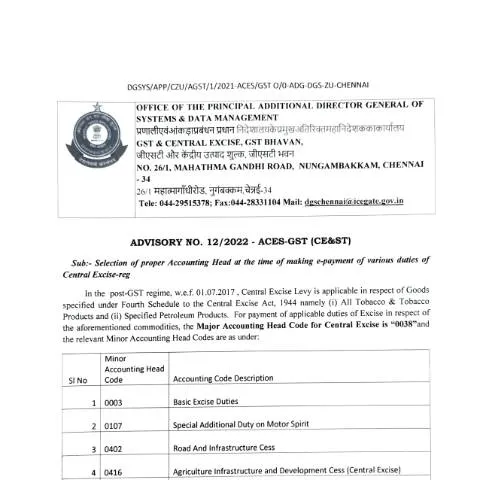
Navigating the Advisory 12 2022 180522: A Guide to the Proper Accounting Head for E-Payment CE Duty
Understanding the complexities of the Goods and Services Tax (GST) regime in India is essential for businesses and taxpayers alike. The Advisory 12 2022 180522 document from the GST department plays a pivotal role in guiding taxpayers regarding the selection of the proper accounting head for e-payment of Central Excise (CE) duties. This advisory is not merely a form; it is a critical tool that can facilitate compliance and enhance the efficiency of tax obligations.
The Context of Advisory 12 2022 180522 in GST Compliance
In the framework of the National e-Governance Plan established under the IT Act, 2000, the Advisory 12 2022 180522 serves to clarify the accounting procedures necessary for the electronic payment of CE duties. This advisory is particularly relevant for organizations that engage in transactions subject to CE duties, ensuring that they select the appropriate accounting head as dictated by the GST Council's regulations.
Importance of Accurate Accounting Head Selection
The selection of the correct accounting head is fundamental for proper tax accounting and compliance. An incorrect entry could lead to discrepancies in tax filings, resulting in penalties or fines. Thus, it is crucial for taxpayers to understand the implications of each accounting head listed in the advisory.
Decoding the Components of the Advisory Document
The Advisory 12 2022 180522 outlines various components crucial for taxpayers. Each section must be meticulously reviewed and understood:
1. Accessibility of the Advisory
The advisory is designed for easy access to all GST-registered entities. It is advisable to download the advisory directly from the official GST portal for the most updated information.
2. Key Sections of the Advisory
- Section A: Overview of Accounting Heads
- Section B: Guidelines on E-Payment Procedures
- Section C: Common Special Cases and Exemptions
Each of these sections contains critical information that must be adhered to during the accounting process.
Who Needs to Submit the Advisory 12 2022 180522?
Businesses, entities, and individuals engaged in activities liable for CE duties must take into account the provisions of this advisory. Typically, the following profiles are involved:
- Manufacturers of excise goods
- Importers subjected to CE duties
- Registered taxpayers under GST
- Anyone in charge of financial compliance within a business
Specific Considerations for Different Profiles
It's essential to note that while all taxpayers must comply, the advisory may present unique considerations based on the nature and size of the taxpayer's operations:
- Small Businesses: May need additional support in understanding tax implications.
- Multinational Corporations: Must navigate complexities of inter-company transactions.
Addressing Unique Situations: Exceptions and Special Cases
Some situations call for special attention regarding the Advisory 12 2022 180522. For instance:
1. Foreign Entities Engaging in Transactions
Foreign businesses planning to operate in India must understand local tax obligations. The advisory provides guidance on how to appropriately classify their transactions under the Indian GST framework.
2. Minors or Non-Registered Individuals
In cases where a minor or a non-registered individual is involved, it is essential to discuss their obligations with a tax professional to ensure compliance without missteps.
Essential Steps for Completing and Submitting the Advisory
Upon recognizing the necessity to comply with Advisory 12 2022 180522, taxpayers must follow these steps:
Step 1: Gather Necessary Information
Ensure that all financial records, including transaction details and previous payment records, are organized and ready for review. Accurate data is crucial for the completion of the advisory.
Step 2: Fill Out the Advisory Form
While each section has unique requirements, common fields include:
| Field | Description |
|---|---|
| Taxpayer Identification Number (TIN) | Your GST identification number. |
| Transaction Details | Specifics of the goods/services subject to CE duties. |
| Selected Accounting Head | The accounting classification relevant to your transaction. |
Step 3: Review and Validate
Cross-check all entries for accuracy to avoid errors upon submission. It is advisable to have an experienced accountant or tax advisor review your form before final submission.
Step 4: Submit the Advisory
Once completed, the advisory must be submitted through the designated GST filing portal. Ensure to retain a copy of the submission for your records.
Post-Submission: Monitoring Your Advisory Status
After submission, it is essential to track the status of your advisory. You can do so by:
- Logging into the GST portal
- Using the tracking number provided upon submission
Responding to Queries from Authorities
Post-submission, the GST authorities may reach out for clarifications. It is crucial to respond promptly to any queries or requests for additional information to avoid delays in processing.
Conclusion: Emphasizing the Importance of Advisory 12 2022 180522
In the ever-evolving landscape of Indian taxation, the Advisory 12 2022 180522 serves as an essential document for ensuring compliance with CE duties. It is a significant resource for taxpayers, providing clarity and guidance on the selection of accounting heads for e-payments. Understanding its contents and implications cannot be overstated, as it plays a critical role in upholding the integrity of the GST system in India.
Understanding the Importance of Proper Accounting Heads for e-Payment of Central Excise Duty
In the context of the Advisory 12 of 2022, it's crucial to delve deeper into the significance of selecting the appropriate accounting heads while making e-payments for Central Excise Duty (CED). The correct accounting head not only ensures compliance with the legal framework but also streamlines the entire payment process.
Firstly, the accounting head represents the specific category of revenue that the payment falls under. For example, Central Excise Duty can be associated with multiple headings, including goods manufactured in India or imported products. It’s imperative that you identify the right accounting head to avoid discrepancies in your tax obligations, which may lead to penalties or interest charges.
Moreover, incorrect selections may cause delays in the reconciliation process, affecting your financial reporting and compliance standing with the Central Board of Indirect Taxes and Customs (CBIC). Therefore, it is advisable to refer to the CBEC-GST portal for updated information on the various accounting heads related to CED and ensure that your payments are aligned with the current tax structure.
To assist you further, the following are the steps to select the appropriate accounting head:
- Identify the nature of your goods and their classification under the Central Excise Tariff Act.
- Consult the list of accounting heads published by the CBIC, ensuring to cross-reference with the latest amendments.
- Utilize the e-payment platform that is compliant with the e-Governance framework under the IT Act, 2000, ensuring that you select the corresponding accounting head option during payment.
Common Challenges in Selecting Accounting Heads and Their Solutions
While the process of selecting proper accounting heads for e-payment of Central Excise Duty might seem straightforward, various challenges can arise, often leading to confusion for taxpayers. This section intends to highlight some of these common challenges and provide practical solutions to overcome them.
One frequent issue is the lack of comprehensive knowledge regarding the classification of goods. Many businesses struggle with determining the accurate accounting head due to the complexity of the Central Excise Tariff. To mitigate this, it is recommended that you engage with a tax consultant who specializes in Central Excise taxation. They can provide valuable insights and ensure that your business is compliant with current regulations.
Another challenge is the rapid changes in tax laws and regulations. As government policies evolve, the corresponding accounting heads may also be updated. To stay informed, regularly check official announcements from CBIC or subscribe to their newsletters. This will help you to remain compliant with any changes that affect your e-payment obligations.
Lastly, system technicalities can sometimes hinder the selection process. For instance, if the e-payment portal is experiencing downtime or technical glitches, you might be unable to complete your payment. In such cases, it’s advisable to keep track of the official communication channels provided by CBIC for maintenance updates. Additionally, always have alternative methods for tax payments available to avoid disruptions.
The Role of Technology in Facilitating Compliance with Central Excise Duty Payments
In the age of digital transformation, technology plays an instrumental role in ensuring compliance with tax obligations, including Central Excise Duty payments. The integration of e-Governance platforms, like those facilitated by the National Informatics Centre (NIC), enhances the efficiency and transparency of the tax payment process.
One significant aspect of this technological shift is the use of DigiLocker and Aadhaar e-Sign capabilities. These technologies allow taxpayers to securely store and access their documents online, facilitating a seamless payment process. When making e-payments, you can quickly retrieve essential documents and verify your identity using your Aadhaar number, which is now mandatory for most financial transactions.
Moreover, the introduction of automated systems within e-payment platforms enables real-time tracking of payments. This means that you can monitor your transaction status instantly, minimizing the possibilities of errors or misunderstandings regarding payment completion. The transparency offered by these systems fosters trust and reliability in the process, ensuring that your payments align with the intended accounting heads.
Additionally, the adoption of analytical tools can help businesses assess their compliance levels. By tracking payment histories and identifying trends in Central Excise Duty obligations, companies can anticipate their future liabilities and budget accordingly.
In summary, leveraging technology not only simplifies the e-payment process for Central Excise Duty but also enhances compliance, making it easier for taxpayers to adhere to their fiscal responsibilities.