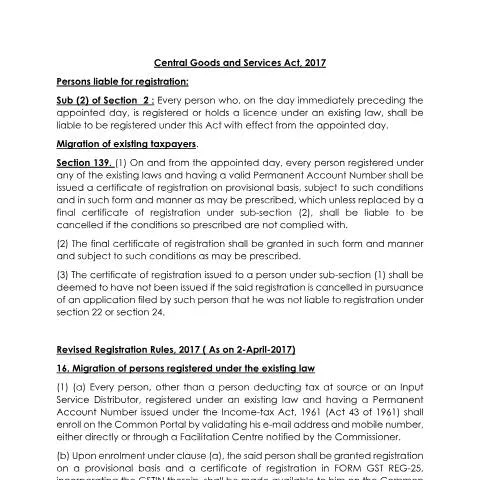
Navigating the Legal Provisions Migration Form: A Comprehensive Guide
The importance of the Legal Provisions Migration form cannot be understated in the context of the Goods and Services Tax (GST) framework in India. When you find yourself needing to comply with the legal requirements for migration, understanding the nuances of this document becomes essential. This guide is designed to provide a detailed exploration of the form, ensuring you are well-equipped to navigate the complexities involved in its submission and processing.
The Role of the Legal Provisions Migration in GST Compliance
The Legal Provisions Migration form plays a pivotal role in the overall framework of GST compliance. It serves as the connective tissue between existing tax frameworks and the new GST paradigm. This form is particularly significant for businesses transitioning from older tax regimes to the GST structure.
Understanding the Migration Process
- Submission: The form is submitted by businesses wishing to migrate their existing tax records to the GST system.
- Verification: Upon submission, the GST authorities verify the details provided to ensure compliance with legal provisions.
- Approval: Successful migration leads to the issuance of a GST registration, marking the official transition to the GST framework.
It is critical to understand that this process is not merely a formality; it facilitates the transition into a comprehensive tax structure that significantly impacts operational viability.
Who Needs to Fill Out the Legal Provisions Migration Form?
The requirement to fill out this form is not limited to one specific group. Various profiles are involved:
- Existing Taxpayers: Individuals or businesses already registered under previous tax regimes.
- New Entities: Businesses starting operations in India that need to comply with GST regulations from the outset.
- Foreign Entities: Non-resident businesses looking to establish a presence in India.
Each of these profiles has unique considerations and potential complexities in filling out the form.
Specific Scenarios: Complexity in Migration
Understanding special cases can make or break the migration process:
- Foreign Entities: Must provide additional documentation, demonstrating compliance with Indian regulations.
- Associated Companies: Businesses with multiple branches may face unique challenges, requiring careful attention to the details of each branch's tax records.
- Transitioning from Composition Scheme: Businesses moving from a composition scheme must ensure that the details reflect their current operational model under GST.
Breaking Down the Legal Provisions Migration Form: Section by Section
Filling out the Legal Provisions Migration form is an intricate task that requires careful attention to every section. Here, we dissect the form into its key components.
| Section | Description | Common Pitfalls |
|---|---|---|
| Basic Information | Includes details such as your GSTIN (Goods and Services Tax Identification Number) and business PAN (Permanent Account Number). | Ensure that all entries match exactly what is recorded with the tax authorities. |
| Business Details | Information about the business structure, including partners, directors, and shareholding. | Missing information about foreign shareholders can cause delays. |
| Tax History | History of tax payments and compliance prior to GST. | Omitting any discrepancies in previous compliance can lead to complications. |
| Bank Details | Bank account information that will be used for GST transactions. | Inaccurate account information can result in transaction failures. |
Every detail counts, and inaccuracies can derail the entire migration process. Take the time to verify each section thoroughly.
Implications of Submission: Rights and Obligations
When you submit the Legal Provisions Migration form, you are not just fulfilling a requirement; you are entering into a contract with the GST authorities.
Rights Upon Successful Submission
- GST Registration: Successful migration grants you a GST registration number, essential for compliance.
- Tax Input Credits: You gain access to input tax credits that are crucial for tax efficiency.
- Legal Recognition: Your business is recognized under the new GST framework, allowing for smoother operations.
Obligations after Submission
- Compliance with GST Regulations: Adherence to all GST filing and payment obligations is mandatory.
- Record Maintenance: You are required to maintain records of all transactions for a specified period.
- Timely Updates: Any changes in business structure must be reported to the GST authorities immediately.
Neglecting obligations could lead to penalties or loss of GST registration, adversely impacting your business operations.
What to Do in Case of Issues: Responses to Refusal or Missing Documents
Receiving a refusal or notification of missing documents after submitting the Legal Provisions Migration form can be disheartening. However, knowing the steps to remedy such situations is key.
Steps to Address a Refusal
- Review Notice: Carefully read the refusal notice for specific reasons.
- Gather Documentation: Compile all necessary documents that were either missing or incorrectly presented.
- Appeal Process: If you believe the refusal is unfounded, you have the right to appeal to the relevant GST adjudicating authority.
Handling Missing Documents
In instances of missing documents:
- Immediate Action: Quickly gather the requested documents.
- Submit Additional Documentation: Use the prescribed method for submitting any additional documents.
Ensuring a swift reaction can prevent delays in your migration process and maintain your compliance status.
Choosing the Right Submission Channel: Online vs Offline
Your choice of submission channel for the Legal Provisions Migration form can affect the efficiency and speed of your application. Both online and offline methods are available, each with its unique advantages.
Online Submission
- Convenience: You can submit your application anytime without needing to visit an office.
- Immediate Acknowledgment: Online submissions often come with instant confirmation of receipt.
- Tracking: The status of your application can be tracked easily through the GST portal.
Offline Submission
- Personal Interaction: For complex cases, face-to-face interaction with officials can be beneficial.
- Verification: In-person submissions allow for immediate verification of documents.
- Fewer Technical Issues: Submitting hard copies avoids potential technical glitches with online forms.
Ultimately, your choice of submission channel should align with your specific needs and capacities.
Final Considerations: Staying Ahead in Your Migration Journey
As you prepare to submit the Legal Provisions Migration form, consider the implications of this document on your business's future. Beyond mere compliance, this migration is a step towards unlocking new opportunities under the GST regime.
Engaging with Professional Support
Given the complexity of tax legislation, seeking the assistance of a qualified tax consultant can provide additional security in ensuring your migration is successful. Their expertise can help navigate potential pitfalls and streamline your application process.
Monitoring Compliance Post-Migration
Once migrated, ongoing compliance is essential. Make it a practice to regularly review your tax filings and maintain accurate records to avoid complications in the future.
By understanding the nuances of the Legal Provisions Migration form and preparing adequately, you can navigate this process smoothly and set your business up for success under the GST framework.
Understanding the Legal Framework for Migration in India
Migration in India is governed by a multitude of laws and regulations that address various aspects, including labor migration, refugee status, and the rights of migrants. The key legislation includes the Immigration Act of 1983, which outlines the provisions for the entry, exit, and deportation of foreign nationals. Additionally, the Foreigners Act of 1946 provides the foundational legal structure for regulating the presence of non-Indians in the country.
You should also familiarize yourself with the Passport (Entry into India) Act, 1920, which specifies the requirements for entering India. Furthermore, the Registration of Foreigners Act, 1939 mandates the registration of foreigners residing in India for more than 180 days. Understanding these laws is crucial for anyone involved in migration processes, as they define the legal obligations and rights of individuals.
Moreover, India is a signatory to various international treaties and conventions concerning the protection of migrants' rights, such as the International Convention on the Protection of the Rights of All Migrant Workers and Members of Their Families. It is essential to understand how these international frameworks interface with domestic laws, particularly in situations where individual rights may be at stake.
In addition to these frameworks, it is vital to note that various states and Union Territories may have their own regulations that apply to migration, which can lead to regional variations in the application of laws. This local complexity means that you must be vigilant about the specific requirements and processes in the state you are migrating to or within.
Procedures for Legal Migration to India
The process of legal migration to India involves several critical steps, each governed by specific administrative requirements. If you are a foreign national seeking to migrate, you must begin by determining the appropriate visa category for your situation. India offers various visa types, including tourist visas, student visas, employment visas, and business visas, each with distinct eligibility criteria and documentation requirements.
Visa Application: To apply for a visa, you must complete the relevant application form (for example, Form VFS/IVS for various visa categories) and submit it to the appropriate Indian embassy or consulate in your country. Ensure that you include all necessary documentation, such as a valid passport, photographs, and any other required supporting documents. The specific requirements may vary based on the visa type and your nationality.
Visa Processing: After submitting your application, the processing time may vary depending on the visa category. It is advisable to check with the embassy or consulate for estimated processing times, which can range from a few days to several weeks.
Visa Issuance: If your visa application is approved, you will receive a visa affixed to your passport. Make sure to verify the validity period and the specific conditions of your visa, as overstaying or violating visa conditions can have serious legal implications.
Registration Upon Arrival: Once you arrive in India, be aware that certain visa categories require you to register with the Foreigners Regional Registration Office (FRRO) or the Foreigners Registration Office (FRO) within 14 days of your arrival. Failing to do so can lead to penalties or even deportation.
Aadhaar Enrollment: If you plan to stay in India for an extended period, you may also wish to enroll for an Aadhaar number, as it is increasingly becoming essential for various services, including banking and healthcare. Aadhaar enrollment requires you to provide a valid visa and proof of residence, which underscores the importance of having your legal immigration status in order.
Challenges and Legal Recourse for Migrants
Migrants in India may face several challenges, ranging from bureaucratic hurdles to social integration issues. Understanding your legal rights and potential recourse options is essential if you encounter difficulties.
Bureaucratic Challenges: Navigating the Indian bureaucracy can be daunting. Delays in visa processing, difficulty in obtaining necessary permits, or even challenges in accessing services can be common. It is advisable to keep thorough records of all communications and documents related to your migration process. If you experience unjust delays, you can file a complaint with the Ministry of Home Affairs or the specific consulate handling your case.
Employment Issues: If you're migrating for work, be aware of your rights as an employee. India's labor laws, such as the Industrial Disputes Act, 1947, and the Minimum Wages Act, 1948, provide protection against unfair labor practices. If you believe your rights are being violated, you can approach the local labor office or seek legal assistance from an attorney specializing in labor law.
Social Integration Challenges: Acceptance and integration into local communities can sometimes be a challenge for migrants. You may encounter discrimination or social isolation. Engaging with local community organizations or migrant support groups can be invaluable in overcoming these challenges. These organizations can provide legal assistance, counseling, and even social networks that can help you acclimatize to your new environment.
Legal Representation: In cases where legal rights are violated or if you face immigration-related disputes, securing legal representation is crucial. Various legal aid organizations in India provide support to migrants needing assistance with their cases. Websites of organizations like The Legal Aid Society offer resources for finding legal help.
Emergency Support: In emergencies, such as threats to personal safety or wrongful detention, you can contact your country's embassy for immediate assistance. They can provide guidance on legal recourse, help facilitate communication with local authorities, and offer support in navigating the legal system in India.
Understanding these challenges and knowing the appropriate recourse options can significantly alleviate the stress associated with migration and ensure your rights are protected during your stay in India.