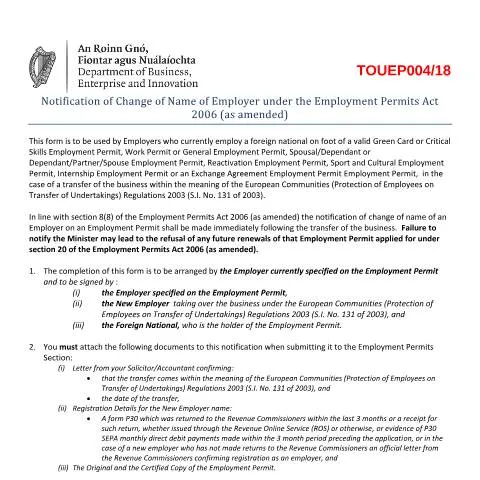
Understanding the Importance of the Dependant Employment Permits – Transfer of Undertaking Employer Form
In the dynamic landscape of employment in Ireland, the Dependant Employment Permits – transfer of undertaking employer form holds significant weight for both employers and foreign nationals. This form, recognized under the Employment Permits Act 2006 (as amended), is essential in situations where a business undergoes a transfer of ownership. It's crucial for employers to navigate this process effectively to ensure compliance with Irish law while safeguarding the rights of employees.
Who Takes Responsibility for Filing the Form?
The responsibility of completing and submitting this form lies primarily with the current employer specified on the relevant Employment Permit. However, it requires the collective effort of three key parties:
- The existing employer currently holding the Employment Permit.
- The new employer assuming control of the business.
- The foreign national employee holding the Employment Permit.
This trio of signatures affirms that all parties are aware of the transition and its implications. Notably, the submission must occur immediately following the business transfer to comply with legal obligations outlined in the aforementioned act.
Breaking Down the Form: Essential Sections to Complete
Completing this form necessitates attention to detail. Each section is pivotal in ensuring that the transfer is legally recognized. Let's delve into the critical sections:
Identification and Employer Information
The top portion of the form requires the Application ID or Employment Permit Number. This unique identifier is crucial for processing your submission efficiently. Following this, provide:
- Name of the Existing Employer: Exactly as it appears on the Employment Permit.
- Name of the New Employer: The legal name of the business taking over operations.
Any discrepancies here could lead to delays or complications.
Registration Details
For the new employer, registration details are mandatory. Include the registration number under relevant acts, such as:
- Companies Acts
- Limited Partnerships Act 1907
- Industrial and Provident Societies Acts
Providing accurate registration details helps establish legitimacy and compliance with regulatory bodies.
Signatures: Authorization and Acknowledgment
Each party—the current employer, the new employer, and the foreign national—must sign and date the form. This section is not just a formality; it signifies the agreement to the terms and confirms that the employment conditions remain unchanged post-transfer.
Critical Documents to Accompany the Form
Submitting the transfer form alone is insufficient; several supporting documents must accompany it. Here’s a comprehensive list:
- Letter from a Solicitor/Accountant: This letter must confirm the legality of the transfer in accordance with the European Communities (Protection of Employees on Transfer of Undertakings) Regulations 2003 and specify the transfer date.
- Registration Details: Include a returned P30 form to the Revenue Commissioners, or evidence of recent tax compliance, such as direct debit payments.
- Employment Permit: Both the original and a certified copy must be submitted to validate the foreign national's employment status.
Failure to include the required documentation can lead to rejection of the application, resulting in complications for the employee and the new employer.
Consequences and Reasons for Timeliness
Timing plays a crucial role in the filing of this form. As stipulated in section 8(8) of the Employment Permits Act 2006, employers must notify the Minister immediately following the transfer. Neglecting this can have serious repercussions:
- The inability to renew the Employment Permit when it expires.
- Potential legal challenges or penalties for the new employer.
Ensuring a prompt and complete submission protects the employment rights of the foreign national and maintains the employer’s standing with regulatory authorities.
Understanding the Historical Context of the Employment Permits Act
To appreciate the significance of the transfer form, it's essential to grasp the legislative backdrop that necessitates its existence. The Employment Permits Act 2006 was established to regulate the employment of non-EEA nationals in Ireland, providing a structured process for employment permits.
The regulation also aligns with European Union law, particularly the directive concerning the protection of employees during business transfers. This legal framework ensures that employees maintain their rights and conditions of employment despite changes in ownership. Understanding this historical context can help employers navigate compliance with greater awareness.
Special Cases: Navigating Unique Situations
Certain circumstances may complicate the completion of the form. Here are some scenarios to consider:
Multiple Employers
In instances where the business has undergone several ownership changes, it may be necessary to compile documentation from each preceding employer. This ensures a seamless transfer of rights and responsibilities to the new employer.
Minor Employees
If the foreign national is a minor, additional legal considerations come into play. Employers must ensure compliance with child employment laws and possibly obtain consent from guardians, further complicating the documentation.
Urgent Transfers
In cases of urgent business transfers, rapid action is required. Employers should prepare documentation in advance and consult legal advisors to ensure all requirements are met promptly, minimizing disruption to the foreign national's employment.
Submission Process: Where and How to Send Your Form
Once the form is completed and all necessary documents are gathered, the next step involves submission. The completed form, along with the supporting documentation, should be sent to:
Employment Permits Section, Department of Business, Enterprise and Innovation, Earlsfort Centre, Lower Hatch Street, Dublin 2, Ireland.Employers should consider using registered mail or a traceable courier service to ensure the form is received securely and on time. This step adds an extra layer of accountability during the submission process.
Post-Submission: What Happens Next?
Once the Employment Permits Section receives the submission, they will review it for completeness and adherence to legal requirements. The steps involved in this review process include:
- Verification of Documentation: The submitted documents will be scrutinized to ensure that they comply with regulations.
- Approval of Transfer: If all factors are in order, the Employment Permit will be re-issued under the new employer's name.
- Notification of Outcome: The employer will receive confirmation of the approval or rejection, along with any reasons for the latter.
It's vital for employers to keep track of this process and maintain communication with the Employment Permits Section to address any potential issues promptly.
Final Thoughts: Navigating the Transition Smoothly
The Dependant Employment Permits – transfer of undertaking employer form is not merely a bureaucratic step; it is a crucial document that protects the rights of employees and ensures compliance with Irish employment law. By understanding the nuances of this form and the associated processes, employers can facilitate smoother transitions during business changes. Keeping an organized approach and seeking legal counsel when necessary can significantly mitigate risks during this potentially complex undertaking.
Understanding Dependent Employment Permits in Ireland
The process of applying for a Dependent Employment Permit in Ireland is not merely a bureaucratic hurdle; it is a vital aspect of facilitating the movement of employees and their families, contributing to the overall workforce diversity. These permits, regulated by the Department of Enterprise, Trade and Employment, allow non-EEA family members of skilled workers to engage in employment while residing in Ireland.
To initially qualify, applicants must demonstrate that their family member possesses a relevant employment permit, such as a Critical Skills Employment Permit or a General Employment Permit. The importance of this relationship cannot be overstated, as the primary permit holder must prove they are actively working in a role listed on the eligible occupations as per the current occupation list.
When applying, the primary applicant must submit the Dependent Employment Permit application alongside supporting documents, including proof of the relationship (marriage or birth certificate), employment details of the primary permit holder, and evidence of residency or legal status in Ireland. The processing times can vary, but it generally takes about 8-12 weeks for the Department to process the application.
The Transfer of Undertaking and its Implications
The Transfer of Undertakings (Protection of Employment) Regulations 2003 (TUPE) is a critical framework within Irish labor law that affects how employment permits function. When a business is sold or transferred, existing employment permits may also transfer to new employers. This is particularly relevant for those holding Dependent Employment Permits, as their continued employment status may hinge on the primary permit holder’s job security.
Under TUPE, the new employer must continue all existing contractual obligations towards the employees, including the terms of their employment permits. Failure to comply with these regulations can result in legal issues for the new employer and create uncertainty for the dependent employees. If the dependent employee finds themselves without employment as a consequence of the transfer, they may be required to apply for a new permit or face potential deportation.
Furthermore, employers must ensure they properly notify the Department of Enterprise, Trade and Employment about any changes in the ownership of the business and provide necessary documentation proving compliance with TUPE regulations. This includes records of employment, copies of existing permits, and any notifications sent to employees regarding the transfer.
Navigating Application Challenges and Common Pitfalls
Applying for a Dependent Employment Permit can sometimes pose significant challenges, particularly for applicants unfamiliar with the Irish immigration system. Understanding potential pitfalls can streamline the application process and alleviate stress. One common issue is the lack of sufficient documentation; applicants must ensure they provide comprehensive evidence of their relationship to the primary permit holder. A simple oversight, such as not supplying a certified translation of documents in a foreign language, can lead to delays or rejections.
Moreover, incorrect or incomplete application forms can result in significant setbacks. For instance, an applicant must clearly indicate their employment intentions and ensure their proposed role aligns with the primary permit holder’s occupation. Misalignment can lead to the application being flagged for further scrutiny or outright refusal.
Another important consideration is the financial threshold required for dependent permits. The primary permit holder must demonstrate a minimum salary level, which may change annually. It is crucial to verify these figures from official sources to avoid potential rejection based on financial grounds.
Lastly, understanding the rights and responsibilities post-approval is vital. Dependent Employment Permit holders are entitled to the same employment rights as other employees in Ireland, including access to pension contributions and protection against unfair dismissal. This knowledge empowers applicants to navigate their employment landscape confidently.