Understanding the S83DB Declaration Form: A Guide for Irish Taxpayers
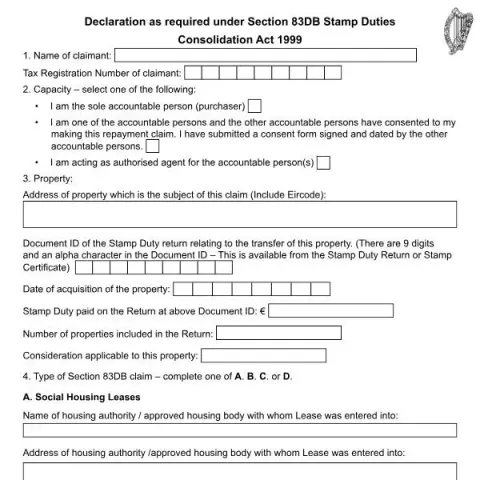
The S83DB Declaration form is an official document issued by the Revenue Commissioners of Ireland, designed to facilitate the repayment of stamp duty under specific circumstances outlined in Section 83DB of the Stamp Duties Consolidation Act 1999. This form is primarily relevant for individuals or entities involved in property transactions or management of designated centres, such as social housing or children’s residential centres, seeking to claim a refund of stamp duty paid on qualifying properties.
Objective and Scope of the S83DB Form
The main purpose of the S83DB declaration is to confirm eligibility for a stamp duty repayment under certain conditions. These conditions include properties designated as social housing leases, cost rental dwellings, or registered as designated centres or children’s residential centres. The form acts as a formal claim, providing the Revenue Commissioners with necessary details to process the repayment request.
It is essential for claimants to understand that this declaration is a legal statement. Making false declarations can lead to penalties, including the repayment of the stamp duty amount with interest, and potential sanctions under Irish tax law.
Preparing Your Submission
Gathering Required Information
Before completing the S83DB form, claimants should assemble key details, including:
- Name and Tax Registration Number (PRSI/Tax Number) of the claimant
- Details of the property, including address with Eircode, Document ID from the Stamp Duty return, date of acquisition, and the amount of stamp duty paid
- Information about the property’s designation, such as the date it was registered as a designated centre or children’s residential centre, or the date it was designated as a cost rental dwelling
- Details of the relevant lease or agreement, including the name and address of the housing authority or approved body, lease date, rent payable, and duration
Completing the Form
The form is structured into clear sections to capture all necessary data:
- Claimant Details: Name, tax number, and capacity (e.g., sole accountable person, authorised agent)
- Property Details: Address, Document ID, acquisition date, stamp duty paid, and consideration
- Claim Type: Select one of the options A through D, corresponding to the property’s designation
- Declaration and Signature: The claimant must sign and date the declaration, confirming the accuracy of the information provided.
Submission and Filing Options
The S83DB form can be submitted either online via the Revenue Online Service (ROS) platform or by paper. For online submissions, claimants need a MyGovID or ROS login, which provides secure access to their tax and property records.
If submitting a paper form, it should be sent to the appropriate Revenue office, with copies of supporting documentation such as the Stamp Duty return or certificates attached. It is advisable to retain proof of submission and any correspondence for future reference.
Processing and Follow-up
Once received, the Revenue Commissioners review the claim to verify eligibility. This process may involve cross-checking property registration details, lease agreements, and stamp duty payments. The processing time varies depending on the complexity of the case and the completeness of the submission.
Claimants will be notified of the outcome, and if approved, the stamp duty repayment will be issued via bank transfer or credited to the claimant’s tax account. It is important to note that the repayment is contingent upon maintaining the property in accordance with the relevant legal provisions for at least 10 years, to prevent clawback of the refunded amount.
Fill in your form directly online
No printing: type your details into the boxes of the official form, tick, then download the PDF ready to send.
- 1Type into the form boxes
- 2Tick in one click
- 3Save and download the PDF
Important Legal and Data Considerations
Making a false declaration under the Irish tax law carries penalties, including repayment of the stamp duty amount with interest, and potential criminal sanctions. The Revenue Commissioners are authorized to collect personal data necessary for tax and property administration, and this data may be shared with other government departments as permitted by law.
Claimants are encouraged to review the Revenue’s data privacy policy, available on the revenue.ie website, to understand how their personal information will be handled during the process.
Key Contacts and Resources
For assistance with completing the S83DB form or questions about the process, taxpayers can contact the Revenue Commissioners directly through their official channels. Additional guidance and detailed instructions are available on the Revenue.ie website, ensuring claimants have access to the latest information and procedural updates.