Understanding the Third Party Request for Landlord Details Form in Ireland
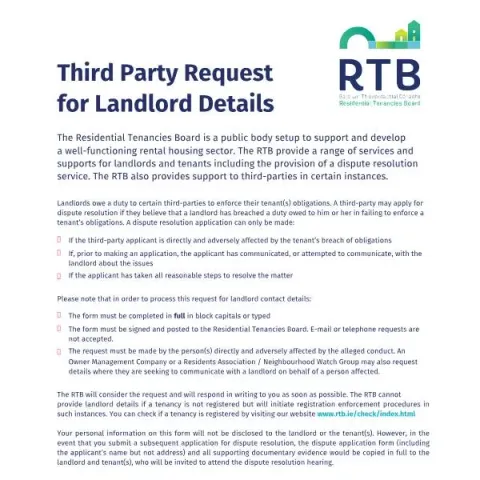
The Residential Tenancies Board (RTB) in Ireland provides a specific form, known as the Third Party Request for Landlord Details, designed to assist third parties in obtaining contact information for landlords. This process is essential when an individual or organisation believes that a landlord has failed to uphold their obligations under tenancy law, and they need to communicate directly with the landlord to address a dispute or issue.
Purpose and Scope of the Form
This form is not an application for dispute resolution itself but a procedural step to access landlord contact details. It allows individuals or groups who are directly and adversely affected by a landlord’s conduct to request the landlord’s contact information from the RTB. Such third parties might include neighbours, residents’ associations, or other affected individuals seeking to resolve issues related to tenancy breaches.
The RTB will process the request and respond in writing. It is important to note that the RTB cannot provide landlord details if the tenancy is not registered with them. In such cases, the RTB will initiate enforcement procedures to ensure the tenancy is registered, which is a legal requirement under Irish law.
Who Can Fill Out the Form?
The form must be completed by the person or organisation who is directly and adversely affected by the alleged breach of tenant obligations. This includes:
- Individuals experiencing issues with a landlord's failure to enforce tenant obligations.
- Owner Management Companies seeking to communicate with the landlord on behalf of affected residents.
- Residents’ associations or neighbourhood watch groups acting on behalf of affected members.
It is crucial that the applicant demonstrates that they have attempted to resolve the issue directly with the landlord before requesting their details from the RTB.
How to Complete the Form
The form must be filled out in full either in block capitals or typed. It includes several sections:
Fill in your form directly online
No printing: type your details into the boxes of the official form, tick, then download the PDF ready to send.
- 1Type into the form boxes
- 2Tick in one click
- 3Save and download the PDF
- Personal and Organisation Details: including your first name, surname, organisation name (if applicable), address, phone number, and email.
- Rented Property Details: including the address of the rental dwelling.
- Proof of Identity and Address: copies of official documents such as a passport or driver’s license, and proof of address, are required to verify your identity.
- Description of the Alleged Breach: detailed information about the breach of tenant obligations, referencing relevant legal obligations under the Residential Tenancies Act.
- Impact and Efforts to Resolve: explanation of how you are directly and adversely affected, including the distance between your property and the rental property, and details of your attempts to contact the landlord.
- Declaration and Signature: confirming the accuracy of information provided and agreeing to use the landlord’s details solely for communication purposes.
Submission and Privacy Considerations
The completed form must be signed and posted to the RTB at the specified address. Requests sent via email or telephone are not accepted. The RTB emphasizes that your personal data will be kept confidential and only used for the purpose of facilitating contact with the landlord. The RTB will not disclose your information to the landlord or tenant(s) unless you submit a dispute resolution application later, in which case your details (excluding address) may be shared with the involved parties.
Important Tips and Common Mistakes
- Ensure the form is fully completed: missing information can delay processing.
- Include all required documentation: proof of identity and address are mandatory.
- Describe the breach clearly and accurately: vague or incomplete descriptions may lead to rejection.
- Demonstrate your efforts to contact the landlord: this shows good faith and adherence to procedural requirements.
Conclusion
The Third Party Request for Landlord Details form is a vital tool for individuals seeking to resolve tenancy issues through direct communication with landlords. Proper completion, along with supporting documents and adherence to procedural rules, ensures that the RTB can facilitate this process efficiently. Remember, this form is a step towards resolving disputes or concerns, and understanding its purpose and proper use can significantly impact the outcome of your case.