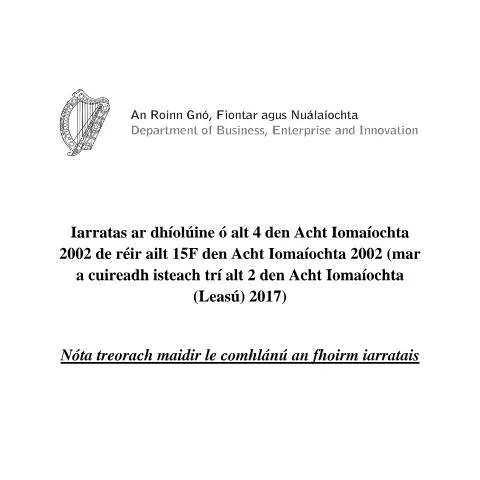
Understanding the Trade Union Exemption Application under Section 4 of the Competition Act 2002 in Ireland
The Department of Enterprise, Tourism and Employment provides guidance for trade unions seeking exemption from Section 4 of the Competition Act 2002. This exemption pertains specifically to certain categories of self-employed workers involved in collective activities, aiming to clarify the application process and ensure compliance with legal requirements.
Purpose and Scope of the Guidance
This guidance document aims to assist trade unions in correctly completing and submitting their application forms for exemption under the Competition Act 2002. The exemption sought relates to specific activities of self-employed workers, particularly those that might otherwise be considered anti-competitive under Irish law.
It is important to understand that any application submitted to the Minister for Business, Enterprise and Innovation (now the Minister for Enterprise, Trade and Employment) must specify the category of self-employed workers for which exemption is being requested, in accordance with Code 2B of the Act. The application process involves demonstrating that the activities of the trade union fall within the legal provisions that allow for exemption, specifically under sections 15E and 15F of the Act.
Legal Framework and Key Definitions
The legislation relevant to this process includes the Competition Act 2002, as amended by the Competition (Amendment) Act 2017. The Act defines specific categories of self-employed workers:
- Fake self-employed workers: Individuals who act under a contract but perform tasks similar to an employee, yet lack the independence and risk associated with genuine self-employment.
- Fully independent self-employed workers: Individuals providing services under a contract, earning income based on their service provision, and operating independently of the contracting party.
These definitions are crucial because applications for exemption must include evidence that the workers involved fit into these categories, and that their activities do not contravene competition law.
Application Process and Required Information
The application must contain comprehensive details about the trade union and the workers involved:
Details of the Trade Union
- Name, address, and contact information of the trade union making the application.
- Proof that the trade union holds a valid negotiation license issued under the Trade Union Act 1941, including license number and relevant details.
Information about Self-Employed Workers
- Clear identification of the workers covered by the application, including the total number of workers and their classification (fake or fully independent).
- Evidence demonstrating that the workers meet the legal definitions of either fake or fully independent self-employed workers, supported by detailed economic and legal analysis.
- Proof that all covered workers are members of the applying trade union and that their dues are fully paid at the time of application.
Evidence and Supporting Documentation
Applicants must provide sufficient evidence to justify the classification of workers and their activities. This includes:
- Legal analysis confirming the workers' status based on the definitions in sections 15D and 15F of the Act.
- Economic analysis illustrating how the workers' activities align with the exemption criteria.
- Documentation proving membership and dues payment status for all workers covered by the application.
Implications of the Application
Successful exemption allows the trade union to engage in collective activities involving the specified categories of self-employed workers without infringing competition law provisions. It provides legal clarity and protection for collective bargaining and other related activities, provided all conditions are met and adequately documented.
Fill in your form directly online
No printing: type your details into the boxes of the official form, tick, then download the PDF ready to send.
- 1Type into the form boxes
- 2Tick in one click
- 3Save and download the PDF
It is essential that applications are complete and thoroughly supported by evidence, as incomplete submissions will be returned for correction. Applicants are advised to review the relevant legislation carefully and seek legal advice if necessary to ensure compliance.
Conclusion
The process of applying for a trade union exemption under Section 4 of the Competition Act 2002 involves detailed preparation and adherence to legal definitions and requirements. By providing comprehensive information and supporting evidence, trade unions can seek legal protection for their activities involving certain categories of self-employed workers, facilitating collective action within the bounds of Irish competition law.