Navigating the ACRES Advisors Subcontract Form: An Essential Tool for Agricultural Agents
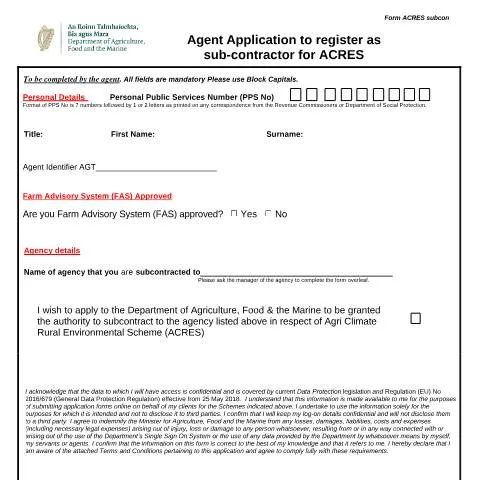
The ACRES Advisors Subcontract Form is a crucial document for agricultural agents who wish to register as subcontractors under the Agri Climate Rural Environmental Scheme (ACRES). This scheme, initiated by the Department of Agriculture, Food and the Marine, aims to incentivize sustainable farming practices and address climate change. Understanding the intricacies of this form is vital for compliance and successful participation in the program.Understanding the ACRES Framework: The Role of the Subcontract Form
Before delving into the specifics of the form, it’s essential to grasp its context within the broader ACRES initiative. The Agri Climate Rural Environmental Scheme is designed to improve the sustainability of farming practices while enabling farmers to contribute positively to the environment. The ACRES Advisors Subcontract Form allows approved agricultural agents to subcontract specific tasks related to these schemes. Without this form, agricultural agents cannot effectively support farmers in accessing the resources and guidance offered through ACRES. It serves as a formal application to grant agents the authority to act on behalf of the farmers they assist, ensuring that all parties involved have the necessary permissions and legal backing.Key Distinctions: ACRES Advisors Subcontract Form vs. Other Agricultural Forms
It's easy to confuse the ACRES Advisors Subcontract Form with other agricultural documentation, such as the Basic Payment Scheme (BPS) application form or the Common Agricultural Policy (CAP) forms. However, the ACRES form has unique features tailored specifically for subcontracting within the context of the ACRES initiative.- Purpose: While BPS forms primarily deal with direct payments to farmers for land management, the ACRES form focuses on the registration of agents subcontracting within a specific environmental framework.
- Approval Requirement: The ACRES form requires agents to be approved under the Farm Advisory System (FAS), a stipulation not present in all agricultural forms.
- Confidentiality and Data Protection: This form emphasizes strict adherence to data protection regulations, which is a critical aspect considering the sensitive nature of client information handled by agents.
Decoding the ACRES Advisors Subcontract Form: Section by Section
Completing the ACRES Advisors Subcontract Form requires attention to detail. Each section is designed to collect specific information necessary for the Department of Agriculture, Food and the Marine to process applications effectively.Personal Details: The Foundation of Your Application
The initial section requires basic personal information, including:- Agent Identifier: A unique identifier assigned to the agent.
- Personal Public Services Number (PPS No): This is mandatory for identity verification, formatted as seven digits followed by one or two letters.
- Name and Contact Information: Essential for communication purposes.
Professional Indemnity Insurance: Mandatory Confirmation
Agents must confirm that their agency has professional indemnity insurance. This protects both the agent and the farmers they serve from potential liabilities arising from the advice given under the ACRES scheme. Failure to provide this confirmation can result in immediate rejection of the form.Agency Details: Collaboration and Accountability
This section must be completed by the manager of the agency to whom the agent is subcontracted. It requires:- Agency Name: The official name of the agency.
- Agriculture Agency Number: This unique number is vital for identification purposes and should be sourced directly from the Department of Agriculture, Food and the Marine.
Declarations: Acknowledging Responsibilities
This portion emphasizes the agent’s understanding of data protection regulations and the responsibilities tied to handling sensitive information. Agents must acknowledge that they will use the information provided solely for the intended purpose and agree not to disclose it to unauthorized third parties.The Timeline: Key Dates and Expected Outcomes
Understanding the timeline associated with submitting the ACRES Advisors Subcontract Form is essential for agents. The application must be submitted by email to the designated department address or mailed to the specified office in Wexford.- Submission Period: Ensure all applications are submitted within the designated timeframe set by the Department, which typically aligns with the opening of ACRES application periods.
- Processing Duration: After submission, the Department will review applications. While specific timelines may vary, agents should anticipate several weeks for processing.
- Notification of Outcome: Successful applicants will be notified via email and provided with further instructions on their next steps.
Integrating the ACRES Form into Broader Agricultural Practices
For agricultural agents, the ACRES Advisors Subcontract Form is just one piece of a much larger puzzle. Agents must also be familiar with other programs and forms, including the Basic Payment Scheme and other environmental initiatives. The ability to navigate these interconnected programs is vital for providing comprehensive support to farmers. Understanding how the ACRES initiative complements other agricultural policies allows agents to offer more robust advice, ensuring farmers can maximize their participation in sustainability efforts while also meeting regulatory requirements.Implications of Non-Compliance: Risks and Consequences
Agents must recognize the importance of compliance with the ACRES Advisors Subcontract Form and the broader ACRES framework. Failing to submit the form correctly or neglecting the associated responsibilities can expose agents and their clients to several risks:- Legal Liabilities: Without proper authorization, agents may inadvertently expose themselves and their clients to legal challenges arising from misrepresentation or unauthorized practices.
- Loss of Access: Agents who do not complete the form correctly may find themselves unable to participate in the ACRES program, depriving farmers of vital resources and support.
- Reputational Damage: Non-compliance can lead to damaged relationships with clients and regulatory bodies, hindering future opportunities and collaborations.
Practical Tips for Successful Completion and Submission
To ensure a smooth application process, agents should consider the following practical tips when completing the ACRES Advisors Subcontract Form:- Double-Check Personal Information: Review all entries for accuracy before submission to avoid delays.
- Consult with Agency Manager: Collaborate closely with the agency manager to ensure all necessary sections are filled out correctly.
- Stay Updated on ACRES Guidelines: Regularly check for any changes in the ACRES framework or relevant legislation that might impact the application process.
- Maintain a Copy of the Submission: Keep a record of the submitted form and any correspondence for future reference.
Final Thoughts: The Importance of Being Informed
The ACRES Advisors Subcontract Form plays a pivotal role in the agricultural landscape of Ireland, facilitating essential collaboration between agents and farmers. By grasping the details of this form and the broader ACRES context, agents can position themselves as valuable partners in advancing sustainable agricultural practices. Understanding the obligations, benefits, and potential consequences linked to this form is essential for any agent looking to make a meaningful impact in Irish agriculture. As sustainability becomes increasingly critical, the role of dedicated agricultural agents equipped with the right knowledge and tools will only grow in importance.Understanding the ACRES Advisory Role
The Agricultural and Climate Research (ACRES) programme, managed by the Department of Agriculture, Food and the Marine (DAFM), is pivotal for guiding farmers in Ireland towards sustainable practices. As an ACRES advisor, one must not only possess a deep understanding of agricultural science and climate change effects but also be well-versed in the intricacies of Irish agricultural policy. ACRES advisors play a critical role in helping farmers navigate the complexities of compliance and find funding opportunities. They provide tailored advice based on farm-specific circumstances, which can include soil health, biodiversity enhancements, and climate resilience strategies.
Furthermore, ACRES advisors are responsible for facilitating the completion of the ACRES Subcon Form, which is essential for farmers to participate in the programme. This form requires detailed information regarding the environmentally sustainable practices that the applicant intends to implement on their farm. It is crucial for advisors to guide farmers through this process, ensuring they understand the eligibility criteria, as well as the types of information that need to be disclosed. This includes specifics such as the farm's land use, existing environmental measures, and proposed actions to enhance sustainability. Advisors should also stay updated on the latest developments in agricultural policies and EU funding opportunities to provide comprehensive support.
Common Challenges faced by Farmers in Completing the ACRES Subcon Form
Completing the ACRES Subcon Form can be a daunting task for many farmers, especially those who may not be familiar with the nuances of agricultural policy or regulatory requirements. One of the most common challenges is the need for accurate data collection. Farmers need to provide precise information about their farming practices, which may require them to gather data from various sources, including land maps and environmental assessments. The requirement for precise information often leads to confusion, particularly if farmers have been accustomed to less stringent reporting guidelines.
Another significant issue is the time commitment required to fill out the form. Many farmers balance multiple responsibilities, and the ACRES Subcon Form can be time-consuming. Advisors often advise clients to start the process early to alleviate some of the time-related stress. Farmers should also be aware that the availability of support services, such as workshops or one-on-one sessions with advisors, can be beneficial in preparing them to complete the form efficiently.
Furthermore, understanding the criteria for acceptance into the ACRES programme can pose another hurdle. Each farm is unique, and what might be an acceptable practice for one farmer may not suffice for another. Therefore, it is essential for advisors to help farmers clearly understand the requirements and tailor their submissions accordingly. Engaging in proper planning sessions that discuss both current practices and future goals can significantly enhance the quality of the information provided in the form.
Future Developments and Sustainability in the ACRES Programme
The ACRES programme is not static; it is expected to evolve in response to changing agricultural landscapes and climate challenges. Future developments may include expanded funding opportunities and the introduction of new, innovative practices aimed at enhancing sustainability in Irish agriculture. As the EU continues to shape agricultural policies through the Common Agricultural Policy (CAP), Irish farmers must stay informed about how these changes may affect their participation in ACRES and other related initiatives.
Moreover, there is a growing emphasis on integrating technology into the ACRES programme. Digital tools such as precision farming and remote sensing can provide farmers with valuable data to enhance their sustainability efforts. Advisors will play a significant role in encouraging farmers to adopt these technologies, helping them to understand the benefits and how best to implement these practices alongside traditional methods. This integration of technology could lead to improved farm efficiency and reduced environmental impact, aligning with the overarching goals of ACRES.
Lastly, as climate change continues to be a pressing global issue, the ACRES programme is likely to become increasingly focused on resilience strategies. This could involve training farmers on how to adapt their practices in response to climate variability, as well as supporting research into resilient crop varieties and sustainable livestock management. Advisors will need to be well-informed about these developments to provide relevant, forward-thinking guidance to their clients.