Understanding the Gender Equality Report: A Key Document for Ireland
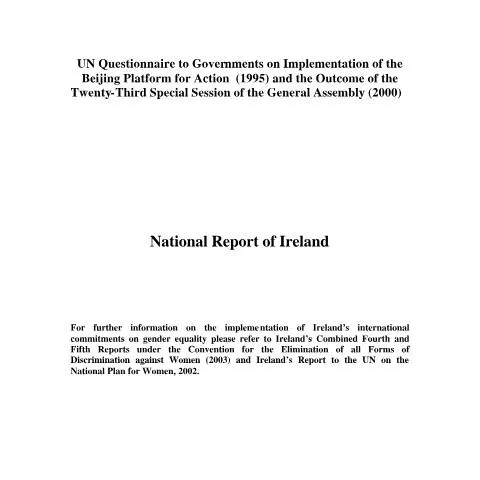
The National Report of Ireland 2004 in response to the UN Questionnaire on the implementation of the Beijing Platform for Action (1995) serves as a critical document that reflects Ireland's commitment to gender equality. This report, submitted to the Department of Children, Disability and Equality, encapsulates the achievements, challenges, and ongoing efforts in advancing gender rights since the historic conference in Beijing. The document is not merely a bureaucratic formality; it is an essential reflection of societal progress and accountability to international standards.
A Historical Context: The Evolution of Gender Equality in Ireland
The journey towards gender equality in Ireland has been marked by significant milestones, starting from the 1972 Report of the Commission on the Status of Women. This foundational report highlighted the pervasive inequalities faced by women and set the stage for transformative legislative and policy actions. By the time the Fourth UN World Conference on Women convened in 1995, Ireland had already made strides in addressing these issues, as evidenced by the various progress reports published in the following years.
Key Milestones Leading Up to 2004
- 1993 Report of the Second Commission on the Status of Women: This report introduced 210 recommendations aimed at improving women's status in society.
- 1994-1999 National Progress Reports: These documents verified the implementation of the majority of prior recommendations, showcasing Ireland's dedication to gender equality.
- 2000 Launch of the Statutory Minimum Wage: A pivotal step to ensure fair compensation, particularly benefiting women in the workforce.
Document Structure: Decoding the National Report
The National Report is structured to provide comprehensive insights into the experience of implementing UN commitments on gender equality since 1995. Each section offers a detailed analysis of actions taken and progress made, serving both as a historical account and a guide for future initiatives.
Sections of the Report
- Background and Historical Overview: Discusses previous reports and the broader context.
- Main Developments (1995-2004): Reports specific achievements, including statistics on women's labor force participation and representation in management.
- Implementation Experience of the PFA: Analyzes the practical implications of the commitments made.
The Process of Submission: From Preparation to Delivery
Completing and submitting this National Report is an intricate process that involves multiple stakeholders and careful consideration of the data presented. The report was crafted through extensive consultations and data collection within various governmental and non-governmental organizations.
Steps to Complete the Submission
- Engagement with Stakeholders: Involvement of various groups to gather comprehensive data.
- Analysis of Gender Equality Policies: Review of current policies to assess effectiveness.
- Drafting the Report: Compilation of findings into a structured format.
- Submission to the Department: Finalizing and submitting to the Department of Children, Disability and Equality.
Critical Insights: Achievements and Challenges Post-2004
The report outlines several noteworthy achievements in gender equality, along with persistent challenges that need addressing. While progress has been made, particularly in women's labor force participation rising to 55%, disparities remain, such as the gender pay gap and representation in leadership roles.
Achievements Highlighted in the Report
| Achievement | Description |
|---|---|
| Increased Participation in Workforce | Women's labor force participation rose significantly, indicating a shift in societal norms and economic engagement. |
| Narrowing Gender Pay Gap | The gender pay gap decreased from 18% to 15% from 1994 to 2000, reflecting legislative improvements. |
| Improved Representation | Women constituted 30% of state boards, marking progress in leadership roles. |
Unpacking the Form: Key Sections of the National Report
The report consists of sections that detail specific commitments and outcomes under the Beijing Platform for Action. Understanding these sections is crucial for stakeholders engaged in gender equality initiatives.
Key Sections Explained
- Gender Mainstreaming in Policies: Focus on integrating gender perspectives in all policy areas.
- Women’s Health Strategy: Addressing specific health issues faced by women, launched in 1997.
- Combatting Violence Against Women: Enhanced structures and strategies developed to tackle this critical issue.
Case Scenarios: Addressing Unique Circumstances
While the report captures broad trends and achievements, it also highlights the need for tailored approaches to address specific demographics and challenges. Different groups, such as immigrants, minors, and those facing socio-economic barriers, require unique considerations.
Special Considerations for Various Groups
- Immigrant Women: Addressing unique challenges faced by immigrant women in accessing services and support.
- Young Girls: Initiatives focusing on educational and economic opportunities for girls.
- Women in Rural Areas: Specific programs designed to support women’s economic activities in less populated regions.
Documenting Evidence: Justifications and Data Collection
The credibility of the National Report relies heavily on the evidence and data presented. Collecting and documenting appropriate evidence is essential for accurately portraying Ireland's gender equality landscape.
Preparing Supporting Documentation
Types of Data and Evidence Required- Statistical Data: Labor force participation rates, gender pay gap statistics.
- Case Studies: Real-life examples of successful gender equality initiatives.
- Policy Documents: Existing legislation and frameworks supporting gender equality.
The Future of Gender Equality Reporting in Ireland
As Ireland continues to navigate its commitments to gender equality, the role of such reports will only become more critical. The national report is not an endpoint; rather, it is a stepping stone toward ongoing dialogue and policy refinement.
Looking Ahead
- Continuous Monitoring: Ongoing assessment of gender equality policies is crucial for future reports.
- Inclusion of Diverse Voices: Engaging a broader range of stakeholders for more comprehensive insights.
- Focus on Outcomes: Emphasizing the impact of policies on real lives will be essential for future documentation.
Historical Context of Gender Equality in Ireland
To understand the current landscape of gender equality in Ireland, it's essential to consider its historical context. The role of women in Irish society has evolved significantly over the decades, particularly since the establishment of the State in 1922. Initially, traditional gender roles were deeply ingrained, with women primarily seen as homemakers and caregivers.
The 1970s marked a turning point, driven by the global feminist movement. Policies began to emerge aimed at addressing disparities in employment, education, and legal rights for women. The introduction of the Employment Equality Act in 1977 set the groundwork for combating discrimination in the workplace based on gender.
Furthermore, the ratification of key international agreements, such as the Convention on the Elimination of All Forms of Discrimination Against Women (CEDAW) in 1985, prompted the Irish government to reassess and reform its policies regarding gender equality. Ireland's national report in response to the UN questionnaire in 2004 reflects these historical shifts, showcasing both progress and lingering challenges in implementing gender equality policies.
Current Legislative Framework Supporting Gender Equality
As of 2023, Ireland boasts a robust legislative framework supporting gender equality, influenced by both EU directives and national policies. The Gender Recognition Act 2015 was a landmark piece of legislation, allowing individuals to self-define their gender, which is a significant step towards inclusivity.
The Irish government has also enacted the National Strategy for Women and Girls 2017-2020, which aims to address systemic barriers faced by women and promote gender equality across various sectors, including health, education, and the workplace. This strategic framework includes measurable targets and sets an agenda for ongoing consultation and assessment to ensure accountability.
Moreover, the Gender Equality Bill, currently under consideration, proposes a variety of measures to tackle gender-based discrimination and promote equal representation in decision-making roles across public and private sectors. Key provisions include mandatory gender quotas for political candidates and measures to enhance women's participation in leadership roles within companies and organizations.
Challenges and Areas for Improvement
Despite significant advancements in gender equality in Ireland, several challenges remain that require ongoing attention. Gender-based violence is a pressing issue, with the government committing to the implementation of the Third National Strategy on Domestic, Sexual and Gender-Based Violence 2016-2021. However, there are criticisms regarding the adequacy of resources allocated for the support services and the effectiveness of current measures.
Another area of concern is the gender pay gap, which remains a persistent issue. The Central Statistics Office (CSO) reported in its 2021 data that women earn approximately 14% less than men, a disparity that exists across various sectors and job levels. While the Gender Pay Gap Information Act 2021 aims to tackle this issue by requiring companies to report their pay data, the implementation and enforcement of these regulations are crucial for achieving real change.
Additionally, the underrepresentation of women in leadership and decision-making roles within both public and private sectors continues to be a significant barrier to achieving true gender equality. While initiatives such as the 30% Club have emerged to advocate for increased female representation on corporate boards, a cultural shift is necessary to challenge the status quo.
Lastly, intersectionality must be a priority in addressing gender equality. Marginalized groups, including women from ethnic minorities, LGBTQ+ individuals, and those with disabilities, often face compounded discrimination. Thus, tailored approaches are required to ensure that gender equality policies are inclusive and reflect the diverse experiences of all women in Ireland.