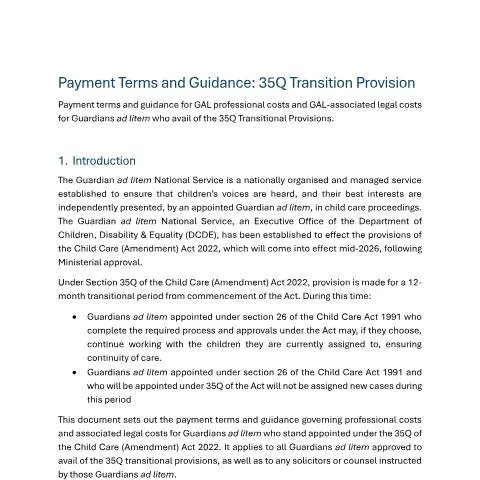
Understanding the Transition as a Guardian ad Litem under Section 35Q
In the child care proceedings in Ireland, the role of a Guardian ad litem (GAL) is crucial, especially in ensuring that the voice of the child is heard. As the Child Care (Amendment) Act 2022 paves the way for significant changes in the child care system, the application for transition as a Guardian ad litem under Section 35Q becomes a vital document. This section outlines the payment terms and guidance for those who choose to avail themselves of this transition. For professionals in the field, understanding this document is paramount, as it not only affects their responsibilities but also the well-being of the children they serve.
The Background of the Guardian ad Litem National Service
The Guardian ad litem National Service, under the Department of Children, Disability and Equality (DCDE), aims to ensure that children's voices are represented independently during care proceedings. The establishment of this service is rooted in the provisions of the Child Care (Amendment) Act 2022, which is designed to enhance the participation of children in legal processes affecting them.
Section 35Q specifically introduces a transitional period of 12 months for Guardians ad litem currently appointed under Section 26 of the Child Care Act 1991. This allows them to continue working with their assigned children post-amendment, ensuring a seamless transition in care during a time of significant reform in child welfare legislation.
Who Must Complete the Application?
The application to transition as a Guardian ad litem under Section 35Q is required for:
- Guardians ad litem currently appointed under Section 26 of the Child Care Act 1991.
- New Guardians ad litem who are to be appointed under Section 35Q of the Child Care (Amendment) Act 2022.
It is essential for these individuals to understand their responsibilities as outlined in the Act and the implications of the transition on their existing cases.
Navigating the Application Process: A Step-by-Step Guide
Completing the application to avail of the transition under Section 35Q involves several steps. Below is a structured approach to ensure a smooth process:
- Gather Necessary Documentation: Ensure all required personal and professional documentation is in order, including previous appointment letters and relevant identification.
- Review Payment Terms: Familiarize yourself with the payment terms and conditions that govern the financial aspects of your role. This includes understanding the GAL professional costs and GAL-associated legal costs.
- Complete the Application Form: Fill out the application with accurate details, ensuring compliance with all specified guidelines.
- Submit the Application: Choose your submission method—either online or by post—keeping in mind that electronic submissions may expedite the processing time.
- Await Confirmation: After submission, monitor for the confirmation of your application status from the Guardian ad litem National Service.
Each step is integral to ensuring that your application is processed efficiently, allowing you to continue your vital work with children in care.
Payment Terms for Guardians ad Litem under the 35Q Provisions
Understanding the payment framework is crucial for Guardians ad litem navigating the transitional provisions. Under Section 35Q, two categories of costs can be claimed:
1. GAL Professional Costs
This category includes expenses incurred directly by the Guardian ad litem, such as:
- Time spent engaging with children and relevant parties.
- Preparation and submission of court reports.
- Attendance at court hearings, including all preparatory work.
- Travel expenses related to case activities.
2. GAL-Associated Legal Costs
These costs arise from legal representation and include:
- Solicitor fees for legal advice and representation.
- Counsel fees, if applicable.
- Necessary disbursements that are properly documented.
Additionally, it is vital to note that while GAL professional costs are exempt from Value-Added Tax (VAT), legal services provided to GALs are subject to VAT.
Essential Invoicing Protocols
Proper invoicing is critical for timely payments and maintaining clarity. Observing the following guidelines will ensure compliance:
- Each Guardian ad litem must submit one invoice per case per month.
- Invoices must be submitted electronically to the designated payments mailbox by the 5th of the following month.
- Late submissions may lead to delays in processing and payment.
Utilizing the standard invoice template provided by the Guardian ad litem National Service will facilitate a smooth validation process. Invoices should reflect precise and complete information regarding the services rendered.
Preparing Supporting Documentation: A Checklist
To support your application and invoicing process, it is crucial to prepare the necessary documentation meticulously. Here’s a checklist of what to include:
| Document Type | Description | Requirement |
|---|---|---|
| Appointment Letter | Proof of your current status as a Guardian ad litem. | Mandatory |
| Professional Hours Log | Record of hours spent on case-related activities. | Mandatory |
| Travel Records | Documentation for travel expenses incurred. | As applicable |
| Legal Representation Invoices | Invoices from solicitors or counsel, if applicable. | As applicable |
Ensuring that all supporting documentation is complete and accurate will facilitate prompt processing of your application and payments.
Unique Scenarios: Handling Complex Cases
While the above guidelines serve as a general framework, it is essential to recognize the variety of situations that may arise. Here are a few considerations for unique cases:
- International Guardianship: Guardians ad litem dealing with cross-border cases may need additional documentation, including proof of jurisdiction and any relevant international legal agreements.
- Cases Involving Minors: When representing minors, ensure that all necessary consent forms are completed and that the welfare of the child remains paramount throughout the process.
- Urgent Applications: In situations requiring immediate attention, such as potential endangerment of a child, it may be necessary to expedite the application process. Communicating directly with the Guardian ad litem National Service may facilitate faster processing.
Each case presents its own complexities; thus, being well-versed in the specific requirements for these variations is essential for Guardians ad litem.
Consequences of Non-compliance and Oversight
Guardians ad litem must adhere to the guidelines provided to avoid potential repercussions. Non-compliance can result in:
- Delayed payment processing, impacting financial stability.
- Possible rejection of invoices resulting from inaccuracies or missing information.
- Legal ramifications in extreme cases, particularly concerning the welfare of the child involved.
It is imperative to remain attentive to deadlines and the accuracy of all documentation to prevent such issues from arising.
The Broader Context of the 35Q Application
The application to transition as a Guardian ad litem is not an isolated process; it is integral to the larger framework of child welfare and legal representation in Ireland. As the Child Care (Amendment) Act 2022 takes effect, the overarching aim is to strengthen the rights of children and enhance their participation in care proceedings.
Guardians ad litem play a pivotal role in this transformation. As they navigate this transitional phase, it is vital that they remain informed, proactive, and compliant with all regulations to ensure that the interests of the children they serve are safeguarded.
Embracing the responsibilities associated with the transition under Section 35Q not only enhances professional practice but also contributes to a robust child care system in Ireland, ensuring that every child has a voice and representation in legal matters affecting them.
Understanding the Role of a Guardian ad Litem in Ireland
The Guardian ad Litem (GAL) plays a pivotal role in the Irish legal system, particularly concerning children in legal proceedings. Appointed under Section 35Q of the Child Care Act 1991, a GAL serves as an independent representative of a child's best interests during court hearings, ensuring their voice is heard in matters that affect their welfare. This is especially crucial in cases involving custody disputes, care orders, or any situations where the child’s views and feelings need to be adequately represented.
The responsibilities of a Guardian ad Litem include gathering evidence, interviewing the child, and liaising with social workers, legal representatives, and parents. This process often involves compiling reports for the court, which detail the child's perspective and any recommendations regarding their future welfare. It is essential for a GAL to have a comprehensive understanding of child welfare legislation and the ability to communicate effectively with children and families, ensuring their concerns are articulated in a manner that the court can understand and consider.
Moreover, the appointment of a Guardian ad Litem is not merely procedural; it signifies a commitment to prioritizing the child’s best interests in the judicial process. The GAL must adhere to specific ethical standards, maintaining confidentiality and impartiality throughout their involvement. This role can vary significantly based on individual cases, and as such, a deep understanding of the nuances of family law and child psychology is paramount for anyone considering this position.
Application Process for Guardian ad Litem: Key Considerations
When applying for a transition as a Guardian ad Litem under Section 35Q, it’s essential to understand the comprehensive application process and the criteria that must be met. While the guidelines provided by the Child and Family Agency (Tusla) are crucial, prospective applicants should also consider several key factors that can influence their application positively.
First, candidates must possess relevant qualifications or experience in child welfare, social work, or a related field. Evidence of training, such as completion of the GAL training programme offered by Tusla, can significantly enhance an application. This program equips prospective GALs with the necessary skills to effectively advocate for a child’s best interests in various legal contexts.
Secondly, it is vital to understand the importance of gathering robust references. Applicants should seek references from professionals in social work, family law, or child advocacy to vouch for their capabilities and character. These references should ideally reflect a depth of experience working with children and families in sensitive situations.
Furthermore, demonstrating a strong understanding of the legal framework surrounding child protection is essential. A thorough knowledge of relevant legislation, such as the Children First Act 2015 and the Child Care Act 1991, will showcase the applicant's readiness to undertake the responsibilities of a Guardian ad Litem. Engaging in continuous professional development can also reflect a commitment to staying current with best practices and emerging issues in child protection law.
Lastly, the applicant must complete the appropriate application form (available from the Child and Family Agency) and submit it along with all required documentation before the specified deadline. Ensuring that every part of the application is meticulously filled out and that all necessary supporting documents are included will significantly enhance the chances of a successful application.
Financial Implications and Funding for Guardian ad Litem Services
The role of a Guardian ad Litem, while vital, can also carry financial implications, both for the GAL and the families involved. Under the payment terms outlined in Section 35Q, the remuneration for GALs is typically arranged through Tusla, but understanding how this funding works is crucial for both the GAL and the parties involved in a case.
Guardian ad Litems are generally paid on a per-case basis, and the rates can vary depending on the complexity of the case and the experience level of the GAL. It’s important for prospective GALs to clarify the payment structure during the application process and ensure they understand how and when payments will be issued. Tusla usually provides a breakdown of allowable expenses, which may include travel costs incurred while meeting with children and preparing reports for the court.
Additionally, families involved in legal proceedings where a GAL is appointed should be informed about potential costs associated with the GAL’s service. In most cases, the state covers these costs, but there may be exceptions based on individual circumstances. It’s advisable for families to consult with their legal representatives to clarify any financial responsibilities they may have concerning the GAL’s fees.
In cases where a GAL's appointment extends over a longer period or involves multiple hearings, it may be worth discussing a budget plan or cap on fees with Tusla. This proactive approach can help manage expectations and avoid disputes regarding payments later in the process.
Ultimately, transparency about financial arrangements is beneficial for all parties involved. Prospective Guardians ad Litem should not hesitate to seek clarification on any financial aspects before accepting appointments, and families should remain informed about the funding mechanisms in place to ensure child welfare services are adequately compensated for their work.