Navigating the IR56B: Understanding Its Critical Role in Hong Kong's Employment Landscape
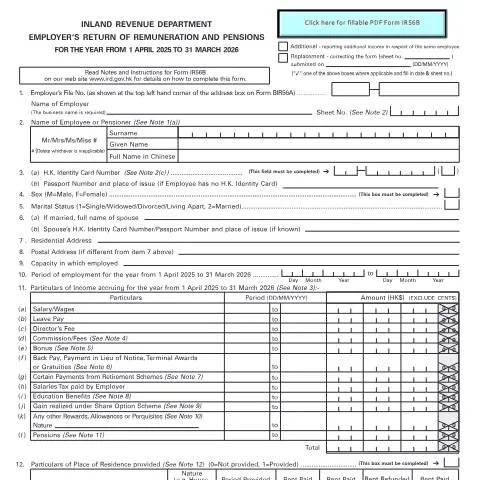
In the bustling environment of Hong Kong's employment sector, the IR56B form stands as a crucial instrument for employers and employees alike. This form, officially titled "Employer’s Return of Remuneration and Pensions for the year ended 31 March 2026," is not merely a bureaucratic requirement; it plays an essential role in the transparency and accountability of income declarations. Employers must be thoroughly acquainted with this form to ensure compliance and avoid penalties.
Unpacking the Structure of the IR56B
Before diving into the specifics of completion and submission, it’s vital to understand the structure of the IR56B. The form contains various sections, each serving a distinct purpose:
- Employer Information: This section requires the employer's file number and name, ensuring that the submission is accurately linked to the correct business entity.
- Employee Details: Collects essential personal information about the employee, including their identity card number, date of birth, marital status, and residential address.
- Income Breakdown: Employers must detail all remuneration the employee received during the financial year, categorized by types like salary, bonuses, and other allowances.
- Place of Residence: This section helps assess any benefits related to housing, vital for taxation purposes.
- Remarks: A space for any additional notes that might be relevant to the submission.
Preparing for Submission: Gathering Required Documentation
As with many administrative processes, preparation is key. Employers should compile the necessary documentation before filling out the IR56B:
Document Checklist
- Employer's file number (from previous submissions).
- Employee's HKID card or passport details, including the place of issue if applicable.
- Comprehensive records of all payments made to the employee during the reporting period, broken down to match the categories on the form.
- Details of any non-cash benefits, such as housing allowances, that may affect tax calculations.
- Information about any payments made to pension schemes on behalf of the employee.
Step-by-Step: Completing the IR56B Form
Completing the IR56B requires careful attention to detail. Below is a breakdown of sections that demand particular focus:
1. Employee Identification
Ensure that the employee's HKID number is correctly entered, as this field is mandatory. If the employee does not possess an HKID, the passport number must be provided. Missing this detail can lead to delays.
2. Income Sections
Each type of income must be clearly delineated. For example:
| Type of Income | Description |
|---|---|
| Salary/Wages | Regular payments made for work performed. |
| Bonus | Additional payment often based on performance. |
| Director's Fee | Compensation for serving on the board of directors. |
| Pensions | Contributions to retirement funds. |
Accuracy in these figures is essential as inaccuracies can lead to legal consequences and financial penalties.
Submission Channels: Online vs. Paper
With advances in technology, the Hong Kong Inland Revenue Department offers multiple channels for submitting the IR56B. Employers should consider the following:
Online Submission
Utilizing the online platform is efficient and ensures that submissions are received instantly. It also provides a record of the submission, which can be beneficial in case of disputes.
Paper Submission
For those who prefer traditional methods, paper submissions are still accepted. However, this method can introduce delays, as documents must be physically delivered and processed.
In-Person Submission
Employers may also choose to deliver the form in person at designated offices. This allows for immediate clarification of any questions with IRD staff, though it can be time-consuming.
From Submission to Validation: Understanding the Timeline
Once the IR56B has been submitted, employers should be aware of the typical timeline for processing. Here’s what to expect throughout the validation process:
- Initial Acknowledgment: Within a few days, employers should receive acknowledgment of receipt, confirming that the IR56B has been filed.
- Verification Process: The IRD will take approximately 4 to 6 weeks to verify the submitted information.
- Outcome Notification: Employers will be notified of any discrepancies or issues that need addressing, or they may receive a confirmation that the form is accepted.
Navigating Challenges: What to Do in Case of Issues
Even with the best preparations, challenges can arise. Here’s how to handle common issues associated with the IR56B:
1. Incorrect Information
If errors are discovered post-submission, employers must file a correction using the specified protocols laid out by the IRD. This typically involves completing a new form and clearly marking it as a correction.
2. Missing Documentation
In instances where supporting documents are incomplete, employers should proactively contact the IRD to ascertain what is needed and submit the missing information promptly to avoid penalties.
Distinguishing the IR56B from Similar Forms
Employers may encounter various forms within the framework of Hong Kong’s tax requirements. Understanding the differences between the IR56B and other documents is crucial:
- IR56E: This variant is used primarily for reporting non-Hong Kong residents or for individuals who have left employment.
- IR56F: Used for individuals undergoing tax assessments post-employment.
- IR56G: This form is specifically for reporting departures from Hong Kong.
Confusing these forms can lead to significant compliance issues, making it vital to know which document is relevant in each situation.
Practical Insights: Key Takeaways for Employers
Successfully completing and submitting the IR56B can seem daunting, but armed with the right knowledge and preparation, employers can navigate this process smoothly. Key insights to keep in mind include:
- Maintain accurate and organized employee records throughout the financial year.
- Consider electronic submission for efficiency and tracking.
- Be proactive in addressing any discrepancies or issues following submission.
Understanding the intricacies of the IR56B ensures that employers can focus on their primary goal: managing their workforce efficiently while remaining compliant with Hong Kong’s tax regulations.