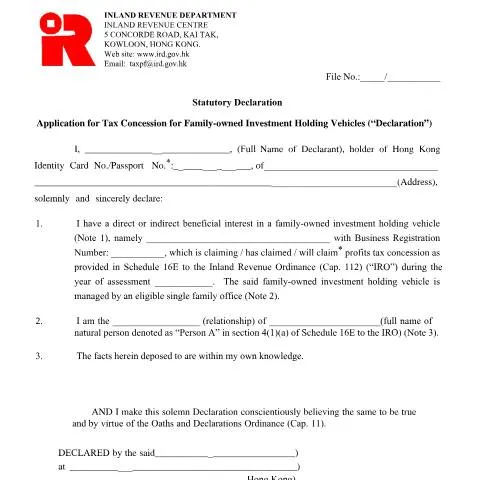
Understanding the IR 1480: A Vital Step Towards Tax Concessions
In the realm of Hong Kong's taxation system, the Statutory Declaration - Application for Tax Concession for Family-owned Investment Holding Vehicles (IR 1480) emerges as a crucial document for individuals interested in claiming a tax concession under the Inland Revenue Ordinance. This declaration is particularly pivotal for those who have a beneficial interest in family-owned investment holding vehicles (FIHVs). For many families managing their wealth through investment vehicles, understanding how to effectively complete and submit this form can significantly impact their tax liabilities.
The Profile of Stakeholders: Who Needs to Fill Out IR 1480?
It is essential to identify the key participants who may need to complete the IR 1480. The primary applicants typically include:
- Beneficial Owners: Individuals who have a direct or indirect beneficial interest in a family-owned investment holding vehicle.
- Family Members: These can include spouses, children, parents, siblings, or any other individuals closely related to the entity managing the FIHV.
- Family Offices: Specifically, an Eligible Single Family Office (ESF Office) that provides dedicated services to family members.
However, exceptions do exist. For instance, if a family office has a charitable entity with up to 25% beneficial interest, this must be disclosed. Understanding these specific roles is paramount for the correct filing of the IR 1480.
Differentiating Between Family and Unrelated Parties
The definition of "family" and "members of family" as articulated in section 4 of Schedule 16E to the IRO is critical. A family is generally defined as all persons related by blood or marriage. In stark contrast, an “unrelated person” is defined as anyone not part of this familial sphere. This distinction plays a fundamental role in determining the eligibility for tax concessions.
A Closer Look at the Contents of the Form
The IR 1480 is structured to capture vital information essential for the application process. Each section serves a distinct purpose, and understanding its contents is key to successful completion.
- Section 1: This section requires the declarant to state their beneficial interest in the FIHV, which must be identified by its Business Registration Number.
- Section 2: The relationship to the primary family member (Person A) must be explicitly stated here.
- Section 3: This is a declaration of the factual accuracy of the information provided, which is a serious legal commitment.
Notably, when documenting your relationship to Person A, clarity is paramount. Misrepresentation, even unintentionally, can result in severe penalties, including potential imprisonment for making false statements under the Crimes Ordinance.
Common Pitfalls in Completing the IR 1480
When filling out the IR 1480, several common pitfalls can derail an otherwise straightforward process:
- Incorrect Business Registration Number: Ensure that the number matches exactly with the official documentation.
- Ambiguous Relationships: Clearly define your relationship to Person A; vague terms could lead to confusion or misinterpretation.
- Lack of Signature: As a statutory declaration, your signature is mandatory and must be witnessed by an authorized individual, such as a Notary Public or a Commissioner for Oaths.
Filing Process: From Submission to Approval
The journey from submission of the IR 1480 to the potential approval of tax concessions can be summarized in several key stages:
- Preparation: Gather all required documentation, including identification and proof of relationship to Person A.
- Completion: Fill out the form meticulously, ensuring that each section is completed accurately.
- Submission: File the IR 1480 with the Inland Revenue Department (IRD), ensuring that it is submitted within the stipulated deadlines.
- Await Response: After submission, the IRD will review the application. This process may take several weeks, and any queries must be addressed promptly.
- Follow Up: If approved, the tax concession will be applied; if denied, the reasons will be provided for potential rectification.
Each of these stages is crucial and requires attention to detail to ensure a smooth process.
Addressing Challenges: What If the Application Is Denied?
Receiving a denial on your IR 1480 can be disheartening. However, understanding the next steps can aid in addressing this situation:
- Request for Clarification: The IRD will typically provide reasons for the application’s denial. Understanding these reasons is the first step in deciding how to proceed.
- Revisions and Resubmission: If the denial was due to errors in the application, correcting these and resubmitting may lead to approval.
- Legal Recourse: In cases where the denial seems unjust, seeking legal guidance to challenge the decision may be warranted.
It is imperative to act swiftly in these instances, as there may be deadlines for appeals or resubmissions.
Preparing Supporting Documents
The IR 1480 often requires supporting documents to substantiate claims made within the form. Depending on individual circumstances, these can include:
| Document | Description | Condition |
|---|---|---|
| Business Registration Certificate | Proof of registration for the family-owned investment vehicle. | Mandatory |
| Proof of Relationship | Documents establishing the familial relationship (e.g., birth certificates, marriage certificates). | Mandatory |
| Tax Documents | Prior year tax filings or assessments for additional context. | Advisable |
The Real Implications of Filing IR 1480
Completing the IR 1480 correctly opens doors to tax concessions that can lead to significant savings. However, it's important to understand the obligations and consequences tied to this application:
- Tax Benefits: Successful applications can reduce financial burdens, allowing more resources to be allocated for investment purposes.
- Legal Compliance: Adhering to the guidelines of the IR 1480 ensures that individuals remain compliant with tax laws, avoiding penalties.
- Long-term Planning: The information provided can play a role in future tax planning and strategy for families.
Neglecting this process or making errors can lead to not only financial loss but potential legal ramifications, making diligence in the application a necessity.
Final Thoughts: Navigating the IR 1480 with Confidence
While the IR 1480 might seem like just another bureaucratic hurdle, it represents a significant opportunity for families managing their investments in Hong Kong. By understanding the nuances of the form, the implications of its completion, and the process that follows, individuals can navigate this aspect of domestic tax law with greater confidence. Remember, accurate information, timely submissions, and thorough preparations are the keys to unlocking the potential benefits this declaration affords.
Understanding the Requirements for a Statutory Declaration
When applying for a tax concession for family-owned investment holding vehicles (FIHVs) in Hong Kong, submitting a statutory declaration is an essential step. This formal statement must adhere to specific legal requirements as outlined by the Inland Revenue Department (IRD). Understanding these requirements not only facilitates the application process but also ensures compliance with local legal standards.
The statutory declaration must confirm that the entity qualifies as an FIHV under the prevailing regulations. This includes a clear definition of what constitutes a family-owned investment holding vehicle and the relationship of the stakeholders involved. In this context, 'family-owned' typically means ownership by members of the same family, including relatives up to a certain degree of kinship. It is crucial to provide detailed information including names, relationships, and shares held by each family member to avoid any misunderstanding.
Furthermore, the declaration should include a statement regarding the intended use of the vehicle. This clarifies that the investment is held for passive purposes, which is a requirement for tax concession eligibility. The declaration must also affirm compliance with the conditions set out in the relevant tax laws, particularly those outlined in the Inland Revenue Ordinance, which governs tax concessions and exemptions applicable to FIHVs.
It is recommended to consult with a legal advisor who specializes in tax law to ensure that the statutory declaration conforms to all legal formalities. Any omissions or inaccuracies can lead to delays or rejection of the application, underscoring the importance of meticulous preparation.
Filing and Submission Process for the Statutory Declaration
The process of filing a statutory declaration for tax concession applications in Hong Kong involves several definite steps that must be adhered to strictly. Initially, applicants must prepare the statutory declaration document in the required format and ensure it is duly signed before a Commissioner for Oaths or another authorized entity. The signature must be witnessed in accordance with the legal provisions of the Basic Law of the Hong Kong Special Administrative Region.
Once the statutory declaration is executed, it should be submitted alongside the application for the tax concession to the IRD. It is advisable to file these documents through the IRD's e-Services platform for expediency, allowing for immediate acknowledgment of receipt. If you prefer to utilize traditional methods, ensure that your documents are submitted to the appropriate department of the IRD, specifically designed for handling FIHV applications.
In addition to the statutory declaration, various supporting documents must also accompany the application. This may include proof of family relationships, evidence of share ownership, and any other documentation that substantiates the claims made in the statutory declaration. It is essential to organize these documents clearly and to reference them in the declaration to facilitate the IRD's review process.
Moreover, be aware of the submission deadlines associated with the tax concession application. The IRD operates strict timelines, and late submissions can result in forfeiture of the tax benefits. Generally, applications must be submitted within the fiscal year in which the tax concession is sought, which runs from 1 April to 31 March of the following year.
Common Pitfalls to Avoid When Applying for Tax Concessions
The application process for tax concessions for family-owned investment holding vehicles can be complex, and applicants frequently encounter various challenges that can hinder their success. To mitigate these issues, it is vital to be aware of common pitfalls and to take proactive measures to avoid them.
One of the most prevalent mistakes is the failure to provide adequate documentation. Each claim made in the statutory declaration must be substantiated by relevant proof. This is particularly crucial for demonstrating the familial relationship and the passive nature of the investments. Insufficient or poorly organized documentation can lead to delays in processing or outright denial of the application.
Another frequent issue arises from misunderstandings regarding the definition of what constitutes a family-owned investment holding vehicle. Applicants may inadvertently submit declarations that do not align with the requirements set by the IRD. It is imperative to thoroughly review the definitions and criteria laid out in the IRD's official guidelines to ensure compliance.
Additionally, applicants should be cautious about the accuracy of information provided. Any discrepancies, whether intentional or accidental, can have serious repercussions. Misinformation can lead to tax liabilities or penalties, undermining the very purpose of seeking a tax concession.
Lastly, neglecting to seek professional assistance can be detrimental. Navigating the complexities of tax law without the support of a qualified legal or tax advisor can increase the risk of errors. Consulting with a professional can provide critical insights and guidance, ensuring that the application process runs smoothly.