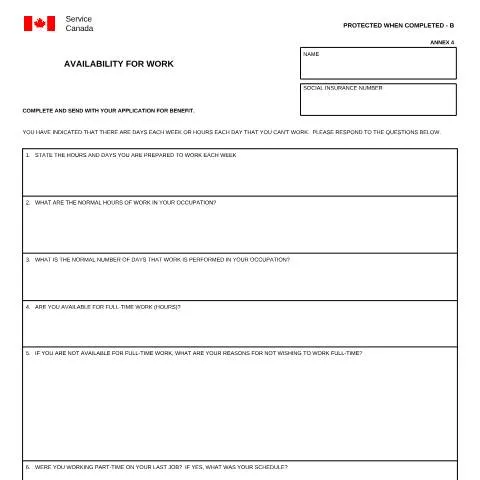
Navigating Employment Insurance: Unpacking the Availability for Work Form
When you're facing unemployment, understanding the nuances of the Employment Insurance (EI) process can feel overwhelming. One pivotal document in this journey is the Availability for Work form, coded INS5108. This form plays a crucial role in determining your eligibility for EI benefits and ensuring that you receive the support you need in a timely manner. Let’s delve into the specifics of this form, its purpose, and how to navigate it effectively.
Understanding the Context: The Role of Employment Insurance in Canada
Employment Insurance is more than just a financial aid program; it is a safety net designed to support Canadians during periods of job loss. Established under the Employment Insurance Act, this program provides temporary financial assistance to unemployed individuals while they seek work or upgrade their skills. The Availability for Work form is a key component in this framework, allowing the government to assess whether you meet the eligibility criteria for EI benefits based on your willingness and ability to work.
The form requests specific details about your availability, which helps the authorities determine how actively you are seeking employment. It is essential for anyone applying for EI to fill this form out correctly to avoid delays in receiving benefits.
Clarifying the Unique Aspects of the INS5108 Form
At first glance, the INS5108 may seem similar to other EI-related forms, but it serves a distinctly different purpose. While some forms pertain to previous employment history or the amount of benefits requested, the Availability for Work form focuses solely on your current situation regarding employability.
- Purpose: It assesses your readiness to work as opposed to providing information on past employment.
- Content: It requires details about your daily availability and the flexibility of your work schedule.
It’s crucial to ensure that you use the correct form for your specific situation, as using the wrong document can lead to delays or denials of your EI claim.
Who Should Complete the Availability for Work Form?
This form is required for individuals who are currently receiving or applying for Employment Insurance benefits. Typically, it applies to:
- Individuals who have recently lost their job and are actively looking for work.
- Those who have indicated a limitation on their working hours or availability due to various circumstances, such as personal commitments or health issues.
Moreover, it is important to understand that while this document is standard, there are exceptions based on personal situations. For example, if you are a student or have childcare responsibilities, your availability may differ significantly from someone without such commitments.
The Critical Importance of Accuracy: What Happens if You Miss the Mark?
Providing inaccurate or incomplete information on the Availability for Work form can have serious repercussions. The government relies on the honesty and accuracy of the information you provide to determine your eligibility for EI benefits.
Consider the following implications:
- Delay in Benefits: Inaccurate details can lead to delays as your claim may require additional review.
- Penalties: If it is determined that you provided false information, there may be penalties involved, including potential repayment of benefits received.
To safeguard against these issues, ensure you review your responses multiple times and confirm that they are truthful and current.
A Deep Dive into the Form Sections: What You Need to Know
The Availability for Work form comprises several sections, each requiring careful consideration and detail. Here’s a closer look at what each section entails:
1. Stating Your Availability
The first question asks for the specific hours and days you are prepared to work each week. This section sets the tone for your availability assessment, so be as detailed as possible.
2. Normal Working Hours
Next, you’ll provide insight into what the typical working hours are within your occupation. This helps the EI assess if your availability aligns with industry standards.
3. Workdays in Your Occupation
Here, you will indicate the normal number of days work is performed in your job. This allows the authorities to understand the landscape of your employment field better.
4. Full-Time Availability
If you are available for full-time work, clearly state this. If not, you'll need to elaborate on your reasons for not wishing to work full-time in the subsequent section.
5. Reasons Against Full-Time Work
This section is critical. If you have valid reasons for not being available for full-time work—be it personal commitments, health concerns, or educational pursuits—these must be clearly articulated.
6. Previous Employment Status
In this part, you will need to indicate if you were working part-time on your last job. Providing accurate details about your previous work schedule can enhance the credibility of your claim.
7. Part-Time Work History
Lastly, the form asks how long you worked on a part-time basis for your last employer or others. This section provides context to your work history that may affect your EI benefits.
Preparing Your Supporting Documents: A Checklist
When submitting the Availability for Work form, you may need to accompany it with supporting documentation. Here’s a checklist to help you get organized:
- Job Search Records: Keep a log of your job applications, interviews, and any networking efforts.
- Medical Documentation: If health-related issues impact your availability, ensure you have relevant medical records ready.
- Education Enrollment Proof: If you’re pursuing education, documentation confirming your enrollment can help clarify your situation.
Having these documents prepared can streamline the process and provide additional context to your claim.
The Path Forward: After Submission of the Form
Once you submit the Availability for Work form along with your application for EI benefits, what happens next? Understanding the process can help alleviate anxiety during what can be a stressful time.
- Review Process: Your submission will be reviewed by Service Canada representatives who will assess your eligibility based on the provided information.
- Follow-Up: You may receive follow-up questions or requests for additional information, particularly if any details are unclear.
- Decision Notification: You will be informed about the decision regarding your EI benefits either through mail or electronically, depending on your chosen method of communication.
Staying responsive and proactive during this phase can facilitate a smoother resolution to your EI claim.
Final Thoughts: The Importance of Being Proactive
As you navigate the intricacies of the Availability for Work form, remember that clarity and honesty are your greatest allies. Understanding the significance of each question, providing accurate responses, and being prepared with supporting documentation can greatly enhance your chances of a successful EI claim. By taking these steps, you are not just fulfilling an administrative requirement; you are ensuring that you have the resources you need to support yourself during a challenging time.
Understanding Availability for Work in Canada: Legal Definitions and Requirements
When it comes to employment insurance and related benefits in Canada, the term "availability for work" holds significant importance. This concept is especially relevant if you are applying for Employment Insurance (EI) benefits or seeking social assistance programs. But what does "availability for work" truly mean within the context of Canadian administrative law?
According to Employment and Social Development Canada (ESDC), you must be actively seeking employment and ready to accept suitable work if it becomes available. This means that your availability must be consistent and genuine. The requirements may vary based on your individual circumstances, but generally, you should be prepared to work a minimum of 15 hours a week, unless a medical condition or other legitimate reasons prevent you from doing so.
It’s essential to understand that simply stating you are available is not enough. For your claims to be valid, you may be asked to provide additional documentation, such as:
- A detailed record of job applications you've submitted.
- An outline of your job search strategy, including types of employment you are looking for.
- Proof of participation in training programs or job readiness workshops.
Moreover, if you have specific restrictions that affect your availability—such as caregiving responsibilities or health issues—make sure to document these circumstances clearly. The ESDC may require this information to assess your eligibility for benefits accurately.
Ultimately, maintaining a clear line of communication with Service Canada is crucial. If your availability changes—whether due to a new job opportunity, personal circumstances, or health issues—it's your responsibility to inform them immediately to avoid any potential repercussions regarding your benefits.
Common Misunderstandings About Availability for Work
As with many aspects of administrative processes, misunderstandings about "availability for work" can lead to confusion and erroneous claims. One of the most common misconceptions is the belief that individuals can solely rely on part-time jobs to meet the availability requirements for EI benefits. However, it’s essential to remember that the nature of the work must be suitable—meaning it should align with your skills, experience, and previous employment history.
Another notable misunderstanding lies in the assumption that availability applies equally to all job seekers. For example, if you're a recent graduate entering the workforce, your availability criteria may differ from those of someone who has been in the workforce for years. The ESDC considers factors such as:
- Your age and experience level.
- The current economic conditions in your region.
- The job market for your specific skills and qualifications.
Therefore, it's vital to tailor your job search and claims to reflect your situation accurately. Additionally, be proactive about clarifying any uncertainties with your Service Canada representative. This will not only help you understand your obligations but also ensure you are on the right track to obtaining the benefits you are entitled to.
Strategies for Demonstrating Availability for Work
Demonstrating your availability for work can sometimes feel like a daunting task, especially when you are navigating the complexities of governmental processes. However, there are effective strategies you can employ to make this process more manageable.
First and foremost, maintaining an organized record of your job search is crucial. Keep a dedicated notebook or digital file where you log the following:
- The names of companies you applied to, including the positions.
- The dates of applications and any correspondence you have had.
- Follow-up actions you’ve taken, such as phone calls or emails.
This will not only serve as evidence of your job-seeking efforts but will also help you track your progress, making it easier to identify which strategies are effective.
Another effective approach is to engage in networking. Reach out to former colleagues, friends, or industry professionals who may have leads on job openings. Document these interactions as well, as they can add to your evidence of actively seeking employment.
Consider joining online job boards or local community groups focused on job searching. Participation in workshops, webinars, or job fairs can also demonstrate your proactive approach to finding employment. Make sure to take notes on these activities, as they can supplement your claim for demonstrating availability.
Lastly, don’t shy away from seeking professional guidance. Many non-profit organizations and community centers offer career counseling services, often free of charge. Utilizing these resources can not only enhance your job search but also provide you with documentation that reinforces your availability for work.