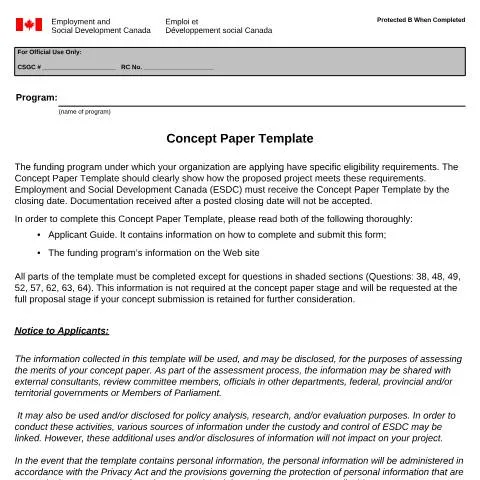
Understanding the Concept Paper Template: A Gateway to Funding Opportunities
The Concept Paper Template (CPT) is not just another bureaucratic document; it is your organization’s initial step towards unlocking funding from Employment and Social Development Canada (ESDC). Whether you're a non-profit, community organization, or a small enterprise, this template plays a pivotal role in the funding application process. It captures essential project details and showcases how your initiative aligns with ESDC's objectives, thus serving as a preliminary assessment tool.
Who Should Consider Submitting the Concept Paper Template?
Before diving deep into the particulars of filling out the CPT, it is crucial to understand who should submit this document.
- Non-Profit Organizations: Many non-profits looking for funding to support community initiatives are often required to submit a CPT to outline their project.
- For-Profit Entities: Certain for-profit organizations may also qualify for specific funding programs and need to present a concept paper to demonstrate their project’s value.
- Community Groups: Grassroots organizations engaging in local projects that align with ESDC’s goals can also benefit from this template.
Overall, any entity seeking financial support for projects aimed at improving social welfare, employment opportunities, or community development in Canada should consider using the CPT.
Decoding the Nuances: Filling Out the Concept Paper Template
Completing the CPT accurately is vital for the success of your application. This document is structured into various sections, each requiring detailed information. Below are the key areas to focus on:
Organization Identification
The first part requires basic yet crucial information about your organization:
- Legal Name: The official name under which your organization is registered.
- Operating Name: Any common name used by your organization, if different from the legal name.
- Organization Type: Specify whether you are a charity, non-profit, or for-profit entity.
Each of these fields is mandatory and must be filled in accurately to avoid delays in processing.
Organizational Capacity
This section assesses whether your organization has the human resources and experience necessary to carry out the proposed project. Respond to questions about:
- The number of employees currently engaged in your organization.
- Any significant organizational changes in the past two years.
- Your track record with past projects, especially those funded by ESDC.
Detailing your organizational capacity not only provides credibility but also reassures the funding body of your capability to manage the proposed initiative.
Project Identification
This is arguably the most critical section, where you describe the essence of your proposed project:
- Project Title: A concise and descriptive title that captures the project’s intent.
- Planned Project Dates: Clearly state your project’s start and end dates, ensuring they are realistic.
Be specific about the project aims, target audience, and expected outcomes, as this section sets the tone for how your initiative aligns with ESDC’s priorities.
Submission Channels: Navigating the Process
After completing the CPT, the next step is to submit it to ESDC. Applicants have a few different submission methods, which cater to different preferences and requirements.
Online Submission
For many applicants, submitting the CPT online is the most efficient option. You can fill out the form and submit it directly through the ESDC's designated online portal. This method is often faster and includes immediate confirmation of submission. Make sure to:
- Double-check all entries for accuracy.
- Keep a copy of the submitted form for your records.
Paper Submission
Prefer a traditional approach? You can print the completed CPT, sign it, and mail it to the appropriate ESDC office. However, bear in mind:
- Mailing can introduce delays; always send it via registered mail to track its delivery.
- Ensure you allow enough time before the submission deadline.
In-Person Submission at Service Canada Centres
For those who want to ensure their documents are received, you can also submit the CPT in person at a local Service Canada Centre. This face-to-face option provides an opportunity for immediate clarification of any questions you might have.
Distinguishing the CPT from Similar Forms
The Concept Paper Template is often confused with other forms used in funding applications. Understanding these differences can save you time and effort:
| Form | Purpose | Stage in Application |
|---|---|---|
| Concept Paper Template (CPT) | Details project concept for initial assessment | Preliminary stage |
| Full Proposal Application | Comprehensive project details for final review | Final stage |
| Budget Proposal | Details financial aspects of the initiative | Requires prior approval of the concept |
By clarifying its unique purpose, you can ensure that you are using the correct form in your funding journey.
Step-by-Step: From Submission to Decision
Once you have submitted the CPT, a process unfolds that can take varying amounts of time depending on the complexity of the project and the volume of applications received.
Initial Review
Upon receipt, ESDC conducts an initial review to determine if your proposed project meets the basic eligibility criteria outlined in the applicant guide. Key aspects they will assess include:
- Alignment with ESDC’s funding goals.
- Feasibility of the proposed project.
- Organizational capacity to execute the project.
Feedback and Next Steps
If your CPT is flagged for further consideration, you may be invited to submit a full proposal. This full proposal will require much more detail and must address not just the project specifics but also budgetary elements and a sustainability plan.
Decision Notification
Regardless of the outcome, you will receive formal communication regarding the decision. If approved, the next steps will be outlined in the communication. Conversely, if a decision is made against your project, you will have the opportunity to understand the reasons for the refusal.
Handling Potential Issues: Errors, Refusals, or Missing Documents
If your CPT is returned due to errors or missing documents, don’t despair. Here's how to manage such situations effectively:
Addressing Mistakes
Should you receive feedback indicating errors, carefully review the comments provided by ESDC. Common errors include:
- Incomplete information in mandatory fields.
- Inconsistent data between sections (e.g., organizational name not matching).
Rectify these mistakes and consider seeking assistance from colleagues or other stakeholders to ensure clarity and accuracy.
Refusal of Funding
If your project concept is denied funding, it’s essential to understand why. Take the time to:
- Request a detailed explanation from ESDC regarding the decision.
- Engage in a constructive dialogue to clarify uncertainties.
- Consider re-applying with improved details based on feedback received.
The Regulatory Framework Behind the Concept Paper Template
The CPT operates within a broader regulatory framework that governs funding applications in Canada. Understanding this backdrop can enhance your application’s effectiveness.
The key legislative acts pertinent to the CPT include:
- Privacy Act: Protects the personal information collected during the funding application process.
- Access to Information Act: Ensures transparency in how public funds are allocated and spent.
Moreover, ESDC adheres to both federal and provincial guidelines to ensure that funding is allocated equitably and adheres to policy goals.
Final Tips for a Successful Submission
As you prepare your Concept Paper Template, here are some final insights that could enhance your submission:
- Clarity is Key: Use straightforward language and avoid jargon. The clearer your project description, the easier it will be for reviewers to understand your initiative.
- Align with ESDC Goals: Make explicit connections between your project and ESDC's broader objectives to increase the appeal of your application.
- Review and Revise: Before submission, have multiple sets of eyes review the document. Fresh perspectives can catch errors or suggest improvements.
By following these guidelines and understanding the nuances of the Concept Paper Template, you position your organization favorably in the competitive landscape of public funding.
Understanding the Concept Paper: Purpose and Utility in Canadian Administrative Processes
A concept paper serves as a vital tool in the early stages of project development and decision-making within various sectors in Canada, including government, non-profit, and academic institutions. Essentially, it outlines the fundamental ideas underlying a proposed initiative, providing a framework for stakeholders to understand the vision, objectives, and potential impact of the project. When you are drafting a concept paper, particularly for submission to government agencies or funding bodies, it's crucial to articulate your ideas clearly and concisely.
The primary purpose of a concept paper is to communicate preliminary ideas to decision-makers and gather feedback before significant resources are committed. For instance, if you are looking to secure funding from Employment and Social Development Canada (ESDC) for a new social program, your concept paper should highlight the social issue you intend to address, the proposed solution, and the anticipated outcomes. By presenting your ideas in a structured format, you can facilitate discussions that drive your initiative forward.
Key Elements of a Concept Paper Template in the Canadian Context
When preparing a concept paper in Canada, several key elements should be included to meet the expectations of potential stakeholders and funders. These components not only enhance the clarity of your proposal but also increase its credibility.
- Title: A concise title that reflects the essence of your project.
- Introduction: Briefly introduce the problem or opportunity your project addresses. Clearly define the scope and significance, ensuring the reader understands why this initiative matters.
- Background Information: Provide context related to the issue at hand, such as statistical data or historical perspectives. This section can demonstrate the need for your proposed solution.
- Objectives: List the main goals of your project. These should be specific, measurable, achievable, relevant, and time-bound (SMART).
- Proposed Activities: Describe the activities you will undertake to achieve your objectives. This might include timelines, methodologies, and key personnel involved.
- Potential Impact: Discuss the anticipated outcomes and benefits of your project. Utilize qualitative and quantitative measures to bolster your claims, which can be particularly persuasive for funding applications.
- Budget Overview: Provide a high-level budget estimate, highlighting the major expense categories necessary to implement the project. While a detailed budget is not required at this stage, stakeholders appreciate seeing that you have considered the financial implications.
- Conclusion: Summarize the main points and reiterate the importance of the project. Encourage stakeholders to engage with you for further discussion, emphasizing your openness to feedback.
In conclusion, a well-structured concept paper not only articulates your vision but also encourages collaborative dialogue among stakeholders, ensuring your project has the potential for success from the outset.
Best Practices for Drafting a Concept Paper: Tips for Success
Drafting a concept paper can be a challenging yet rewarding process. To enhance your chances of success, consider implementing these best practices:
- Know Your Audience: Tailor your concept paper to meet the expectations and interests of your audience. If you are submitting to a specific government agency, review their guidelines and previous successful proposals to understand their focus areas.
- Be Concise: Aim for clarity and brevity. Avoid jargon and overly technical language unless it is essential for understanding your project. Use straightforward language to ensure that your message resonates with a diverse audience.
- Leverage Visuals: Whenever applicable, incorporate charts, graphs, or infographics to illustrate key data and make your concept paper visually appealing. This can help break up text-heavy sections and enhance engagement.
- Solicit Feedback: Before finalizing your concept paper, seek input from colleagues or industry experts. They may provide valuable insights or identify areas for improvement that you may have overlooked.
- Revise and Edit: Allocate time for thorough revision and editing. An impeccably polished document reflects professionalism and attention to detail, increasing your credibility with stakeholders.
By embracing these best practices, you can create a compelling concept paper that captures attention and garners interest in your proposed initiative.