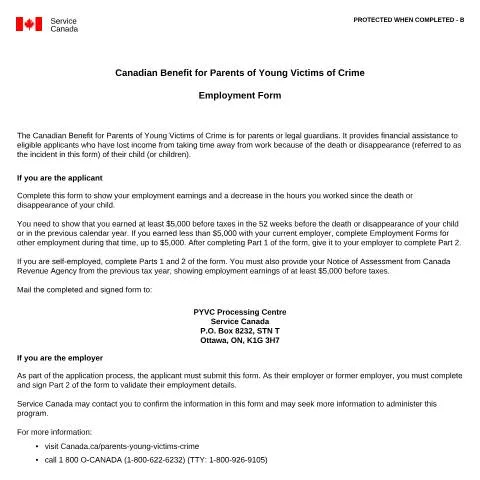
Navigating the Canadian Benefit for Parents of Young Victims of Crime Employment Form
For parents grappling with the aftermath of crime affecting their children, understanding the financial assistance available can be paramount. The Canadian Benefit for Parents of Young Victims of Crime Employment Form (EMP5635) is a crucial document designed to help eligible parents demonstrate their reduced income due to the tragic circumstances involving their child. This article takes you through the various facets of this form, including its purpose, completion process, submission methods, and more.
Understanding the Employment Form in Context
After a traumatic incident involving a child, parents often find themselves needing to take time off work, which can lead to financial hardship. The Employment Form serves as a bridge for these families to access financial support. This grant aims to alleviate some of the economic pressures by providing financial assistance to eligible applicants who have suffered a loss of income as a result of their child's death or disappearance.
Who Needs to Complete This Form?
The Employment Form must be filled out by two parties: the applicant, who is the parent or legal guardian of the child, and the employer or former employer. The applicant must demonstrate a reduction in income and work hours due to the incident. This includes providing details about their earnings in the year preceding the incident.
Breaking Down the Form: Step-by-Step
Completing the Employment Form requires careful attention to detail. Below is a breakdown of the essential sections of the form, along with tips on how to fill them out correctly.
Part 1: Applicant Information
This section requires the applicant to provide personal details including:
- Social Insurance Number: Essential for identification.
- Name: Complete your first, middle, and last names.
- Phone Number: For subsequent communication regarding your application.
- Self-employment Status: Indicate if you are self-employed. This affects the information you need to provide.
One common pitfall here is failing to report accurate earnings. Ensure that you have your Notice of Assessment from the Canada Revenue Agency ready, as it will substantiate your claim of earning at least $5,000 in the year prior to the incident.
Part 2: Employment Information
In this section, employers or former employers are asked to confirm specific employment details. Key elements include:
- Name of Employer/Business: Provide full details to ensure proper identification.
- Employment Status: Choose the correct option reflecting the applicant's current employment status (stopped working, working less than standard hours, etc.).
- Total Earnings: Report the total employment earnings from the previous calendar year.
Employers must sign this section, affirming that the information provided is accurate. A missing signature can lead to delays in processing your application.
Submission Channels: Where and How to Send Your Form
Upon completing the Employment Form, applicants have several avenues available for submission:
- By Mail: Send the completed form to the PYVC Processing Centre at the address provided on the form.
- Online Submission: While the form itself must be mailed, you can find additional resources and information online at the Government of Canada’s website.
- In-Person Visits: Although less common, you may choose to visit a Service Canada Centre for assistance.
Comparative Analysis of Submission Methods
| Method | Advantages | Disadvantages |
|---|---|---|
| Can be tracked; keeps a physical record. | Longer processing time. | |
| Online Resources | Access to immediate information and updates. | Form submission still requires mailing. |
| In-Person | Direct assistance and clarification. | Time-consuming; may require an appointment. |
What to Expect After Submission
Once your form is submitted, it enters the processing phase. The timeline for processing can vary, but here’s what generally occurs:
- The form is reviewed for completeness and accuracy by Service Canada.
- If further information is needed, Service Canada may contact you or your employer for clarification.
- Once reviewed, you will receive a notification regarding the outcome of your application.
Follow-Up Procedures
If you haven’t received any communication within a reasonable time frame, consider following up. Here’s how:
- Contact the PYVC Processing Centre directly using the provided phone number.
- Keep your application reference number handy for quicker assistance.
Troubleshooting Common Issues
Understanding how to address potential challenges can save time and frustration. Here’s a look at common scenarios:
What If My Application Is Refused?
If your application is denied, you will receive a written explanation. You have the right to appeal the decision. Here are steps to follow:
- Review the reasons for denial carefully.
- Collect any additional documentation that may strengthen your case.
- Submit an appeal letter, clearly stating your case and including supporting documents.
Handling Missing Documentation
In situations where documents are found to be missing:
- Quickly gather the required documents as stated in the notification.
- Submit the missing information promptly to avoid delays.
Key Dates and Timelines
Timeliness is crucial when navigating the application process. Here’s a timeline to keep in mind:
- Application Submission: Ideally, submit as soon as you can after the incident.
- Processing Time: While it varies, expect a timeframe of several weeks.
- Notification of Decision: Should arrive within 30-60 days after submission.
What Happens After Approval?
If approved, you will receive details regarding the amount of financial assistance you are eligible for, along with the timeline for disbursement. Payments can often be made directly to your bank account or via cheque.
Distinguishing the EMP5635 from Other Forms
Many parents may encounter other forms related to financial assistance. Here’s how the EMP5635 stands apart:
- This form specifically addresses the needs of parents dealing with the fallout from crimes against minors.
- Other forms may serve different demographics or types of assistance, such as employment insurance or general social benefits.
- The eligibility criteria and required supporting documents can differ significantly, making it essential to use the correct form for your situation.
Final Thoughts
Engaging with the Canadian Benefit for Parents of Young Victims of Crime is a nuanced process, and understanding each step is essential for successful application. Familiarizing yourself with the Employment Form, the required details, and the process can significantly ease the burden of navigating this difficult time. For further assistance, consider reaching out to Service Canada or community support organizations focused on aiding victims and their families.
Understanding the Eligibility Criteria
To successfully apply for the Canadian Benefit for Parent of Young Victims of Crime Grant, it's essential to first understand the specific eligibility criteria set forth by the program. This grant is designed to assist parents or guardians who are experiencing financial hardship due to the victimization of their child. Here’s a detailed breakdown of the requirements:
- Victim's Age: The young victim must be under the age of 18 at the time of the crime.
- Type of Crime: The crime must be a violent crime, such as assault, sexual abuse, or homicide. Non-violent crimes do not qualify for this grant.
- Proof of Victimization: Applicants must provide documentation that confirms the crime occurred and that the victim is indeed their child. This could include police reports or court documentation.
- Financial Need: You need to demonstrate that you are facing financial hardship directly related to the crime. This may involve providing financial records or other proof of income loss.
- Residency Requirement: You must be a resident of Canada and have a valid Social Insurance Number (SIN) to apply for the grant.
It’s important to note that meeting these criteria doesn't guarantee approval, as each application is assessed on a case-by-case basis. Additionally, if you are applying from a province or territory with its own victim services program, you may need to check if there are supplementary requirements or specific forms to complete.
Preparing Your Application: Key Documents and Considerations
As you prepare to submit your application for the Canadian Benefit for Parent of Young Victims of Crime Grant, gathering and organizing the necessary documents is crucial. Here are some key documents to include, along with considerations for each:
- Identification: Ensure you have a valid SIN and government-issued ID (like a driver’s license or passport) for yourself and your child.
- Proof of Relationship: You may need to provide documents that confirm your relationship to the victim, such as a birth certificate or adoption papers.
- Documentation of the Crime: Collect police reports, court documents, or any other official records that detail the crime committed against your child.
- Financial Documents: This includes recent pay stubs, tax returns, or bank statements that illustrate your current financial situation, demonstrating the hardships you are experiencing.
- Personal Statement: While not mandatory, including a personal letter explaining your situation, the impact of the crime on your family, and why you need the grant can provide a human element to your application.
Make sure all documents are clear and legible. If you are submitting copies, they must be certified to avoid any delays in processing. Ensure to keep copies of everything you send for your records. Being thorough in your application can significantly increase your chances of a favorable decision.
Understanding the Grant Application Process
The application process for the Canadian Benefit for Parent of Young Victims of Crime Grant may seem overwhelming, but breaking it down into manageable steps can help ease the burden. Here’s a detailed overview of what you can expect:
- Application Form: Begin by downloading the official application form from the Government of Canada’s designated website. Ensure you are using the most updated version of the form to avoid any processing delays.
- Completion of the Form: Fill out the application form completely. Double-check for accuracy and completeness to ensure that all sections are filled out correctly. Missing information could lead to a rejection or a delay.
- Submission: Once the application is complete, submit it either by mail or online, depending on the guidelines provided. If submitting by mail, be sure to send it to the designated address listed on the form.
- Awaiting Response: After submission, you will receive an acknowledgment of your application within a few weeks. The processing time can vary, so be patient. If you do not hear back after a reasonable period, consider following up with the relevant office.
- Grant Decision: You will receive a decision regarding your application in writing. If approved, the letter will outline the details of the grant and how to access funds. If denied, it will also provide reasons for the decision, which can be useful for any future applications.
Stay proactive throughout this process. Keep track of any correspondence and follow up with the agency if you have questions or need further clarification. Being informed can help you navigate the system more effectively.
Support Services and Resources
Lastly, as you navigate the application process for the Canadian Benefit for Parent of Young Victims of Crime Grant, remember that various support services and resources are available to you. These can provide invaluable assistance during what is often a difficult time. Here are some options to consider:
- Victim Services Programs: Many provinces and territories offer victim services that can provide emotional support, information about your rights, and guidance through the legal process. These programs may also assist with filling out your grant application.
- Community Organizations: Look for local non-profits that focus on victim support or family services. They can often provide resources, counseling, and advocacy to help you understand your options and provide emotional support.
- Legal Aid Clinics: If your situation is complex or you require legal assistance, consider reaching out to a legal aid clinic in your area. They can provide free or low-cost legal consultations to help you understand your rights and responsibilities.
- Support Groups: Joining a support group for parents of young victims can help you connect with others who understand your situation. Sharing experiences and coping strategies can be incredibly therapeutic.
- Online Resources: The Government of Canada’s website offers extensive information regarding the grant and related support services. Additionally, various advocacy groups provide online resources that can help guide you through the application process and beyond.
Utilizing these resources can alleviate some of the stress associated with your application and provide the emotional and practical support you need during this challenging time.