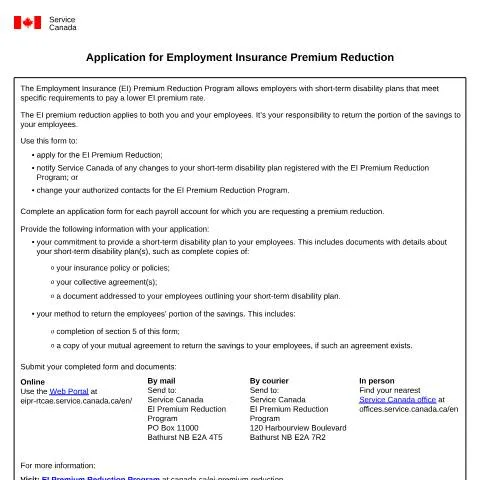
Unlocking Savings: The Application for Employment Insurance Premium Reduction Explained
When managing a business in Canada, you may find yourself navigating the complexities of employment-related expenses. Among the various costs, Employment Insurance (EI) premiums feature prominently. However, did you know that through the Application for Employment Insurance Premium Reduction (NAS5022), you can potentially reduce these costs? Understanding how to effectively utilize this application can make a significant difference for your business's bottom line.
A Brief History: The Evolution of the EI Premium Reduction Program
The origins of the Employment Insurance Premium Reduction Program can be traced back to the need for a more equitable approach to employment insurance for employers who offer short-term disability plans. This program was developed to encourage employers to provide benefits that would lessen the burden on the EI system and ensure employees have access to essential support during periods of temporary incapacity.
Over the years, the EI Premium Reduction Program has undergone various adjustments to refine eligibility criteria and streamline the application process. By aligning the program with the evolving needs of both employers and employees, Service Canada aims to promote a healthier workforce while alleviating financial pressures on businesses.
Identifying Your Eligibility: Who Should Apply?
As an employer, understanding whether your business qualifies for this premium reduction is the first step. Generally, the following conditions must be met:
- You must have a registered short-term disability plan that meets the criteria set by Service Canada.
- The plan must remain in effect during the period for which you are seeking a premium reduction.
- You must fulfill your obligation to return a portion of the savings to your employees.
It’s crucial to note that if your business has recently started offering a short-term disability plan, you may need to wait for a specific duration before applying. Typically, this duration aligns with the benefits' eligibility period, which is three months or less.
Document Preparation: Gathering the Necessary Justifications
Before diving into the application form, take a moment to compile the necessary documentation that will support your application. This includes:
- Your short-term disability plan details: This should involve policy documents and any agreements in place.
- Information regarding the financial return to employees: The method by which you plan to return the savings must be well-documented.
- Evidence of how the plan benefits your employees: This could include enhancement of existing employee benefits.
By meticulously gathering this information, you will be in a stronger position to complete the application accurately and securely.
Deciphering the Application Form: A Step-by-Step Breakdown
The Application for Employment Insurance Premium Reduction (NAS5022) consists of several sections that require your attention. Here, we’ll dissect each part to ensure you understand what information is necessary and what pitfalls to avoid.
Part 1: Purpose of Application
In this section, you will indicate whether you are submitting a new application, notifying changes, or changing authorized contacts. It’s essential to select the correct option as it determines the subsequent sections you’ll need to complete.
Part 2: Company Information
This segment requires details about your business. Be precise with your legal and operating name, and ensure your mailing address is correct. Consider the impact of these details on your application’s processing time.
Part 3: Insurer or Plan Administrator Information
Providing the correct policy number and information about the insurer or plan administrator is crucial. Inaccurate or missing information could lead to delays.
Part 4: Employee Information
This section will ask how many employees are covered under your short-term disability plan. You’ll need to account for factors such as unionized employees and whether the plan is included in a collective agreement.
Part 5: Returning the Employees’ Portion of the Savings
Perhaps the most critical part of the application, here you’ll detail how you intend to return 5/12 of the savings to your employees. Choosing between cash remittance or mutual agreement can significantly affect employee trust.
Part 6: Authorized Contacts
Finally, you’ll need to provide contact information for individuals authorized to communicate with Service Canada regarding your application. Ensure these contacts are reachable and informed about the application to facilitate any necessary follow-ups.
Submissions Made Easy: Channels for Application Delivery
Once you’ve completed your application and gathered the necessary documentation, it’s time to submit. Service Canada offers multiple channels for submission:
| Method | Description | Timeframe |
|---|---|---|
| Online | Using the Web Portal for a quicker processing time. | Immediate confirmation via email. |
| By Mail | Send documents to the designated PO Box in Bathurst. | Generally 2–4 weeks for processing. |
| By Courier | Direct drop-off at the Service Canada office in Bathurst. | Faster than regular mail but still up to 2 weeks for processing. |
| In Person | Visit your nearest Service Canada office. | Immediate assistance, but be prepared for possible wait times. |
Tracking Your Application: Following Up with Service Canada
After submitting your application, you may wonder how to track its status or what steps to take if you encounter delays. Service Canada provides a system for tracking your application:
- Reference Number: Ensure you keep a record of your application reference number for inquiries.
- Contact Service Canada: You can call their dedicated line to inquire about your application status.
- Online Tracking: The Web Portal may offer insights into your application status if submitted online.
Being proactive in following up can help expedite the process and ensure that your application is not lost in the shuffle.
Understanding Consequences: What Happens After Submission?
Once your application is processed, you will receive a confirmation of either approval or denial. In the case of approval, you’ll receive details about the premium reduction and how to implement it in your payroll system.
If your application is denied, Service Canada will provide reasons for the decision. It’s imperative to carefully review these reasons, as they may offer insights into what adjustments you need to make before resubmitting.
The Bigger Picture: How This Application Fits into Broader Employment Strategies
The Application for Employment Insurance Premium Reduction is more than just a form; it plays a pivotal role in how businesses manage their employee benefits and financial responsibilities. Effectively utilizing this program can lead to:
- A more motivated workforce due to improved employee benefits.
- Reduced financial strain on your business, allowing for reinvestment in other areas.
- A stronger relationship with your employees, bolstered by transparency and shared savings.
Therefore, engaging with the EI Premium Reduction Program not only aids your business financially but also contributes to a more supportive work environment.
Understanding the nuances of the Application for Employment Insurance Premium Reduction is fundamental for any employer looking to optimize their financial responsibilities while enhancing employee benefits. By taking advantage of this program, you not only save on costs but also invest in the well-being of your workforce.
Eligibility Criteria for Employment Insurance Premium Reduction
Before diving into the application process for an Employment Insurance (EI) Premium Reduction, it's crucial to understand the eligibility criteria that dictate who can apply. The EI Premium Reduction is available primarily for employers who contribute to the EI system but also meet specific conditions. You must be an employer registered with the Canada Revenue Agency (CRA) and remit EI premiums for your employees. Additionally, to qualify for a reduction, your business must have a valid payroll program account number.
Moreover, your business must be classified under specific industry sectors outlined by the CRA, which typically includes sectors that have a lower risk of unemployment. It’s advisable to verify the classification of your business before applying, as this can impact your eligibility. Employers with multiple business locations must ensure that they meet the requirements for each location separately, as eligibility is assessed on a per-account basis.
The Application Process: Step-by-Step Guidance
The application process for the Employment Insurance Premium Reduction involves several critical steps to ensure the proper assessment of your eligibility. Firstly, you need to complete the EI Premium Reduction Request (Form EI-7), which collects essential information about your business, including your payroll account number and total EI premiums paid during the previous year.
Once you have filled out the EI-7 form, the next step is to submit it to the CRA. You can do this either through mail or electronically; however, electronic submission is generally faster and comes with immediate confirmation of receipt. Along with your application, you may need to include additional documentation as evidence of your business operations and payroll records. This might include income statements, employee lists, and other relevant financial information that demonstrates your eligibility for the reduction.
After submitting your application, the CRA will review your request. This can take several weeks, and during this period, you may receive requests for additional information or clarification. It’s essential to respond promptly to any queries from the CRA to avoid delays in the processing of your application. Once your application is approved, the CRA will issue a confirmation letter, outlining the new reduced EI rate that you’ll apply to your payroll deductions moving forward.
Impact on Your Business's Financial Planning
Understanding the financial implications of the Employment Insurance Premium Reduction is vital for your business's budgeting and financial health. By obtaining a reduction in EI premiums, you can free up capital that can be reallocated to other critical areas of your business, such as employee development, operational enhancements, or saving for future investments. Depending on your payroll size, the reduction can significantly impact your overall payroll expenses, allowing you to manage your cash flow more effectively.
Moreover, it’s essential to factor in the long-term benefits of applying for the EI Premium Reduction. While the immediate savings are beneficial, think of the potential for reinvestment into your workforce. For instance, you might consider using some of the saved funds to provide training programs to enhance skills within your team or to invest in employee wellness initiatives that could lead to higher retention rates.
Remember, however, that while a reduction in EI premiums can yield financial benefits, it’s crucial to maintain compliance with all requirements set forth by the CRA. Regular audits and compliance checks are standard practices in the Canadian tax landscape, and ensuring that you maintain accurate payroll records will safeguard your business from future liabilities.