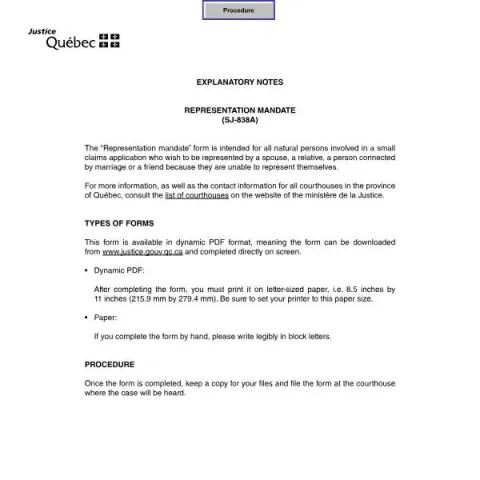
Understanding the Representation Mandate Form (SJ-838A) in the Quebec Small Claims Court
If you are involved in a small claims case in the province of Quebec and find yourself unable to represent yourself, the Representation Mandate form (SJ-838A) is a crucial document to understand. This official form, issued by the Canada Court of Québec under the Ministry of Justice, allows you to authorize another individual—such as a spouse, relative, or friend—to act on your behalf during your case. Here, we explain what this form is, who should fill it out, how to complete it properly, and the steps to submit it.
What Is the Purpose of the Representation Mandate Form?
The primary purpose of the SJ-838A form is to formally appoint someone to represent you before the Small Claims Division of the Quebec Court of Québec. This can be necessary if you are unable to attend court or manage your case due to health issues, language barriers, or other personal reasons. By completing this form, you legally authorize another person to:
- Sign and file legal documents on your behalf
- Participate in hearings and negotiations
- Make settlement agreements
- Request adjournments and execute judgments
This ensures your case continues smoothly, even if you cannot be physically present or actively participate yourself.
Who Should Fill Out the Form?
The form is intended for individuals involved in a small claims case who are unable to represent themselves. This includes:
- Plaintiffs seeking compensation or resolution
- Defendants responding to claims or defending their interests
- Intervening third parties who have an interest in the case
The person granting the authority, known as the principal, must complete the form, and the individual they appoint, the mandatary, must accept the appointment by signing the document.
How to Complete the Form Correctly
Step 1: Fill in Your Details
Begin by entering your role in the case (plaintiff, defendant, or intervening third party). Provide your full name and address, as well as the case file number and the courthouse district where your case is being heard.
Step 2: Identify the Mandatary
Write the given name and family name of the person you are appointing as your representative. Include their complete address and specify their relationship to you by checking the appropriate box (spouse, relative, connected by marriage, or friend).
Step 3: Specify the Scope of Authority
Check all the boxes that describe the powers you are granting to your mandatary. This may include signing and filing applications, participating in hearings, making settlements, requesting adjournments, or executing judgments. If there are other specific powers, indicate them in the space provided.
Step 4: State the Reasons for the Mandate
Explain clearly why you are unable to represent yourself. For example, health issues, language difficulties, or personal commitments are valid reasons. This section helps the court understand your situation.
Fill in your form directly online
No printing: type your details into the boxes of the official form, tick, then download the PDF ready to send.
- 1Type into the form boxes
- 2Tick in one click
- 3Save and download the PDF
Step 5: Date and Sign
Finally, specify the date and location where you are signing the form. Both you (the principal) and the mandatary must sign the document to validate the mandate.
Submitting the Form
Once completed, you should keep a copy of the signed form for your records. The original must be filed at the courthouse where your case is scheduled to be heard. It is recommended to verify the specific courthouse procedures beforehand, as some may require electronic or in-person submission.
Important Tips and Common Errors to Avoid
- Legibility: Whether completing digitally or by hand, ensure all information is clear and legible.
- Accurate Details: Double-check names, addresses, and case numbers to prevent delays.
- Scope of Authority: Be precise about what powers you are granting to avoid misunderstandings.
- Signatures: Both parties must sign; unsigned forms are invalid.
By following these steps and tips, you can effectively use the SJ-838A form to ensure your case is properly managed even if you cannot be present yourself. For further guidance, consult the official website of the Quebec Ministry of Justice or contact your local courthouse.