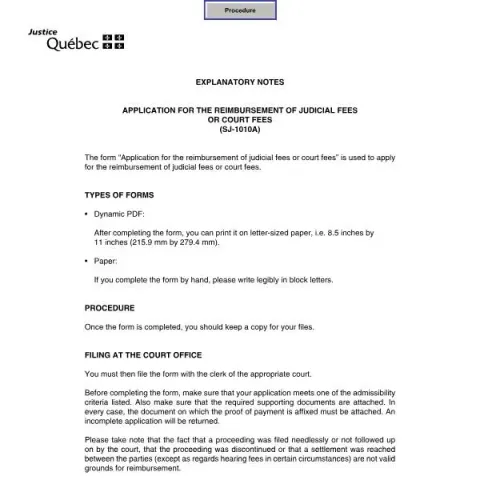
Understanding the Application for Reimbursement of Judicial or Court Fees
If you have paid judicial or court fees in relation to a legal proceeding in Canada, you may be eligible to request a reimbursement through the official form provided by the Ministry of Justice. The form designated for this purpose is the Application for the Reimbursement of Judicial Fees or Court Fees (form code: SJ-1010A). This article offers a comprehensive overview of the process, requirements, and tips to help you prepare and submit your application correctly.
Purpose of the Form and Who Should Use It
The SJ-1010A form is specifically designed for individuals seeking reimbursement of judicial or court fees they have paid during legal proceedings. Whether you are a party to a case, a witness, or someone who paid fees on behalf of another, this form allows you to apply for a refund if you meet the eligibility criteria.
It is important to note that this form is intended solely for applications related to fees paid for court procedures, not for other types of legal expenses. Before completing the form, ensure that your case qualifies under the admissibility criteria specified by the Ministry of Justice.
Preparing Your Application
Gather Necessary Documentation
- Proof of Payment: Attach the original document on which the payment is recorded, such as a receipt or bank statement.
- Supporting Documents: Depending on your situation, you may need to include additional documents, such as court orders or decisions, that justify your claim.
Completing the Form
The form can be completed either digitally or by hand:
- Digital (Dynamic PDF): Fill out the form electronically, then print it on standard letter-sized paper (8.5 x 11 inches).
- Handwritten: Write legibly in block letters to ensure clarity and avoid processing delays.
Ensure all sections are accurately filled out, including your personal details, payment amounts, and reasons for the reimbursement request. Incomplete applications will be returned, delaying the process.
Filing Your Application
Where and How to Submit
Once completed, you must submit your application to the clerk of the appropriate court where the proceeding took place. It is advisable to keep a copy of your application for your records.
Before submitting, verify that your application meets one of the admissibility criteria, such as overpayment, error in fee calculation, or court-ordered reimbursement. Also, confirm that all required supporting documents are attached.
Important Considerations
- Invalid Grounds: Reimbursements are generally not granted for proceedings that were filed but not pursued, discontinued, or settled out of court (except in certain hearing fee cases).
- Incomplete Applications: Will be returned without processing, so double-check your form and attachments.
Follow-Up and Decision
After submission, the court clerk or the Ministry of Justice personnel will review your application. They will determine whether your case qualifies for reimbursement based on the provided documentation and admissibility criteria.
Fill in your form directly online
No printing: type your details into the boxes of the official form, tick, then download the PDF ready to send.
- 1Type into the form boxes
- 2Tick in one click
- 3Save and download the PDF
If approved, the reimbursement will be processed, and a cheque or electronic transfer will be issued. If your application is denied, you will receive an explanation outlining the reasons for refusal.
Contact and Additional Information
For further details, including a list of court locations and specific procedural guidance, consult the official website of the Ministry of Justice. It is also recommended to contact your local court office if you have questions about the submission process or required documentation.
Remember, accurate and complete applications facilitate a smoother reimbursement process and reduce delays in receiving your funds.