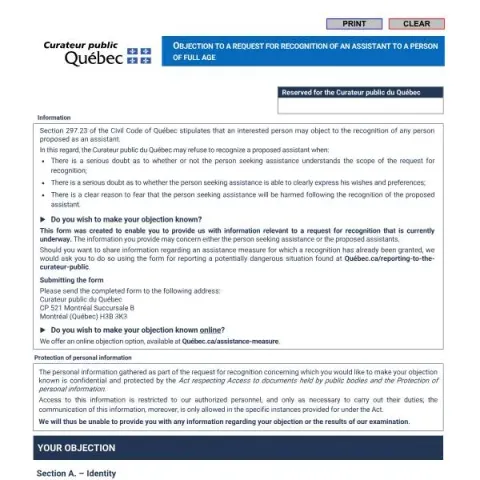
Understanding the Official Form for Objecting to a Recognition Request of an Assistant to an Adult in Quebec
The Curateur public du Québec provides a formal process for individuals to express objections to the recognition of an assistant proposed to support an adult who may require assistance. This process is governed by Section 297.23 of the Civil Code of Québec, which allows interested persons to raise concerns if they believe the proposed assistance could harm the individual or if there are doubts about their capacity to consent or communicate their wishes.
What is the purpose of this form?
This official form, identified as MAST-OPP (12-2021), enables concerned parties to formally submit objections regarding a current or pending request for recognition of an assistant. Its primary goal is to ensure the protection of the rights and well-being of the adult in question by allowing third parties to provide relevant information that might influence the decision-making process of the Curateur public du Québec.
Who should fill out this form?
This form is intended for individuals who have a legitimate interest in the case—such as family members, friends, or service providers—who wish to raise concerns about the proposed assistant or the recognition process. It is especially relevant if you believe that:
- The person seeking assistance does not fully understand the scope of the request;
- The person cannot clearly express their wishes or preferences;
- There are reasons to fear the person might be harmed if assistance is recognized as proposed.
How to complete the form: step-by-step
Section A: Identity of the Objector
Begin by providing your last name and first name. This information is mandatory and helps identify who is submitting the objection.
Section B: Relationship with the Person Seeking Assistance
Indicate your relationship with the adult in question by selecting the relevant option—such as parent, sibling, friend, or service provider. If your relationship is not listed, choose "Other" and specify.
Section C: Contact Details
Provide at least one telephone number—either a cellular or other phone line—and your email address. This contact information allows the Curateur public to reach you if necessary, although you will not receive updates about the outcome of your objection due to confidentiality policies.
Section D: Details of the Objection
Identify whether your objection concerns the adult seeking assistance or the proposed assistants. If your concern involves the assistants, specify their names.
In the space provided, describe your reasons for objecting. Include details such as:
- The circumstances or events leading to your concern;
- The individuals involved;
- The type of potential harm or risk you fear;
- Any additional information that could help the Curateur public evaluate your objection.
Submitting your objection
You can send your completed form either by mail or online:
Fill in your form directly online
No printing: type your details into the boxes of the official form, tick, then download the PDF ready to send.
- 1Type into the form boxes
- 2Tick in one click
- 3Save and download the PDF
- By mail: Address the form to:
- Curateur public du Québec
- CP 521 Montréal Succursale B
- Montréal (Québec) H3B 3K3
- Online: Use the dedicated platform available at Québec.ca/assistance-measure.
Protection of your personal information
The information you provide is protected under the Act respecting Access to documents held by public bodies and the Protection of personal information. It is confidential, accessible only to authorized personnel, and used solely for processing your objection. The Curateur public cannot disclose your details or the results of their review to you directly, respecting privacy laws.
Important considerations when filling out the form
Ensure all mandatory fields marked with an asterisk are completed accurately. Be as detailed as possible in your explanation to assist the Curateur public in understanding your concerns. Remember that false or incomplete information could affect the review process.
Conclusion
This form is a vital tool for safeguarding the rights and well-being of adults who may need assistance. If you believe that the recognition of an assistant could be harmful or that the adult’s capacity is in question, submitting a well-documented objection helps ensure that their interests are thoroughly considered by the appropriate authorities.