The Role of the Oath or Solemn Affirmation in Canadian Employment
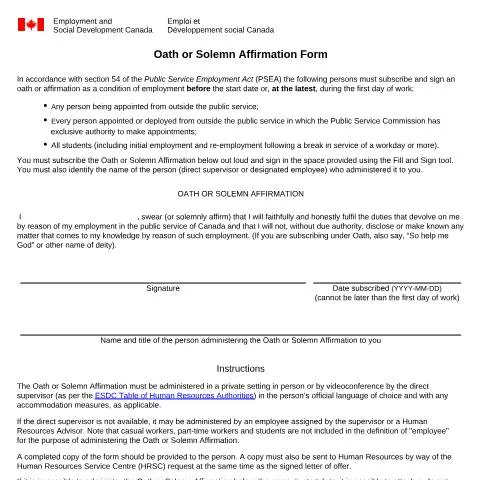
Consider a scenario where a new employee steps into a federal government role, excited yet apprehensive about the responsibilities ahead. This moment marks not just a career move but the commencement of a commitment to uphold the principles of public service. Central to this commitment is the Oath or Solemn Affirmation (ESDC-HRB5072), a critical document that serves as a legal and moral foundation for employment within the Canadian public service.
Historical Context and Regulatory Framework
The Oath or Solemn Affirmation is rooted in the Public Service Employment Act (PSEA), established to ensure integrity and accountability within the public sector. This Act mandates that every individual appointed from outside the public service must subscribe to this oath as a precondition for employment. The regulation fosters not only a professional ethos but also protects the interests of the public and the integrity of the government.
Key Legal Provisions
The legal underpinnings of the oath are outlined in section 54 of the PSEA. It specifically states that:
- All appointees from outside the public sector must sign the oath before their employment begins.
- Those re-entering public service after a break of more than a workday must also take the oath.
- This requirement extends to all students and temporary employees as well.
Such stipulations ensure that every public servant acknowledges their obligations toward ethical behavior and confidentiality, thus reinforcing public trust.
Understanding the Impact on New Employees
For new entrants into the public service, signing the Oath or Solemn Affirmation is more than a formality. It embodies a pledge to serve the public interest. Failing to complete this step can have significant repercussions, including delays in starting employment or even potential disqualification from the role.
Rights and Responsibilities
Upon signing the oath, individuals gain the right to access public service benefits while simultaneously accepting the responsibility to act with integrity. Key aspects of this commitment include:
- Adhering to confidentiality regarding sensitive government information.
- Performing duties with honesty and impartiality.
- Understanding that any breach of this oath may result in disciplinary action, up to and including termination of employment.
Steps for Completing the Oath or Solemn Affirmation
Completing the Oath or Solemn Affirmation involves a few straightforward steps. However, attention to detail is crucial.
Preparation and Required Information
Before filling out the form, gather the following:
- Your full name and the name of your direct supervisor.
- The date on which you are subscribing to the oath.
- Any accommodation measures necessary for completing the process.
It’s essential to ensure that the signing occurs in a private setting, either in-person or via video conference, to maintain the confidentiality of the oath.
Filling Out the Form
The form requires you to provide:
- Your signature, affirming your commitment to the duties of the position.
- The signature of the individual administering the oath, which can be your direct supervisor or another designated employee.
- The date of subscription, ensuring it does not exceed the first day of work.
Submission and Administrative Follow-Up
Once completed, the Oath or Solemn Affirmation must be submitted to the Human Resources Service Centre (HRSC). It is critical to retain a copy for personal records and to ensure a smooth onboarding process.
What Happens After Submission?
After submitting the form, you may wonder about the subsequent steps:
- The HRSC will verify the document against your employment contract.
- A completed copy is essential for your personnel file.
- If complications arise during submission, such as missing documentation, a formal request can be made through a General HR Enquiry.
Differentiating the Oath from Similar Forms
The Oath or Solemn Affirmation is often confused with other forms required during the employment process. Understanding the distinctions can aid in clarity and compliance.
Comparative Overview of Key Employment Forms
| Form Name | Purpose | Who Needs to Complete It? |
|---|---|---|
| Oath or Solemn Affirmation (ESDC-HRB5072) | Legal commitment to uphold duties in public service | All external appointees and certain returning employees |
| Letter of Offer | Official notification of employment | All new hires |
| Employment History Form | Documentation of past employment | Typically required for all new hires |
Preparing Justifications and Supporting Documentation
In some cases, you may need to provide additional documentation to support your oath. Understanding what’s necessary based on individual circumstances can ease the process.
Common Justifications Needed
Here are the typical documents you might need, categorized by situation:
- New Appointees:
- Proof of identity (e.g., SIN card or passport)
- Employment contract or offer letter
- Returning Employees:
- Previous employment records
- Proof of previous oath completion if applicable
- Students:
- Proof of student status or internship agreement
Final Considerations and Tips for a Smooth Process
Completing the Oath or Solemn Affirmation is just the first step in your journey within the public service. Here are a few practical tips:
- Schedule your appointment with the administering official as soon as you receive your letter of offer to avoid delays.
- Ensure that you prepare all necessary documents ahead of time.
- Keep a signed copy of the oath for your records.
- If you encounter any issues, do not hesitate to reach out to HR for guidance.
This commitment lays the groundwork for a fulfilling career in the service of your community and country. Embrace this opportunity to contribute positively to Canadian society.
The Importance of the Oath in Canadian Legal Context
The oath or solemn affirmation plays a crucial role within various legal frameworks in Canada. It serves as a foundational element in many court proceedings, government appointments, and public service roles. The act of swearing an oath demonstrates a commitment to truthfulness and integrity. For example, when witnesses take the stand in courtroom settings, they are required to affirm their oath to tell the truth, which is essential in ensuring that justice is served. This commitment binds individuals legally and morally, emphasizing the gravity of their testimony.
In addition to court functions, oaths are also integral to the functioning of government at all levels. Elected officials, including Members of Parliament and provincial representatives, are required to take an oath of office. This not only instills confidence in their constituents but also formally recognizes their duties and responsibilities. Moreover, those who wish to hold certain professional licenses or positions, such as lawyers, judges, or notaries, must first take an oath. This practice bolsters the public’s trust in various sectors and reinforces the principle of accountability in public service.
How to Make a Declaration in Canada: Step-by-Step Process
Making a declaration (either through an oath or solemn affirmation) in Canada is a straightforward process, but it's essential to follow the proper steps to ensure that your declaration is legally recognized. Here’s a step-by-step guide to assist you:
- Determine the Type of Declaration Needed: Assess whether you need to take an oath or a solemn affirmation based on the requirements of the document or procedure you are involved with. For instance, an oath is often required for legal documents, while an affirmation may be more appropriate for personal declarations.
- Select an Authorized Person to Administer the Oath: In Canada, oaths can only be administered by individuals legally authorized to do so. Common authorities include lawyers, notaries public, and certain government officials. Be sure to check local regulations that specify who can administer these legal affirmations.
- Prepare Your Declaration: Depending on the context, you may need to prepare a written declaration. Make sure the content meets the specific requirements of the document or situation. Provide all necessary details about your identity and the statement you are affirming or swearing to be true.
- Schedule an Appointment: Contact the authorized individual to set up an appointment where you can take your oath or affirmation. Make sure to bring any required identification documents, such as your Social Insurance Number (SIN), to verify your identity.
- Take the Oath or Affirmation: During the meeting, you will be required to declare your commitment to tell the truth. If taking an oath, you may need to place your hand on a holy book, depending on your personal beliefs. For a solemn affirmation, you will simply declare your commitment without the use of religious texts.
- Receive Documentation: After completing the oath or affirmation, ask for a written record of the declaration. This may include a certificate or a statement signed by the authorized person who administered the oath. Keep this documentation safe, as it may be required for future reference.
Following these steps ensures that your declaration is valid and recognized legally, allowing you to proceed with whatever process required the oath or solemn affirmation.
Common Misconceptions About Oaths and Affirmations
Despite the fundamental nature of oaths and solemn affirmations in Canadian society, several misconceptions persist regarding their meanings and implications. Understanding these misunderstandings can provide clarity for individuals who need to engage with these legal practices.
Misconception 1: Oaths and Affirmations are InterchangeableWhile both serve the purpose of affirming the truthfulness of a statement, they are not identical. An oath typically invokes a higher moral authority, often involving a religious text, while an affirmation is a secular commitment. You may choose an affirmation over an oath for personal or religious reasons, and in many legal contexts, both options are valid.
Misconception 2: You Must Have a Religious Affiliation to Take an OathMany people believe that taking an oath requires adherence to a particular religion, as it often involves swearing on a holy book. However, this is not the case. Individuals who do not want to swear on a religious text can opt for a solemn affirmation instead, which allows them to affirm their commitment to truth without religious connotation.
Misconception 3: The Consequences of Breaking an Oath Are Not SeriousIt’s crucial to understand that breaking an oath or affirmation can have significant legal ramifications. Individuals who willfully provide false statements under oath can be charged with perjury, which can lead to serious penalties, including imprisonment. Thus, both oaths and affirmations carry a weighty obligation to speak the truth and can result in severe consequences if violated.
By debunking these misconceptions, individuals can better navigate the legal landscape of oaths and affirmations within Canada, knowing their rights and responsibilities when making solemn commitments.