Navigating Your Social Insurance Number Application: A Comprehensive Guide
For newcomers, job seekers, and permanent residents, obtaining a Social Insurance Number (SIN) is often an essential step in establishing one’s presence in Canada. This document, referenced as NAS2120, serves as the gateway to various benefits and employment opportunities. Yet, the process can seem daunting. Understanding the nuances of the application not only facilitates a smoother experience but also ensures compliance with Canadian regulations.
Who Needs a Social Insurance Number?
The Application for a Social Insurance Number is crucial for diverse groups, including:
- Canadian Citizens: Those born in Canada or naturalized citizens.
- Permanent Residents: Individuals who have been granted permanent resident status in Canada.
- Temporary Residents: Work or study permit holders authorized to work in Canada.
- Registered Indians: Individuals wanting to register their Indian status.
- Foreign Nationals: Individuals residing outside Canada who qualify for Canadian government benefits.
Each category has specific requirements and documents that must be provided to prove identity and eligibility, which can affect their application experience.
Essential Documents: What You Need to Apply
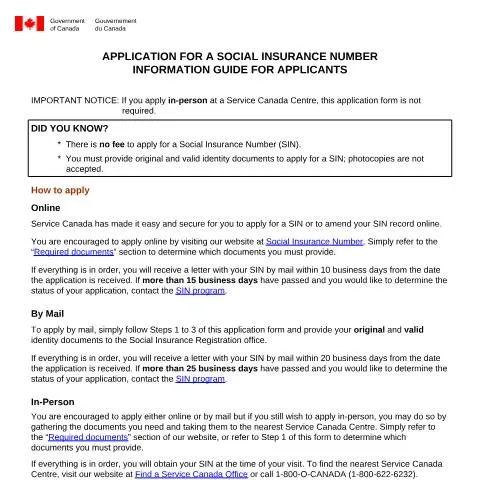
When applying for your SIN, it's imperative to provide the original documents as specified in the application guide—photocopies are not accepted. The primary identity documents required depend on your legal status in Canada:
| Category | Required Documents |
|---|---|
| Canadian Citizens | Birth certificate, citizenship certificate, or registration of birth abroad. |
| Permanent Residents | Permanent resident card, confirmation of permanent residence, or record of landing. |
| Temporary Residents | Work or study permit. |
| Registered Indians | Birth certificate and Certificate of Indian Status. |
| Foreign Nationals | Birth certificate from the respective authority and documentation for benefits eligibility. |
It's essential to ensure that all documentation adheres to the specific guidelines outlined by Service Canada to avoid delays. For instance, translations must be accompanied by an affidavit or attestation if documents are not in English or French.
Choosing Your Application Method: Online, By Mail, or In-Person
Understanding the various avenues for submitting your application can simplify the process significantly. You have the option to apply:
- Online: This method is often the quickest. Visit the official Service Canada website, complete the application, and submit the required documents online.
- By Mail: If you prefer, you can fill out the application form and send it along with your original documents to the designated Social Insurance Registration office. Be mindful that this may take longer for processing.
- In-Person: For those who prefer direct interaction, visiting a Service Canada Centre allows you to submit your documents immediately and receive your SIN on the same day, provided everything is in order.
Each method carries its pros and cons; hence, choose the one that best suits your circumstances.
The Timeline: When to Expect Your SIN
Once you’ve submitted your application, it’s natural to be curious about the processing timeline. Here’s what you can expect:
- If you apply online, you should receive your SIN by mail within 10 business days.
- For applications submitted by mail, expect a processing time of 20 business days.
- If you apply in person, you may receive your SIN immediately if your documentation is complete.
However, if you experience delays in receiving your SIN—such as more than 25 business days for mail applications—you can follow up with Service Canada to check the status of your application.
Understanding Your Rights and Responsibilities Post-Application
Obtaining a SIN is not just a procedural step; it also comes with significant rights and responsibilities:
- Access to Employment: A SIN is essential for legal employment in Canada.
- Eligibility for Benefits: It opens doors to various government-related benefits such as pensions, employment insurance, and social support programs.
- Obligations: You are required to maintain the confidentiality of your SIN and report any loss or theft immediately.
Failure to safeguard your SIN can lead to identity theft, which can have long-term repercussions. Thus, be vigilant and proactive in managing your information.
Distinguishing the Application for a SIN from Other Government Forms
Many individuals confuse the SIN application with related forms, such as those for a Canadian passport or health card. Here’s a quick comparison to clarify:
| Form Type | Purpose | Distinct Features |
|---|---|---|
| SIN Application (NAS2120) | Identification for employment and benefits. | Specific to social services and taxation. |
| Passport Application | International travel identification. | Requires photos and proof of citizenship; longer processing times. |
| Health Card Application | Access to provincial health services. | Dependent on residency; varies by province. |
Recognizing the differences ensures that applicants use the correct forms for their needs and reduces the risk of errors.
Additional Support: Navigating the Process
While the application process for the SIN is straightforward, many applicants may still have questions or require assistance. Here are potential resources to consider:
- Service Canada Website: The primary source for information about the SIN, including updates on processes and requirements.
- Local Service Canada Centres: In-person assistance and guidance are available for those who need it.
- Community Organizations: Various NGOs provide support for newcomers and can assist with documentation and understanding the application process.
Utilizing these resources can enhance your experience and help streamline the application process.
Final Thoughts on Your SIN Application Journey
Applying for a Social Insurance Number is more than a bureaucratic step; it’s a vital part of establishing your life in Canada. By understanding the requirements, timelines, and rights associated with the SIN, you position yourself for success in your new environment. Remember, the information is available, and you are not alone in this journey. Stay informed and proactive, and your transition to life in Canada will be all the smoother.
Understanding the Importance of Your Social Insurance Number (SIN)
Your Social Insurance Number (SIN) is not just a series of numbers; it’s a vital part of your identity in Canada’s financial and social systems. The SIN is used primarily for the government's tax and benefits programs, and having one is essential for numerous activities including employment, accessing government services, and receiving certain benefits.
The Government of Canada employs your SIN to track your earnings and contributions to the Canada Pension Plan (CPP) and Employment Insurance (EI). It’s important to understand that your SIN is unique to you, and you should keep it confidential to prevent identity theft. When you start a job, your employer will require your SIN to accurately report your income and deductions to the Canada Revenue Agency (CRA).
Beyond employment, your SIN is also necessary for applying for various government programs and benefits. For instance, if you’re looking to access healthcare, support during unemployment, or even the Canada Child Benefit (CCB), you will need to provide your SIN. Thus, understanding the implications and responsibilities associated with your SIN is crucial for navigating life in Canada.
Common Reasons for Delays in SIN Application Processing
While applying for a Social Insurance Number is generally a straightforward process, there are several common issues that might lead to delays in your application being processed. Understanding these potential roadblocks can help you prepare and avoid unnecessary frustration.
One of the primary reasons for application delays is incomplete documentation. The Service Canada office requires specific documents to verify your identity and legal status in Canada. If any of the required documents are missing, or if the copies are not clear, your application may be held up. Make sure to double-check the list of necessary documents before submitting your application.
Another potential issue arises if there are discrepancies in your application details. For instance, if your name on the application does not exactly match the name on your identification documents, it could lead to delays. It’s essential to ensure that all information is consistent and correctly filled out.
Finally, during peak application periods, such as the beginning of the fiscal year or tax season, you might experience longer processing times due to increased volume. In such instances, try to apply during off-peak times if possible; this could lead to a quicker response.
What to Do If Your SIN Application is Rejected
Receiving a rejection for your Social Insurance Number application can be disheartening, but it's important to know that you have options. If your application is not accepted, the letter you receive should clearly outline the reason for the rejection. This information is crucial as it guides you on the next steps.
First, carefully read the rejection notice. Common reasons for denial can include insufficient documentation, mismatched personal information, or failure to meet eligibility requirements. Once you identify the reason, you can take corrective action. If you need to provide additional documentation, gather the necessary paperwork as soon as possible.
If the rejection is due to issues with your identity documents or immigration status, consider contacting the agency that issued those documents for clarification or assistance. They may provide you with guidance on how to resolve any discrepancies.
Once you have addressed the issues pointed out in your rejection notice, you may reapply for your SIN. However, it is critical to ensure that all documentation is complete and accurate this time around. If you have questions about the reapplication process or need help, don’t hesitate to contact Service Canada for assistance.